


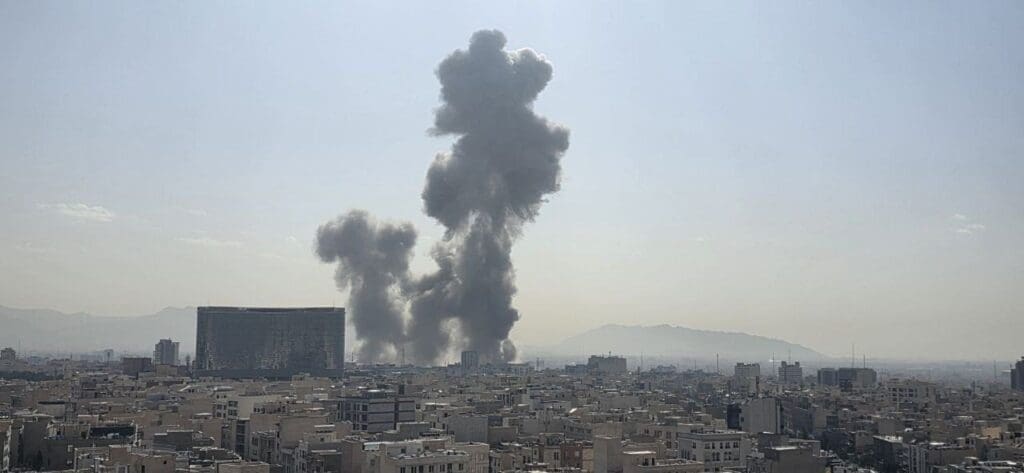
On February 28, Iran’s Supreme Leader Ayatollah Ali Khamenei was killed in joint U.S.-Israeli strikes in Tehran as part of the ongoing military campaign dubbed Operation Epic Fury (U.S.)/Operation Roaring Lion (Israel). Khamenei’s death marks the end of a 36-year reign that witnessed the abolition of democratic values, fierce human rights violations, terror campaigns against perceived adversaries of the regime, and the suppression of opposition voices through unprecedented violence and crackdowns. Concurrently, the operations, eliminated a significant number of senior figures within the Islamic Revolutionary Guard Corps (IRGC). This, coupled with the fracturing of the regime’s political wing, presents a major opportunity to dismantle the state apparatus, as Tehran is no longer able to compensate for the growing losses suffered domestically and across its own proxy network. As the regime struggles to reorganize both its fractured military and political wings amidst the strikes, the question still persists: What comes next for Iran?
Following the 1979 Iranian Revolution, the Pahlavi dynasty was overthrown and replaced by Islamist rule, conclusively dismantling the regime’s pro-Western values. This sudden shift from a secular monarchy to an anti-Western totalitarian state not only marked a new chapter in Iran’s history, but also institutionalized an ever-growing hostility toward the West. This anger was fueled both by the Iranian public’s perception of the Pahlavis as imperialist proxies and by deteriorating living conditions aggravated by rampant corruption within the royal family.
Determined to dismantle the remaining influence of Western powers in its sphere of influence and spread the ideals of its revolution, the regime not only established a vast network of regional proxies, but also pursued an ambitious ballistic missile program to deter adversaries to its rule. Although the means of deterrence employed by the regime frequently threatened the West and its regional allies, the ultimate catalyst for the extensive strikes aimed at toppling the Islamic Republic was Tehran’s pursuit of nuclear-capable warheads, which was considered to be the primary goal of Iran’s nuclear program. Although Tehran’s nuclear program was already documented, a sudden acceleration in the pursuit of nuclear weapons was directly triggered by the diminishing power of Iran’s primary proxies in the region, Lebanon’s Hezbollah and Palestine’s Hamas.
The first strikes aimed at decapitating Iran’s nuclear program occurred on June 13, 2025, when the Israel Defense Forces (IDF) struck the Natanz and Isfahan nuclear facilities—the heart of the country’s nuclear infrastructure. Concurrently, the IDF carried out targeted assassinations against top Iranian nuclear scientists and military figures in the capital city of Iran, Tehran, and across the country. The campaign, dubbed Operation Rising Lion, not only aimed to dismantle Tehran’s pursuit of a nuclear weapon, but also severely hampered its ballistic missile capabilities. By destroying a significant number of launch platforms, the operation effectively reduced the scale and scope of Iran’s retaliation against Israel and, also, against the assets of the U.S. deployed in the region.
Although the initial IDF strikes proved to be a massive success, Israel suffered from a significant lack of deep-strike capabilities that could penetrate Iran’s heavily fortified underground nuclear facility, Fordow—the last remaining bastion of Iran’s nuclear program that could not be targeted by the IDF. Impressed by the success of Israel in taking out Iran’s conventional capabilities, the sentiment towards taking part in the strikes kept growing in the U.S., which eventually led to U.S. President Donald Trump’s approval to take out the last remaining Iranian nuclear facility by the use of bunker-busting arsenals that could be dropped by B-2 stealth bombers.
Humiliated by the success of Israel’s Operation Rising Lion and the U.S. Operation Midnight Hammer, Tehran had no choice but to concede defeat. The Twelve-Day War concluded on June 24, with the U.S. and Israel having successfully crippled Iran’s nuclear program by targeting prominent scientists and strategic facilities nationwide. Which, until now, was considered to be the fatal blow to Iran’s pursuit of acquiring nuclear-capable warheads.
“We wiped it out and they want to start all over again. And they’re at this moment again pursuing their sinister ambitions.”
– President Trump, 2026 State of the Union Address
On February 24, during the State of the Union address, U.S. President Donald Trump delivered remarks on a wide array of topics, but the most striking focal point was Tehran’s nuclear ambitions. In his speech, Trump emphasized Iran’s willingness to continue its weapons program, even though its means of developing such a program were significantly crippled during the strikes of the Twelve-Day War. Additionally, during his address, Trump asserted that Iran was pursuing the construction of missiles that would be capable of reaching U.S. soil. Even though the Foreign Ministry of Iran denied the allegations of an ongoing nuclear weapons program, renewed strikes, four days after Trump’s State of the Union address, hit Iranian soil—ultimately putting an end to the negotiations between Washington and Tehran.
Four days later, on February 28, U.S. President Donald Trump launched Operation Epic Fury, a military campaign aimed at dismantling the Iranian state apparatus. Despite the fact that Trump’s talking points indicated that the main objective of the campaign was to eliminate Tehran’s nuclear ambitions, the targeted assassination of Supreme Leader Ayatollah Ali Khamenei suggests a different reality, one that could be interpreted as a goal far beyond merely neutralizing the nuclear threat Iran possesses.
Why was it necessary to eliminate the head of the Islamic Republic? The answer lies in Ayatollah Ali Khamenei’s staunch pledge to the nation: Tehran would never abandon its nuclear enrichment program. In spite of the elimination of the nation’s military leadership and prominent scientists, Iran’s ruling political wing showed no willingness to compromise on this goal, which was considered to be crucial to sustaining the “independence” of the Islamic Republic and preserving the achievements of the Iranian Revolution by deterring imperialist aspirations.
As the campaign against Iran’s nuclear infrastructure and leadership expands, the central question remains: What lies ahead for Iran? The Islamic Republic’s fracturing centralized power structure is poised to create a massive power vacuum, both domestically and across its proxy network. If the lack of leadership within Iran persists, it is highly likely that Iran’s proxy network will deteriorate—not necessarily due to the military dominance established over Tehran’s proxies, but because of the catastrophic loss of ideological legitimacy, which would ultimately lead to significant divisions inside pro-regime establishments and between pro-regime figures. It is more than likely that the ideological achievements of the Iranian Revolution will soon be faded into obscurity, and the nation, once again, will open a new chapter shaped by those the regime long perceived as its greatest adversaries.


