


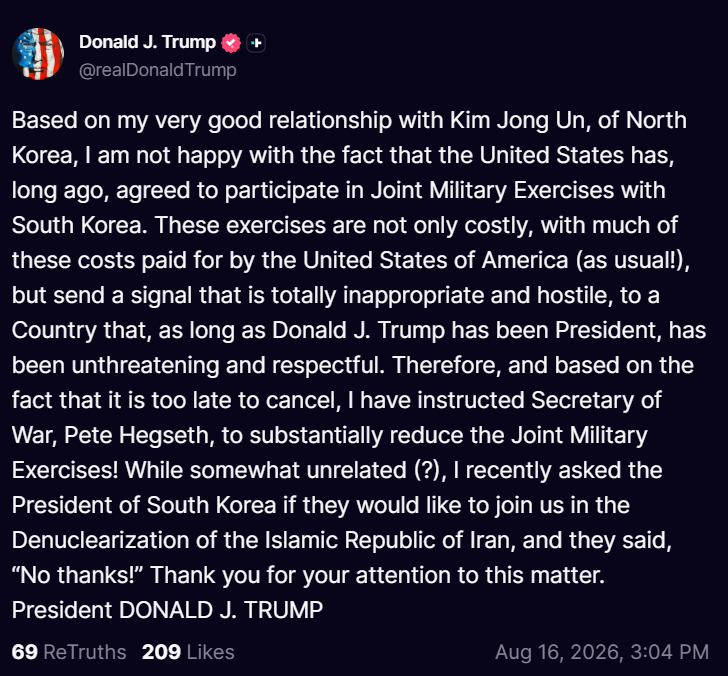
President Donald Trump said Sunday that he has ordered Defense Secretary Pete Hegseth to substantially reduce joint military exercises between the United States and South Korea, marking a significant shift in Washington’s military posture toward the Korean Peninsula. Trump criticized the exercises as expensive and described them as an “inappropriate and hostile” signal to North Korea, reviving concerns he previously raised during his first administration about the scale and cost of allied drills. The president did not immediately specify which exercises would be reduced, how significantly they would be scaled back or whether changes would affect exercises already scheduled to begin this week.
The announcement comes immediately ahead of the annual Ulchi Freedom Shield exercise, one of the largest recurring training events conducted by U.S. and South Korean forces. The drills are designed to test combined wartime command, all-domain operations and government emergency-response procedures while improving interoperability between the two militaries. U.S. Forces Korea describes Ulchi Freedom Shield as a defensive exercise intended to strengthen the alliance’s ability to respond to a range of security threats. The 2026 iteration had been scheduled to begin Aug. 17, placing Trump’s order just before allied forces were expected to start the exercise.

North Korea has long condemned U.S.-South Korean military exercises as rehearsals for invasion and frequently responds with military demonstrations, missile launches or intensified rhetoric. Pyongyang had already sharply criticized the upcoming drills in the days before Trump’s announcement and recently conducted additional ballistic missile testing as regional tensions increased. Trump’s decision therefore represents a potentially significant confidence-building gesture toward North Korea, although there has been no indication that Pyongyang offered reciprocal military concessions before the order was announced.
The move also echoes Trump’s approach following his 2018 summit with North Korean leader Kim Jong Un, when he moved to suspend or scale back major joint exercises while pursuing direct diplomacy. Any reduction will now require coordination between the Pentagon, U.S. Forces Korea and the South Korean government, particularly if previously planned training events are altered on short notice. It remains unclear whether the administration views the change as a temporary diplomatic measure or the beginning of a broader restructuring of allied military exercises on the peninsula.


