Table of Contents
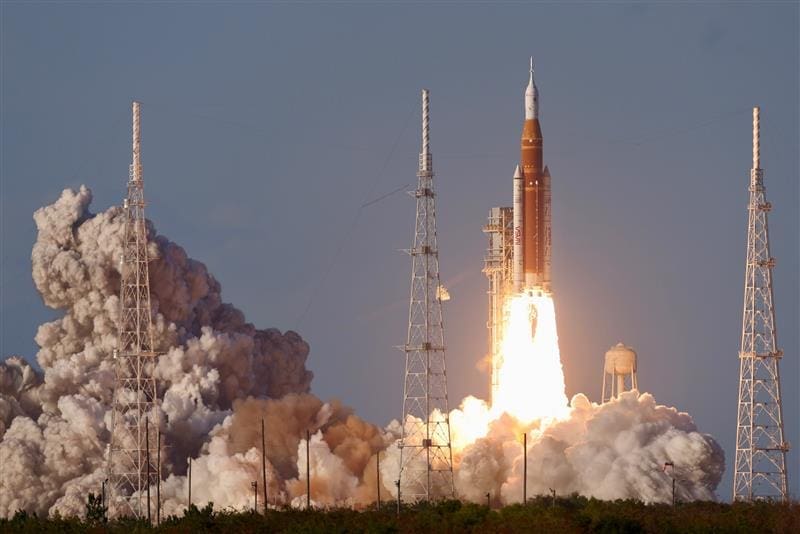
CAPE CANAVERAL, Apr. 1 – NASA on Wednesday launched Artemis II, a mission decades in the making and the agency’s first attempt since the Apollo era to send astronauts beyond low Earth orbit toward the moon. The Space Launch System Block 1 rocket lifted off from Launch Pad 39B at Kennedy Space Center in Florida at 6:35 p.m. EDT, carrying the Orion spacecraft and a four-member crew into space. NASA said the launch marked the start of an approximately 10-day test flight around the moon and back.
The crew aboard Orion consists of NASA astronauts Reid Wiseman, Victor Glover and Christina Koch, along with Canadian Space Agency astronaut Jeremy Hansen. The mission carries several historic firsts: Koch is the first woman assigned to a lunar mission, Glover is the first Black astronaut on such a flight, and Hansen is the first Canadian and first non-American headed into cislunar space on a moon mission. Together, they represent a more international and more inclusive version of lunar exploration than the one Americans last saw in 1972.
Unlike Apollo 11 or the missions that followed it, Artemis II is not a landing mission. Its job is to prove out the hardware and the human systems that future crews will rely on. Reuters reported that the astronauts are expected to spend the first one to two days in high Earth orbit checking Orion’s life-support, propulsion, navigation and communications systems before a translunar injection burn sends them toward the moon. From there, Orion will loop behind the moon on a free-return trajectory, a path designed to bring the spacecraft naturally back toward Earth. The mission will also test Orion’s heat shield during re-entry, when the capsule is expected to plunge into Earth’s atmosphere at roughly 25,000 miles per hour before splashing down in the Pacific.
Launch Competes with China’s Lunar Goals
The significance of the launch is both technical and political. Artemis II is the first crewed mission of NASA’s broader Artemis campaign, which the agency says is meant to establish an enduring human presence on and around the moon and prepare for future Mars exploration. Reuters described the mission as a major step in the United States’ effort to return astronauts to the lunar surface later this decade, amid renewed competition in space, including with China’s lunar ambitions. In that sense, Wednesday’s launch was not simply a nostalgic echo of Apollo, but a declaration that the moon is once again central to great-power strategy, industrial policy and long-term space planning.
NASA has framed the flight in similarly sweeping terms, though its immediate importance is more practical. Artemis II is the first crewed test of both the SLS rocket and Orion spacecraft, and the mission’s success will depend less on spectacle than on performance over the next several days. Life-support systems, crew operations, navigation, communications and re-entry all remain under scrutiny. “The test has just begun,” NASA Associate Administrator Amit Kshatriya said in the agency’s launch release, underscoring that the mission is designed to validate the systems later crews would trust with an actual lunar landing.
Sanitation, Communications Issues Occur During Early Flight
One smaller but telling detail from early coverage involved the spacecraft’s toilet system. According to the Associated Press, mission teams were troubleshooting a minor toilet malfunction in the early phase of the flight, alongside a briefly interrupted communications link. That issue, while not mission-jeopardizing, drew attention because Orion’s sanitation system had already been the subject of unusual interest before launch. NASA’s Artemis II reference materials highlighted the spacecraft’s updated toilet and hygiene setup, a notable improvement over the far cruder waste-management arrangements used during Apollo. In deep-space missions lasting days rather than hours, even mundane systems can become critical tests of spacecraft design.
For NASA, Artemis II is also a bet on continuity after years of delays, cost overruns and doubts about whether the agency’s moon architecture could hold together. Wednesday’s successful launch does not resolve those questions, but it changes the tenor of them. After years in which Artemis often felt more like a programmatic promise than a lived mission, America now has astronauts once again on their way around the moon. That alone is a milestone. If the next 10 days unfold largely as planned, Artemis II will do more than revisit the past. It will establish that the route back to the moon is no longer theoretical.