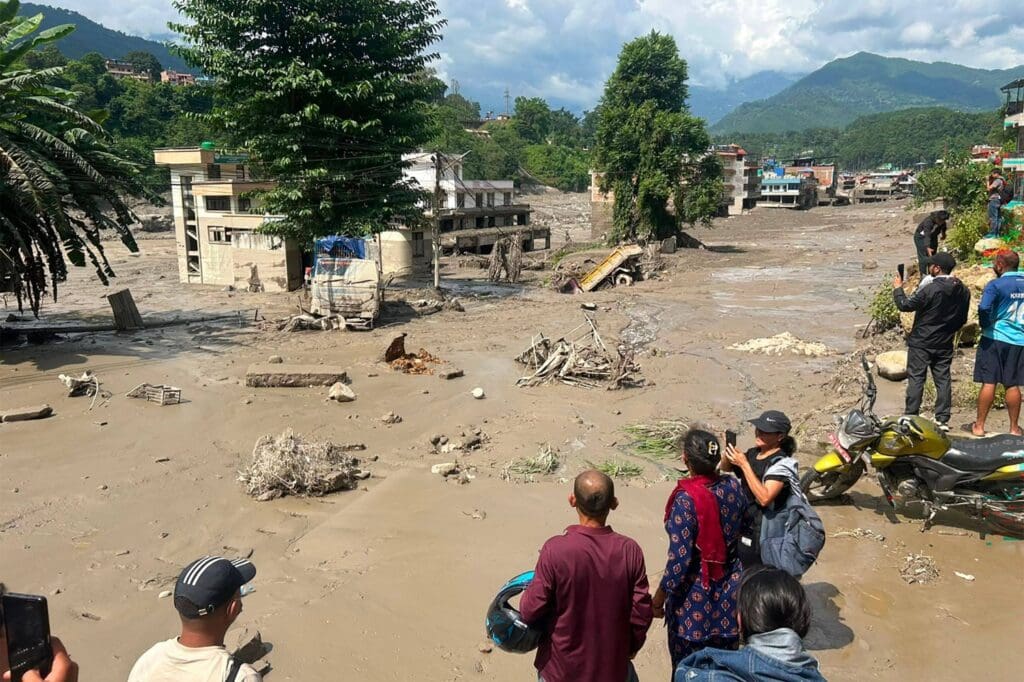
At least 157 people have been confirmed dead in Nepal after a massive flash flood swept through communities near the country’s border with Tibet on Wednesday, destroying villages, roads and bridges as rescue teams searched for hundreds still missing.
The confirmed toll is expected to rise sharply as authorities reach areas buried under mud and debris in Rasuwa and neighboring districts. At least three other people were reported dead on the Chinese side of the border, bringing the confirmed toll across Nepal and Tibet to at least 160. Hundreds more remain unaccounted for.
A far more severe casualty estimate emerged Wednesday in Spanish media. 20 Minutos reported that Nepal’s government appeared to be considering a possible death toll of between 10,000 and 15,000 people. The report attributed the figure to Jordi Abad, a Himalayan mountaineer and race director who said he was receiving information from Kathmandu. It didn’t quote a Nepalese government official directly. Another Spanish outlet, Antena 3, separately reported that the Nepalese government feared between 10,000 and 15,000 deaths.
That estimate remains unconfirmed. Reuters and The Associated Press, citing Nepalese police and government officials, reported 157 confirmed deaths in Nepal as of late Wednesday and did not report an official government projection of 10,000 fatalities. The scale of the destruction and the large number of people still missing mean the final toll remains unclear.
The disaster began Wednesday morning when a powerful surge of water, rock and sediment rushed through the Bhote Koshi and Trishuli river systems. Preliminary analysis indicates that an avalanche of ice and rock from a glacier may have crashed into the Lhende River, creating the sudden flood. A seismic event was recorded in the area shortly before the disaster, though officials are still investigating whether it helped trigger the collapse.
The flood struck with extraordinary speed. Researchers with the International Centre for Integrated Mountain Development said water on the Trishuli River rose by as much as 9 meters, or about 27 feet, in roughly half an hour. Entire settlements along the river were swept away before many residents had time to escape.
At least 19 bridges and nearly 40 kilometers, or 25 miles, of road were destroyed, according to officials. Hydropower facilities, homes and communications infrastructure were also damaged, leaving some communities difficult or impossible for rescuers to reach by road. Helicopters spent Wednesday carrying survivors from accessible areas, while high water and difficult terrain prevented aircraft from landing in some of the hardest-hit communities.
The missing include large numbers of foreign tourists and pilgrims. Nepalese officials said hundreds of travelers were unaccounted for, including citizens of India, the United States, Australia, Britain and Canada. The region is a major route for pilgrims traveling toward Mount Kailash and Lake Manasarovar in Tibet.
Authorities have warned people to stay away from the banks of the Trishuli, Bhotekoshi and Narayani rivers while rescue and recovery operations continue. Nepal has also asked India and China for assistance.
More rain could add to the danger. Forecasts for Rasuwa call for additional showers and thunderstorms through Thursday and Friday, with further rain possible into the weekend. Nepal’s flood forecasting authorities said rainfall could cause river levels to rise, although officials said there was no reliable evidence as of early Thursday that another flood on the scale of Wednesday’s disaster was imminent.
Wednesday’s disaster is the latest in a series of destructive floods to hit Nepal’s Himalayan river valleys. The same region experienced a major flash flood last year after a glacial lake in Tibet overflowed during unusually high temperatures, killing nine people and damaging critical infrastructure, including a bridge linking Nepal and China.
Scientists have warned that the Hindu Kush Himalayan region faces growing risks from melting glaciers, unstable mountain slopes and extreme weather. Warming temperatures can weaken glaciers and increase the risk of avalanches and sudden releases of water into steep valleys below.
For now, the scale of Wednesday’s disaster is still emerging. With roads severed, communications disrupted and hundreds of people missing, officials cautioned that confirmed casualty figures could change substantially as rescuers reach communities along the devastated river corridor.