MILESTONES , FROM TSUNAMI RELIEF TO INDO-PACIFIC ACTION


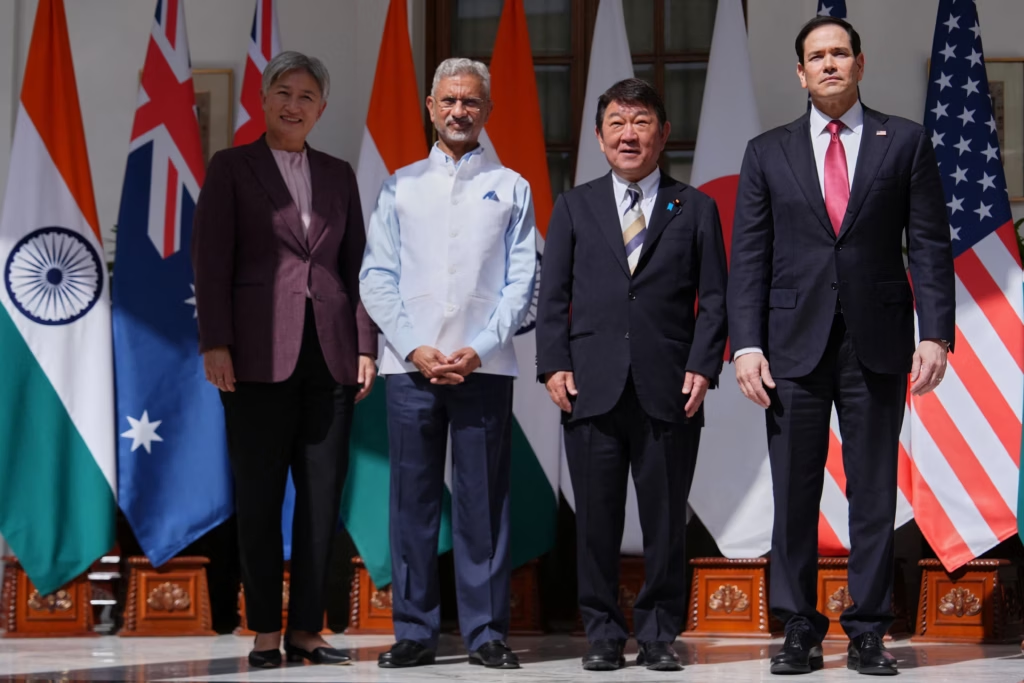
The evolution of the Quad is defined by a series of strategic resurrections. Originally established in 2004 as a functional response to the Indian Ocean tsunami, the grouping entered a decade-long dormancy before its 2017 revival, spurred by intensifying maritime anxieties. Following its 2021 elevation to a leaders-level forum during the Biden era, the partnership pursued a sprawling agenda of vaccines and emerging technologies, yet eventually faced a period of decelerating institutional momentum as geopolitical complexities mounted.
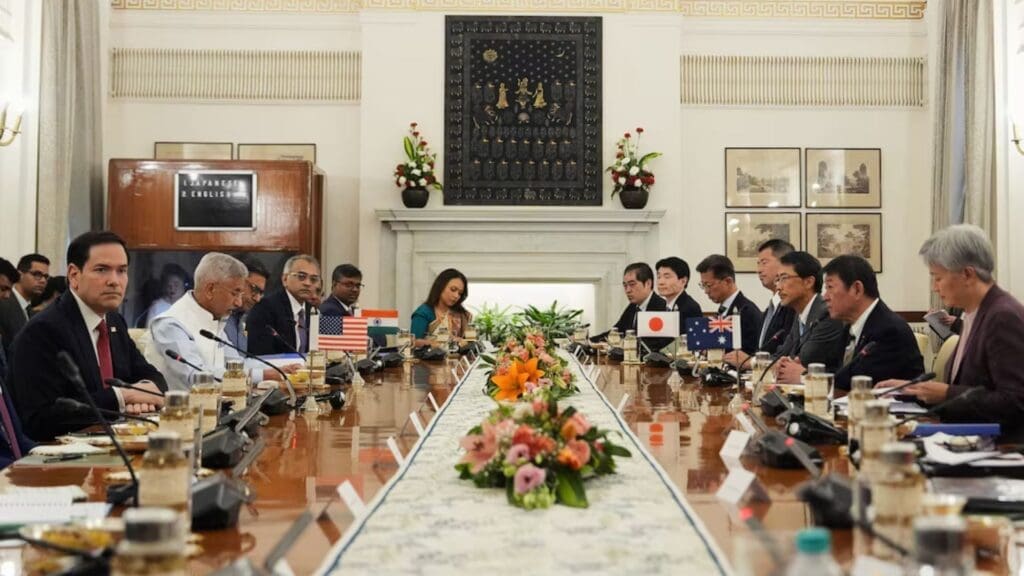
The notable absence of a leaders’ summit in 2025 highlighted significant structural strains within the alliance. Friction regarding trade tariffs between the Trump and Modi administrations, coupled with divergent perspectives on regional security flashpoints, raised fundamental questions about the continuity of Washington’s Indo-Pacific activism. Consequently, the New Delhi ministerial served as a critical platform to signal that the grouping’s architecture remains operationally viable and capable of navigating such bilateral headwinds.
Addressing the prospects for a future leaders-level assembly, the ministers adopted a stance of measured optimism. Secretary Rubio confirmed that diplomatic efforts are focused on securing a meeting in late 2026, while Indian officials continue to advocate for a formal visit by President Trump to New Delhi. Although Tuesday’s proceedings concluded without a confirmed date, analysts increasingly view the Indian capital as the probable venue for the grouping’s next major milestone.
“Three major takeaways: agreed on the Indo-Pacific Maritime Surveillance Initiative and on a common operating picture in the maritime domain.”, EAM S. Jaishankar X/Twitter, May 26, 2026
Press Conference Deep Dive: Four Strategic Focus Areas
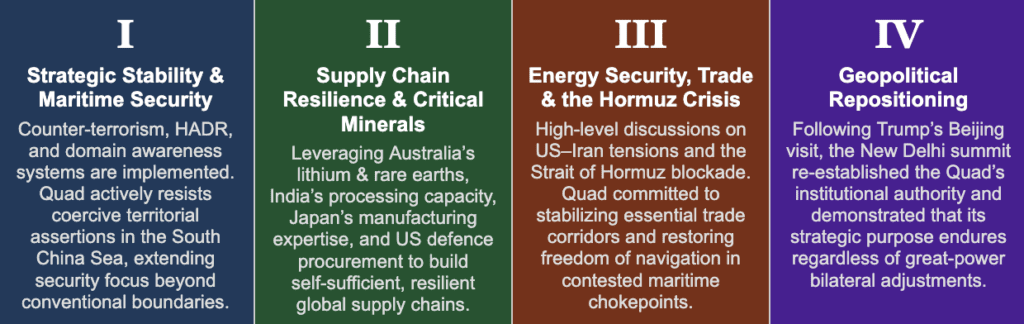
The subsequent press briefing offered a detailed look into four integrated strategic pillars that the alliance plans to advance with significant momentum. Viewed collectively, these focus areas demonstrate a grouping that has deliberately broadened its scope beyond traditional maritime surveillance to a comprehensive vision of institutional resilience, encompassing global supply networks, energy chokepoints, and high-level geopolitical signaling.
FOUR STRATEGIC FOCUS AREAS FROM THE NEW DELHI PRESS CONFERENCE

I. Strategic Stability and Strengthened Maritime Security
The ministerial assembly prioritized the operationalization of functional frameworks for counter-terrorism, disaster response coordination, and maritime domain awareness. In a deliberate expansion of its strategic remit, the Quad now moves beyond traditional territorial constraints, signaling a collective resolve to resist coercive maritime assertions and land reclamation activities in the South China Sea—actions that have profoundly disrupted the regional security architecture. By establishing a shared common operating picture, the grouping has institutionalized a level of real-time maritime visibility across the Indo-Pacific theater that remained elusive just twenty-four months prior.
Simultaneously, the ministers reaffirmed their commitment to the regional architecture, emphasizing unwavering support for ASEAN centrality and unity as a foundational pillar. Rather than seeking to supplant existing multilateral institutions, the grouping continues to position itself as a complementary mechanism operating in synergy with ASEAN-led structures, the Pacific Islands Forum, and the Indian Ocean Rim Association (IORA).
Beyond conventional maritime security, the dialogue addressed escalating unconventional challenges that threaten regional stability. The ministers voiced significant concern regarding the deteriorating situation in Myanmar, noting its potential for broader Indo-Pacific destabilization, and underscored their support for ASEAN-led initiatives aimed at securing an immediate cessation of violence. Furthermore, the assembly reaffirmed its resolute opposition to North Korea’s nuclearization and the proliferation of weapons of mass destruction. This includes a condemnation of Pyongyang’s deepening military collaboration with adversarial states and its sophisticated cyberwarfare campaigns designed to finance illicit weapons programs, signaling a collective determination to mitigate such systemic risks.
II. Supply Chain Durability and Critical Minerals
Recognizing serious weaknesses in international supply networks , starkly exposed by China’s export restrictions on minerals used in aerospace, defence, and semiconductor industries , the alliance committed to deep collaboration on advanced technology oversight and critical mineral resources. The framework is deliberately complementary: Australia holds some of the world’s largest lithium and rare-earth deposits; India offers growing processing and refining capacity; Japan brings advanced manufacturing expertise and technological sophistication; and the United States contributes defence procurement scale and market demand. Together, the four partners believe they can construct an alternative mineral supply architecture that reduces systemic vulnerability to any single competitor’s export leverage.
III. Energy Security, Trade, and the Hormuz Crisis
The discussions deliberately extended beyond the Indo-Pacific theater to address pressing global crises. High-level talks were held on US–Iran tensions and the resulting effective blockade of the Strait of Hormuz , a chokepoint through which approximately 20% of global oil flows. The Quad acknowledged the profound economic impact of maritime obstruction on all four member economies and their regional partners and underscored the collective imperative to stabilize essential trade corridors and restore freedom of navigation. The energy security initiative announced on Tuesday is explicitly designed to build redundancy and emergency response capacity for exactly such scenarios.
IV. Navigating Geopolitics and Institutional Repositioning
Perhaps the least acknowledged but most consequential dimension of the meeting was its geopolitical timing. Following President Trump’s high-profile bilateral visit to Beijing , which had generated speculation about a possible US–China accommodation that might reduce Washington’s Indo-Pacific activism, the New Delhi summit served as an institutional counter-statement. By convening at a ministerial level and delivering concrete deliverables, the Quad demonstrated that its strategic purpose remains intact and operational, regardless of fluctuations in great-power bilateral relations. The message to regional partners, and to Beijing , was explicit: the grouping’s architecture is not contingent on any single bilateral relationship, and it endures.
Analysis: Why the Quad Matters in the 21st Century
The Quad is, at its core, an attempt to answer one of the defining questions of the current era: can democratic maritime nations with complementary strategic interests sustain collective action in an arc of ocean that runs from the Indian Ocean to the Pacific without triggering the very conflict they seek to deter?
The strategic rationale is structural. China has the world’s largest navy by vessel count, has constructed and militarized artificial islands in the South China Sea, maintains substantial claims over waters that international tribunals have ruled against, and is deepening its presence in the Indian Ocean through port infrastructure from Djibouti to Hambantota. No single Indo-Pacific democracy , not India with its population, not Japan with its economy, and not Australia with its resources, can provide a credible counterweight alone.
The Quad fills a crucial architectural gap. Unlike AUKUS , which is explicitly a security pact centered on nuclear submarine technology, the Quad is a broader framework that encompasses economic security, technology governance, infrastructure, and humanitarian cooperation alongside defence. This breadth is both its strength and its historical weakness: ambitious agendas struggle to survive contact with geopolitical turbulence. Tuesday’s meeting suggests the grouping has learned from that experience, focusing on fewer, more concrete deliverables rather than sprawling communiqués.
The grouping is also navigating an uncomfortable asymmetry. India has a long tradition of non-alignment and has refused to characterize the Quad as directed at China , even as China itself identifies it as precisely that. New Delhi’s insistence on framing the grouping in positive, constructive terms (“a free and open Indo-Pacific”) rather than as a containment architecture has allowed it to participate wholeheartedly while preserving diplomatic space with Beijing.
| ANALYST ASSESSMENTThe New Delhi meeting is the most operationally significant Quad ministerial since the grouping’s 2021 elevation to leaders’ level. Moving from declarations to deliverables , a Fiji port, a surveillance network, a minerals framework, and an energy security initiative , the four nations have created constituencies for continuation. The press conference further revealed a grouping that has consciously re-scoped its purpose: from a maritime security forum to a multi-domain resilience architecture spanning supply chains, energy chokepoints, and digital infrastructure. Crucially, the New Delhi summit also served as a geopolitical repositioning exercise: following Trump’s Beijing visit, it demonstrated that the Quad’s institutional authority is independent of any single great-power bilateral dynamic. The grouping has established a clear foundation for enhanced interoperability and a much-awaited leaders’ summit. It is no longer a consultative body; it is a proactive, outcome-oriented partnership. |
The road ahead is not without obstacles. A leaders’ summit remains unscheduled. The India-US bilateral relationship continues to carry undercurrents of trade friction. And the Quad’s ability to maintain cohesion through future US electoral cycles , given its institutional dependence on presidential-level commitment , is an open question that no amount of ministerial communiqués can fully resolve.
Yet in the longer sweep of 21st-century history, what happened at Hyderabad House on Tuesday may look less like a diplomatic meeting and more like the moment that the Quad stopped being a conversation and became a coalition. By directly addressing complicated transnational risks , from Hormuz to rare earths to Pacific port capacity , the Quad has solidified its position as a critical pillar of democratic cooperation. The central message of Tuesday’s proceedings is unambiguous: the Quadrilateral Security Dialogue has evolved beyond a consultative body into a proactive, outcome-oriented partnership committed to defining a future that is secure, prosperous, and open.
SOURCES & REFERENCES
- Joint Statement from the Quad Foreign Ministers’ Meeting in New Delhi, U.S. Department of State, May 26, 2026
- Quad Foreign Ministers’ Meeting Joint Statement, Australian Minister for Foreign Affairs, May 26, 2026
- Ministry of External Affairs, Government of India, Press Release, May 26, 2026
- Port in Fiji, maritime surveillance, minerals pact: Quad means business in the Indo-Pacific , The Week, May 26, 2026
- Quad nations condemn Pahalgam terror attack, reaffirm Free and Open Indo-Pacific , ETV Bharat, May 26, 2026
- Quad foreign ministers hold talks in New Delhi on Indo-Pacific cooperation, AP / WSLS / Washington Post, May 26, 2026