On July 30, U.S. President Donald Trump announced that Hamas had agreed to disarm as part of a deal reached by his Board of Peace. The following day, the Board, operating under the mediation of Egypt, Qatar, Türkiye, and the U.S., released the framework proposal itself, calling it a “historic milestone” and laying out the next phases of the current Gaza ceasefire. The Board’s announcement emphasized that Hamas has agreed to relinquish its weapons and hand over the administration of Gaza to The National Committee for the Administration of Gaza (NCAG), a transitional body first formed in January 2026. This transition will be overseen by the International Stabilization Force (ISF) and is contingent on Israel’s gradual withdrawal of forces from the territory. Trump stated that the framework ensures the complete disarmament of Hamas and other armed groups, a step separate from the original 20-point plan laid out earlier by his administration. In a post on Truth Social later that day, Trump added that the ISF will work alongside a newly established Palestinian police force to root out any remaining dissident influence. However, more than a week has passed since the Board’s declaration, and the proposal has not yet materialized, remaining a mere framework with no further progress, as both sides continue to disagree over which must act first, Hamas’s disarmament or Israel’s withdrawal.
A day before Trump’s announcement, Israeli Channel 13, citing two regional sources, reported that advanced talks were underway for Hamas to announce its disarmament and hand over administrative control of Gaza initially to the ISF. The same sources added that a signing ceremony for the framework proposal could be held within days in Egypt, and that the group’s current armaments would be transferred to a third party, not the Palestinian Authority or the police force. Similarly, Channel 12 reported that the proposed deal covers all Hamas weapons, tunnels, stockpiles, and production sites, and that the withdrawal of Israeli forces would begin only after the full demilitarization of Gaza.
The Board of Peace, founded on January 22, 2026, during the World Economic Forum in Davos, Switzerland, was established with the predefined objective of reaching a tangible solution to pave the way toward erasing Hamas’s influence over Gaza and bringing lasting peace and stability to the torn nation of Palestine. Even though ambitious pledges such as completely disarming Hamas, rebuilding the destroyed infrastructure of Gaza, and solving the prevailing humanitarian crisis were agreed upon by more than two dozen founding members, no significant breakthrough in achieving the entirety of the international body’s goals has been observed. So far, only a few points in the Trump administration’s original 20-point plan, the broader roadmap the Board of Peace was created to implement, have come into force, namely the immediate release of Israeli hostages held captive by Hamas in exchange for Israel releasing Palestinian detainees, and the entry and distribution of aid and basic necessities throughout the Gaza Strip. This leaves not only a big portion of the peace plan unaddressed, but also the disarmament of Hamas as the primary concern.
As the complete disarmament of Hamas remains a major hurdle, skepticism from both sides of the conflict has hurt diplomatic efforts, pivoting both sides to take a hostile stance against each other when tackling the unresolved points of the proposal. Israeli Prime Minister Benjamin Netanyahu, three days prior to the signing ceremony of the Board of Peace, pledged that under no circumstances will there be a reconstruction of Gaza before the full demilitarization of the territory. In a similar manner, Israeli Foreign Minister Gideon Saar emphasized that “there must be a fundamental deradicalization process” before anything else. Even with all the shortcomings of the shaky ceasefire that went into effect on October 10, 2025, Hamas, like Israel, continues to remain vague as to how the implementation of the ceasefire’s phases will take place. Hamas has previously asserted that more comprehensive negotiations must be conducted to seal the fate of the conflict, arguing that the group cannot give up all of its weapons due to the possibility of compromising the public order molded by the group’s police force over the years, meaning that a complete disarmament may not be within the realm of possibility.
Israel has remained skeptical of the NCAG’s role in governing Gaza, and the committee has yet to enter the Strip. Saar had already dismissed a similar move by Hamas as a “trick” back in early July, after the group first announced it would dissolve its governing committee and hand administrative affairs over to the NCAG, warning at the time that Hamas sought to replicate what he called a “Hezbollah model,” one where the Committee would only serve as a husk responsible for carrying out mundane tasks within the Strip, dictated and almost entirely overshadowed by Hamas. Stemming from dilemmas alike, both sides remain locked in a standoff over who must act first, leaving the Board of Peace’s declared “historic milestone” looking, for now, like little more than a framework on paper.
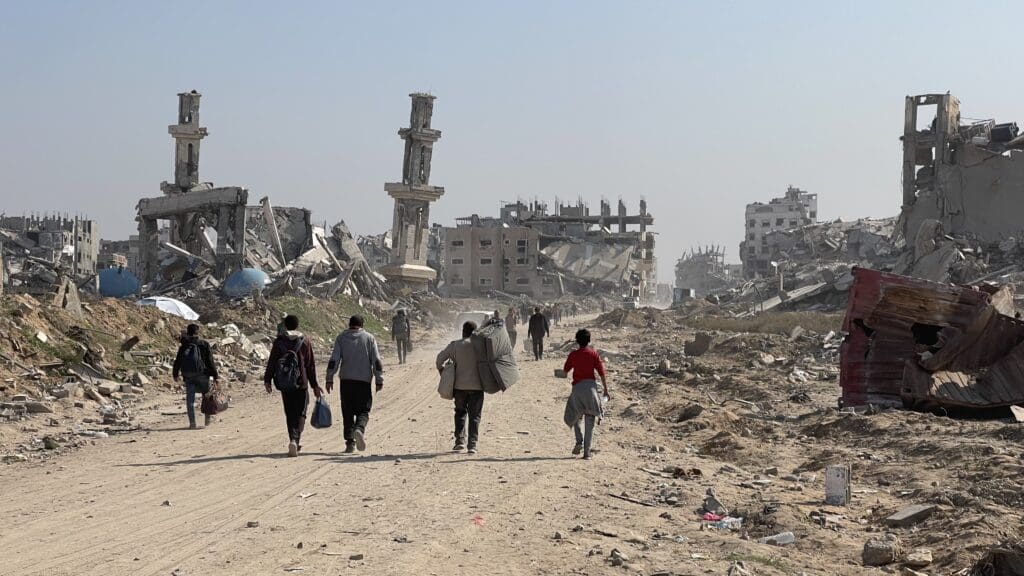
In a statement to Al Jazeera, Hamas negotiator Ghazi Hamad expressed that Hamas has no interest in adhering to the new phase of the established ceasefire unless Israel fulfills its obligations, withdraws its forces from the Gaza Strip, and refrains from conducting further strikes. Considering the reality on the ground, military operations continue in Gaza, where 19 Palestinians were killed just days after the Trump administration’s “historic milestone,” while Hamas has only agreed to relinquish its weapons on paper without taking concrete steps. Holding a similarly rigid view toward the new phase of the ceasefire, Israel’s administration declared on Sunday that it has rejected the new 15-point proposal put together by the Board of Peace. Israel insists it will not withdraw its forces from Gaza unless the threat posed by Hamas is definitively eliminated. Speaking to his Cabinet on Sunday, Netanyahu also ruled out the establishment of a Palestinian state under his leadership. “As long as I am prime minister, there will be no Palestinian state, not in Gaza and not in Judea and Samaria. Neither ‘Fatahstan’ nor ‘Hamastan,'” he vowed during the session. Israel has now rejected the very roadmap it once agreed upon, and Hamas continues to condition its disarmament on an Israeli withdrawal that Netanyahu has explicitly ruled out. That leaves both sides exactly where they started, each waiting on the other to move first.