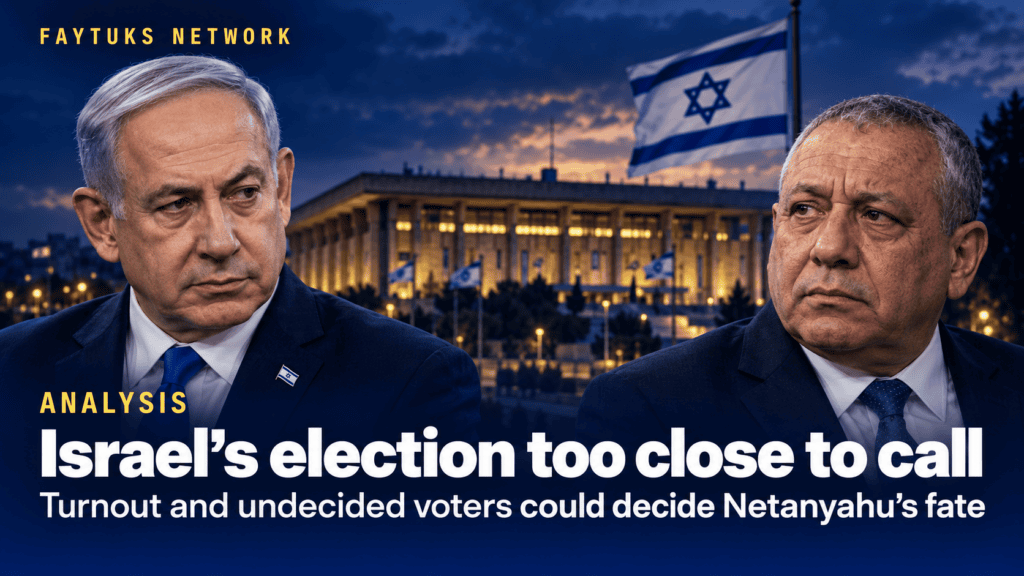
FAYTUKS NETWORK | October 10, 2026
For nearly three years, Prime Minister Benjamin Netanyahu has presided over the most tumultuous and agonizing chapter in Israel’s modern history. He has directed a grinding multifront war across Gaza, Lebanon, Yemen and Iran, faced unprecedented diplomatic isolation, and deflected unrelenting domestic outrage over his refusal to accept direct personal responsibility for the catastrophic intelligence and military breakdown of Oct. 7, 2023.
Now, as Israelis prepare to head to the polls on Oct. 27, the country’s longest-serving leader is once again fighting for his political life. Yet this high-stakes contest is unlikely to be decided by a dramatic national realignment or a sudden swing in ideological allegiance. Instead, in a weary and bitterly polarized nation, the fate of the government could turn on a few thousand stray votes scattered across a handful of demographic fault lines.
The campaign has emerged as one of the most unpredictable in recent memory. Opinion polls have offered conflicting projections, at times signaling that Mr. Netanyahu’s bloc of nationalist and religious allies might scrape together a bare governing majority, and at other times suggesting a breakthrough for the disparate opposition.
Beneath the weekly polling fluctuations, however, lies an unyielding reality: Neither camp has managed to establish a dependable path to the 61 seats needed to control the 120-member Knesset.
For Gadi Eisenkot, the former military chief of staff who has emerged as Mr. Netanyahu’s primary challenger, the barrier to power is institutional as much as it is political. His centrist Yashar party has run neck-and-neck with Mr. Netanyahu’s Likud in recent surveys. But in Israel’s pure system of proportional representation, finishing first offers no guarantee of governing.
Voters do not cast ballots directly for prime minister; they choose closed party lists. The office belongs not to the politician who wins the largest share of the national popular vote, but to the tactician who can marshal a functioning 61-seat coalition through weeks of horse-trading. It is a structure that has repeatedly favored shrewd ideological alliance-builders over broad-tent pluralities, and its peculiarities are poised to decide the country’s trajectory once more.
The Tyranny of the 3.25 Percent

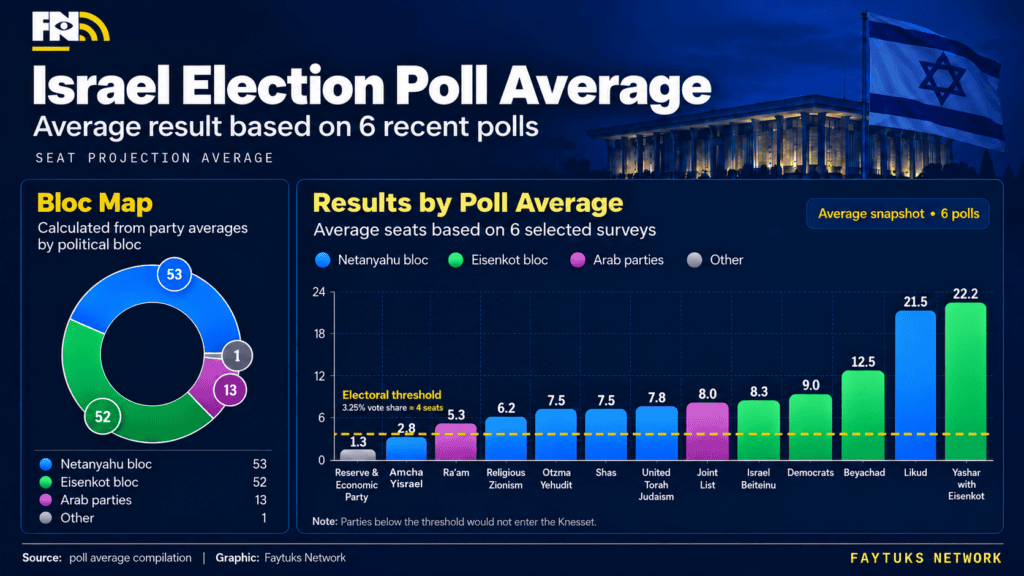
The most hazardous variable in the entire election is an arbitrary legal benchmark: the electoral threshold. Under Israeli law, a party must win at least 3.25 percent of the national vote to gain entry into parliament.
The arithmetic is brutal and absolute. Fall short of 3.25 percent, and every ballot cast for that slate is discarded. Clear it by a fraction of a percent, and the party enters the Knesset with an automatic baseline of four seats, immediately redrawing the coalition map.
A constellation of marginal factions is now hovering dangerously close to that line. On the right, parties associated with figures like Ofer Winter, a hard-line former military commander, alongside lists led by politicians like Yoaz Hendel and Yaron Zelekha, threaten to peel off valuable ideological voters without clearing the gate. Bezalel Smotrich, the contentious finance minister whose Religious Zionism faction has formed a cornerstone of Mr. Netanyahu’s coalition, has also faced persistent viability concerns in some polling.
The systemic effect is asymmetric. If a small faction aligned with Mr. Netanyahu sinks beneath the cutoff, tens of thousands of right-wing votes effectively evaporate from the mathematical formula used to distribute seats. If an anti-Netanyahu faction falters, the arithmetic shifts just as abruptly in the prime minister’s favor.
Israel’s recent history serves as a cautionary tale. In November 2022, Mr. Netanyahu’s bloc won a comfortable 64-seat majority even though the two main political blocs won virtually identical shares of the overall popular vote. The lopsided parliamentary result occurred almost entirely because two parties opposed to Mr. Netanyahu—the left-wing Meretz and the Arab nationalist Balad—narrowly missed the threshold. Nearly 300,000 ballots were discarded, paving the way for Mr. Netanyahu’s dramatic return to power.
An Epidemic of Voter Fatigue
Beyond the threshold arithmetic lies an equally volatile calculation: voter turnout.
In 2022, roughly 71 percent of eligible Israelis cast ballots, a robust figure by Western standards. Yet national figures conceal wide disparities across demographic and geographic boundaries, and after three years of national trauma, voter exhaustion is running high.
For the opposition, high turnout is mandatory in the liberal, secular urban enclaves of Tel Aviv, Haifa, and the Sharon coastal plain. In those areas, anger at the government’s conduct of the war, the handling of hostages, and the erosion of democratic norms remains intense.
For Likud, the central vulnerability is apathy in the party’s traditional heartlands. Mr. Netanyahu has spent decades forging deep personal loyalty among working-class voters in southern development towns, peripheral communities, and northern border areas. But many of those same communities bore the brunt of the Oct. 7 atrocities, months of rocket fire, and the prolonged economic hardship of wartime evacuations.
Critics have assailed Mr. Netanyahu for ducking accountability for the worst security collapse in the state’s history, while his defenders insist that his steadfast resistance to international pressure and his veteran military judgment make him the only leader capable of steering the country through existential peril. Yet even among voters who agree with that argument, profound war fatigue could prompt thousands to simply stay home. In an election settled on the margins, a modest dip in turnout in cities like Ashkelon or Be’er Sheva could unravel Likud’s campaign.
The Arab and Ultra-Orthodox Paradox
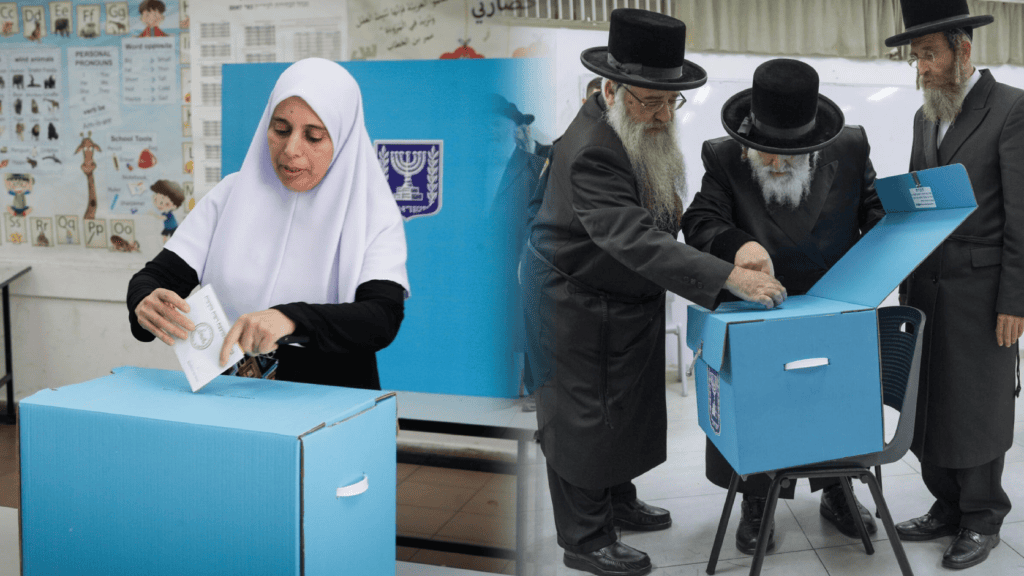
The parliamentary math is further complicated by two major communities that sit outside the classic Zionist secular-nationalist axis.
The first is Israel’s Arab minority, which accounts for roughly one-fifth of the population. Arab voter turnout has fluctuated wildly in recent cycles, falling to 44.6 percent in 2021 before rebounding to 53.2 percent in 2022.
A surge in Arab participation would naturally lift Arab parties in the Knesset, dramatically narrowing Mr. Netanyahu’s routes to a majority. Yet it also creates an acute strategic dilemma for Mr. Eisenkot and his allies. The broad opposition remains deeply fractured over whether to rely on the outside support of Arab factions to establish a government. Some right-leaning opposition figures have categorically ruled out such a partnership, creating the very real possibility of a paradox: an opposition that wins enough seats to block Mr. Netanyahu, but remains ideologically unable to seat a cabinet of its own.
The ultra-Orthodox community presents an entirely different fault line. Ultra-Orthodox, or Haredi, parties have historically provided the most disciplined, predictable voting bloc in Mr. Netanyahu’s political corner. But the war has exacerbated a decades-old social flashpoint over military conscription exemptions for yeshiva students.
A series of landmark Supreme Court rulings striking down blanket exemptions has placed religious leaders at odds with the defense establishment and secular public opinion. While opposition proposals to curtail yeshiva funding could spur Haredi voters to turn out in defense of their institutions, their alliance with Mr. Netanyahu is increasingly marked by transactional frustration and mutual mistrust.
The Spectre of an Endless Stalemate
In the campaign’s final stretch, attention will turn to the phenomenon of eleventh-hour voter consolidation.
In both 2015 and April 2019, Mr. Netanyahu pulled off late-stage recoveries by issuing dire warnings to the right-wing base that the left was on the verge of victory, effectively cannibalizing the support of smaller allied factions to inflate Likud’s seat tally. But that tactic is fraught with peril this year: If Mr. Netanyahu cannibalizes his natural allies so aggressively that they drop below the 3.25 percent threshold, he risks destroying the very seats he requires to reach 61.
At its core, the vote is an existential referendum on Mr. Netanyahu, whose political career has towered over Israel for three decades. He is asking voters to endorse his claim of irreplaceable leadership in a hostile region. Mr. Eisenkot, by contrast, is campaigning as an understated, institutionalist statesman promising to restore public trust in the state’s shattered apparatus.
Yet there is a distinct possibility that neither man will emerge victorious. Between 2019 and 2022, Israel endured five consecutive elections because an evenly divided country repeatedly produced hung parliaments.
If the threshold dynamics, differential turnout, and demographic rifts cancel each other out on Oct. 27, Israel could find itself thrust right back into that exhausting paralysis: an unresolvable Knesset, weeks of deadlocked negotiations, and Benjamin Netanyahu lingering in office as the caretaker prime minister of an ungovernable country.