Editors Note: For operational security reasons this story has been delayed. Some details and imagery reviewed by the intelligence team has been omitted from the article.
AL KHARJ, SAUDI ARABIA, Apr. 27 – An EOS satellite image captured and analyzed by the Faytuks Network Intelligence Team confirms Prince Sultan Air Base in Saudi Arabia remains relatively undamaged following Iranian drone and missile strikes, and remains heavily occupied by high-value U.S. aircraft, even after the loss of a critical airframe at the base.

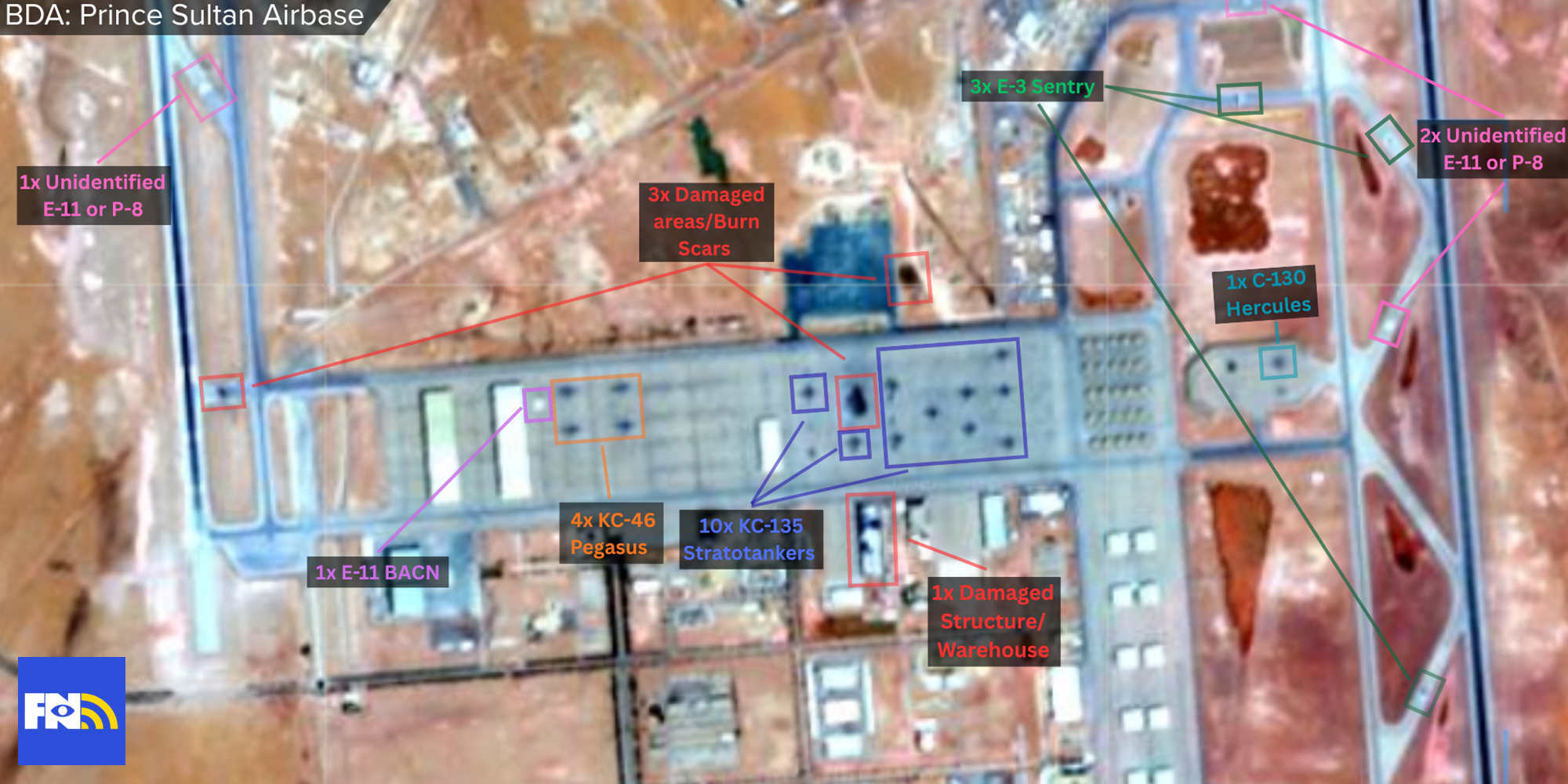
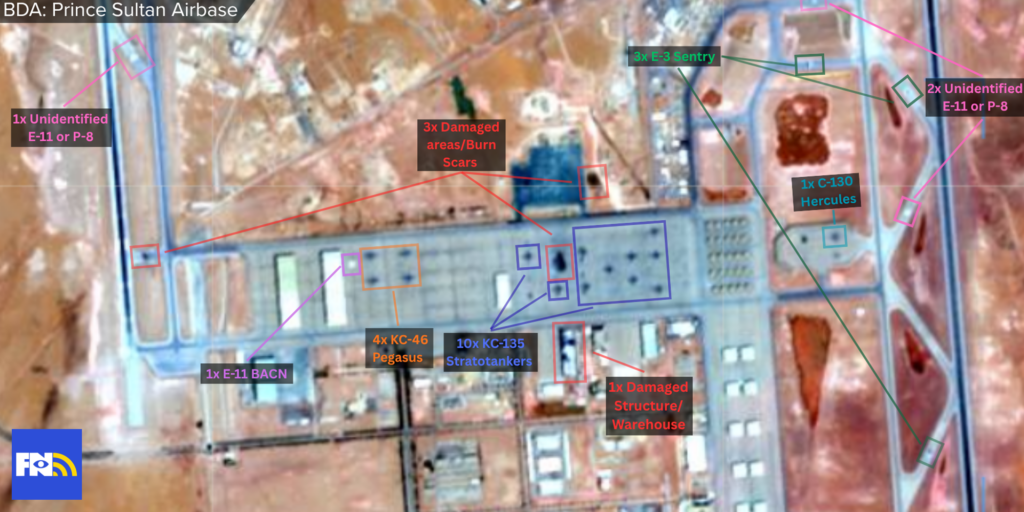
The image shows several E-3 Sentry AWACS dispersed around the airfield, along with E-11 BACN communications relays, KC-46 Pegasus tankers, KC-135 Stratotankers and C-130 Hercules. Due to image quality, Network intelligence analysts note that some of the assets may also be P-8 Poseidon aircraft. The dispersal of the E-3s, P-8s, and E-11s appears designed to reduce vulnerability on the ground, a notable detail at a base that has already been hit during the conflict. Earlier satellite imagery showed a buildup at Prince Sultan with large numbers of tankers and E-3s on the field as tensions with Iran rose.
The new image also shows three scorched areas on the apron and taxiways, along with damage to a structure or warehouse immediately south of the apron. Those burn marks are consistent with previous strike effects seen in imagery from the base after the March 2026 attacks. In total, Iranian attacks over recent weeks have damaged and destroyed several airframes at the base.
Each of the aircraft visible in the image points to the base’s role as a major hub for air surveillance, refueling, transport and command-and-control. The E-3 Sentry is the Air Force’s airborne warning and control platform, using its large radar dome to track aircraft and help commanders manage the air battle. The E-11 BACN (Battlefield Airborne Communications Node) serves as an airborne communications relay, linking otherwise incompatible radios and data systems and extending connectivity across the battlefield. The P-8 Poseidon is the US Navy’s primary maritime patrol and reconnaissance aircraft. The KC-46 Pegasus and KC-135 Stratotanker are aerial refueling aircraft, essential for keeping fighters, bombers, surveillance planes and other assets operating at distance. The C-130 Hercules is a tactical airlifter used to move troops, cargo and equipment into forward areas.
Taken together, the aircraft mix shows Prince Sultan is still being used for exactly the missions that are most critical in a high-threat regional environment: keeping aircraft fueled, maintaining airborne surveillance, moving supplies and preserving communications over long distances. The heavy presence of tankers is especially significant because it supports sustained air operations across the Gulf and surrounding theaters.
The image also underlines that the threat to the base has not gone away. On April 22, the U.S. turned to Ukrainian counter-drone technology to help defend Prince Sultan after Iranian attacks exposed vulnerabilities there. That follows weeks of reporting showing the air base had become both a staging point and a target as the confrontation spread across the region.
In practical terms, this latest BDA suggests two things at once: Prince Sultan has taken real damage, and it is still very much in use. The surviving aircraft, visible burn scars and damaged southern-side structure point to an air base operating under pressure rather than one that has been knocked out. That continued buildup is a clear sign the military posture around Saudi Arabia remains elevated, and that the wider region is still on a war footing.
Faytuks Network has omitted certain details and avoided sharing imagery of additional sensitive aircraft to this story for operational security reasons. In an effort to avoid the release of up to date information on the position of sensitive aircraft, the network is using one-week old imagery, taken on April 21st for this report. .