


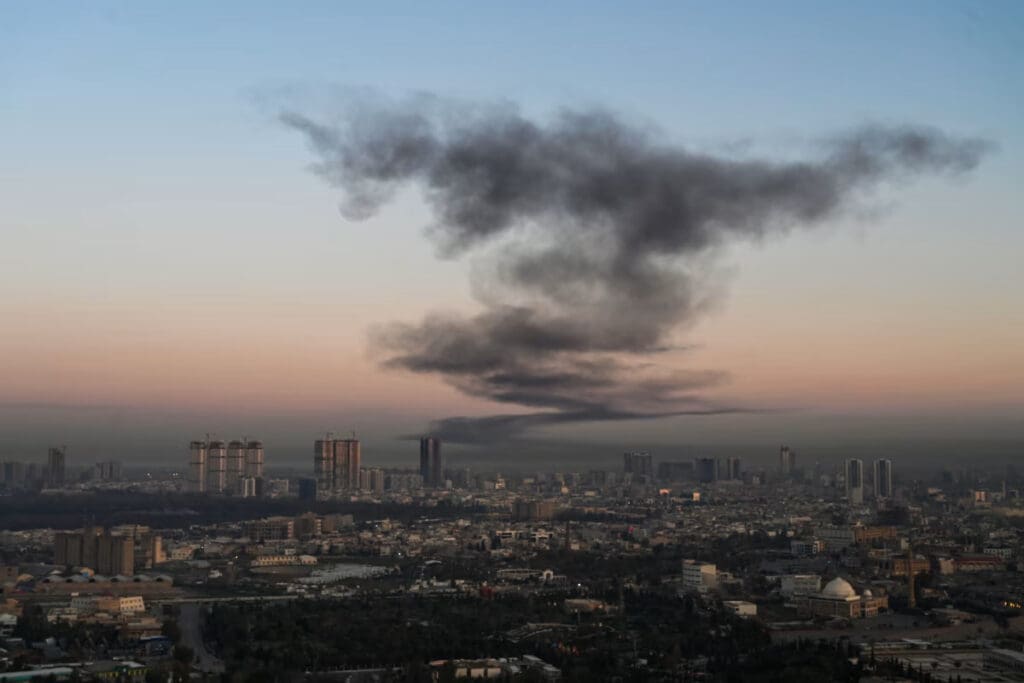
Kurdish authorities directly accused Iran on Monday of launching two explosive-laden drones at senior Kurdistan Regional Government officials in Erbil, sharply escalating the dispute over a strike aimed at the region’s political and security leadership.
The Kurdistan Region’s Counter-Terrorism Directorate said two Hadid-110 drones were launched from Iranian territory and targeted Prime Minister Masrour Barzani’s private office and the residence of the region’s intelligence chief. No casualties were reported. No group has claimed responsibility.
The finding marks a significant shift in the attribution of the attack. Initial reports established that the two sites had been targeted but did not identify where the drones originated. Kurdish security authorities are now publicly placing the launch point inside Iran.
The Hadid-110, also known as the Dalahu, is an Iranian jet-powered one-way attack drone designed to approach targets far faster than the propeller-driven Shahed drones widely used by Iran and its allies. A U.S. Army database lists the drone as capable of cruising at about 510 kilometers per hour, or 317 mph, with a range of roughly 350 kilometers, or 217 miles. It carries a warhead weighing about 30 kilograms, or 66 pounds. Its speed is intended to shorten the time air-defense systems have to detect and intercept it.
Barzani condemned the attack as reckless and unacceptable, calling it a dangerous escalation and a direct threat to the Kurdistan Region’s security and stability. He cited the findings of the Kurdish counterterrorism investigation.
The attack also comes amid fresh reporting about the Kurdistan Region’s role as an intermediary between Washington and Tehran. Axios reported Sunday that Kurdistan Region President Nechirvan Barzani served as a secret U.S. backchannel to senior Islamic Revolutionary Guard Corps leadership, including Gen. Ahmad Vahidi, during efforts earlier this year to negotiate an end to the war. According to the report, Barzani relayed messages between the Trump administration and the IRGC and was considered as a possible host for secret U.S.-Iranian talks in Erbil.
Nechirvan Barzani’s office later confirmed that he had helped relay messages between the United States and Iran and worked to ease tensions. The disclosure adds political context to Monday’s attack, particularly given the Kurdistan Region’s position between Washington and Tehran, but there is no public evidence that Barzani’s mediation role was a motive for the drone strike.
The Kurdistan Region has previously faced direct Iranian pressure over its relationship with Washington and the presence of Iranian Kurdish opposition groups in northern Iraq. During fighting earlier this year, Reuters reported that IRGC officials threatened Kurdish forces near the Iranian border and that Iran and its allies carried out repeated drone and missile attacks across the region. Kurdish authorities have maintained that their territory will not be used to threaten neighboring states.
Tehran has disputed Monday’s attribution. Iranian Foreign Minister Abbas Araqchi told Iraqi Foreign Minister Fuad Hussein that Iran had no information indicating the attack originated from Iranian territory, according to Iran’s semi-official Tasnim news agency.
Iraqi authorities have opened their own investigation into the attack, with Baghdad ordering a committee to determine the source of the drones and identify those responsible.


