


As tensions continue to rise in the region, many actors are scrambling to implement contingency plans, fearing a breakout of regional war. Yet, despite diplomatic efforts championed by the Gulf states, the Islamic Revolutionary Guard Corps (IRGC), a key belligerent in the crisis, pursues a vastly different agenda. It is a strategy at odds with the regional consensus, and one that, if implemented, would send ‘shockwaves’ across the globe.
Even as the civilian government in Tehran signals an interest in de-escalation, the country’s ideologically driven military wing appears to be moving in a different direction, a split underscored by Islamic Revolutionary Guard Corps-affiliated outlets that clash with official diplomatic messaging.
On Feb. 16, Iran’s Revolutionary Guard Navy began a live exercise it called “Smart Control of the Strait of Hormuz,” aimed at testing operational readiness and rehearsing response scenarios to maritime threats, according to Tasnim News Agency.
The announcement came just ahead of a second round of indirect Iran U.S. talks in Geneva, a timing that has prompted fresh questions about whether the IRGC is aligned with Tehran’s diplomatic track.
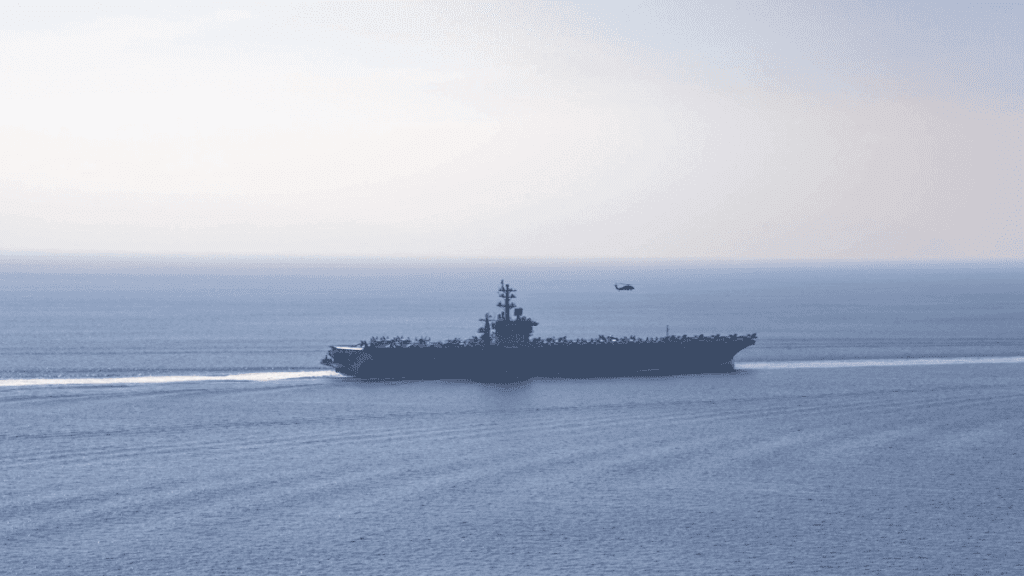
The Islamic Revolutionary Guard Corps hard line echoes the warnings of Ali Khamenei, who on Feb. 1 said a U.S. attack would set off a wider regional war and, on Feb. 17, pointedly invoked weapons capable of sinking American warships. Still, the tenor of IRGC-linked media and recent maneuvers by the Islamic Revolutionary Guard Corps Navy in and around the Strait of Hormuz suggest a strategy built more on calibrated pressure and signaling than on a direct strike against deployed United States assets, which many analysts view as a last-resort escalation.
The Strait of Hormuz is a strategic chokepoint linking the Persian Gulf to the Gulf of Oman and the Indian Ocean, and the principal maritime outlet for Gulf oil and LNG exports. Roughly 25% of the world’s seaborne oil and about 20% of global LNG transits the strait, making any sustained disruption a likely trigger for extreme market volatility, lost Gulf revenue, and sharply higher energy prices. But such a move would also devastate Iran’s own seaborne export economy, creating a scenario of mutual destruction, sources familiar with the matter warn.
Speaking to the Tasnim News Agency during the ongoing maneuvers, IRGCN’s Rear Admiral Alireza Tangsiri declared that his forces are ready to block the Strait of Hormuz if instructed by the nation’s top officials, a move that would shut off the pivotal choke point. Tangsiri’s statement, following live drills and IRGC-affiliated media reports, may signal the regime’s willingness to enact its own contingency plan, which represents a ‘nuclear option.’


