Assessing China’s exposure, response, and the structural divergence between its oil and gas import dependence. At the bottom of the article, you can view the analysis in more detail.


Escalating hostilities in early 2026, sparked by military strikes against Iranian nuclear infrastructure and Tehran’s subsequent legislative move to seal the Strait of Hormuz, have presented a generational challenge to Asian energy stability. The near-total freeze on tanker traffic saw daily transits through this critical corridor plummet from 130 to fewer than ten vessels by March 2026. June trade data further underscores the impact, with Chinese crude inflows contracting by 41% year-on-year. As the premier global destination for Gulf barrels—routing roughly 5.4 million bpd through the waterway, a volume more than twice its Russian pipeline intake—China remains the primary focal point of this supply shock.
Despite these disruptions, the anticipated collapse in supply and unchecked price volatility have failed to materialize. Beijing entered the crisis with a robust buffer of approximately 1.39 billion barrels in storage—equivalent to 120 days of cover—bolstered by a 16% surge in front-loaded procurement throughout the first two months of the year. Furthermore, a twenty-year structural pivot has already reduced Hormuz-dependency to between 40% and 50% of seaborne imports. Consequently, China is currently absorbing the volatility through its reserve assets while utilizing the crisis as a strategic lever to expedite an existing supply-security transformation.
This analysis evaluates the anatomy of the Hormuz shock on China’s trade flows, the specific tactical responses—spanning pipeline expansion, LNG portfolio diversification, and demand-side levers—and the structural divergence between oil and gas dependencies that defines Beijing’s long-term vulnerability profile.
1. The 2026 Hormuz Crisis: Anatomy of the Shock
The geopolitical landscape shifted dramatically in late February 2026 as military incursions against Iranian nuclear sites triggered a legislative mandate from Tehran to obstruct the Strait of Hormuz. This vital artery facilitates the transit of approximately 20% of the world’s petroleum and liquefied natural gas liquidity, serving as the indispensable exit point for hydrocarbons from Saudi Arabia, the UAE, and other Gulf exporters. With negligible bypass infrastructure available, the corridor’s closure represents a systemic threat to the global energy supply chain.

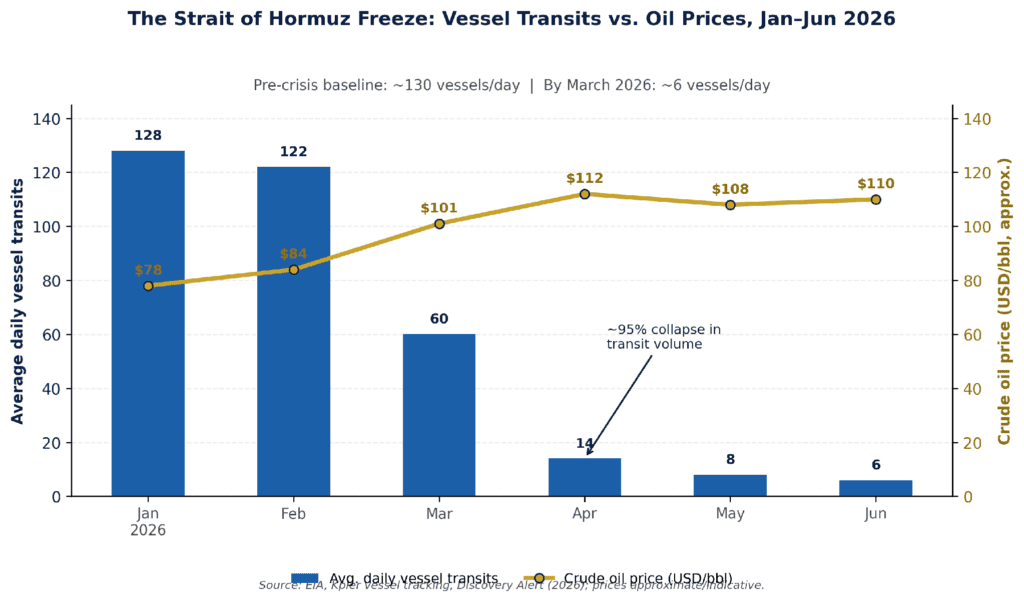
Figure 1: Average daily vessel transits through the Strait of Hormuz collapsed roughly 95% between January and March 2026, coinciding with a run-up in crude prices past $110/bbl.
The regional concentration of risk remains centered on Asia, where the collective demand of China, India, Japan, and South Korea absorbs approximately 69% of the waterway’s total throughput. Within this framework, Beijing maintains its status as the preeminent destination for these barrels, a position it has held consistently since 2020. June 2026 customs data provides a definitive quantification of this vulnerability, revealing that aggregate crude imports contracted to 29.27 million tons—roughly 7.1 million bpd—driven by the suspension of Gulf deliveries and a broad freezing of spot market liquidity.
“The near-total freeze on tanker traffic effectively severed the most direct supply corridor connecting Persian Gulf producers to their largest customers. This was not a gradual decline — it was an abrupt wall.”
Beijing’s tactical maneuvers relied upon a foundational architecture of strategic buffers established prior to the 2026 escalation. Proactively mitigating the fallout from heightening regional friction, Chinese refining entities initiated a 16% surge in front-loaded procurement during the first two months of the year, effectively inflating inventories before the blockade. This effort was augmented by a 300,000 bpd increase in Russian flows via pipeline and maritime channels. Central to China’s resilience is its near-monopsony on Iranian output, absorbing over 90% of Tehran’s exports; this relationship provides a unique cushion through 46 million barrels sequestered in Asian floating storage and bonded facilities in Dalian and Zhoushan, offering a protection profile largely unavailable to its global peers.
2. China’s Diversification Response
Beijing’s tactical response to this geopolitical friction operates across a dual-track framework, blending short-term reserve deployment and grade substitution with a heightened commitment to its long-term strategic decoupling from the Hormuz chokepoint. This structural pivot, two decades in the making, has successfully reduced Gulf-dependency to between 40% and 50% of total seaborne inflows. This evolution reflects an aggregate of sustained capital allocation toward cross-border pipeline networks, the diversification of non-Gulf procurement portfolios, and an accelerating domestic transition toward demand-side electrification.

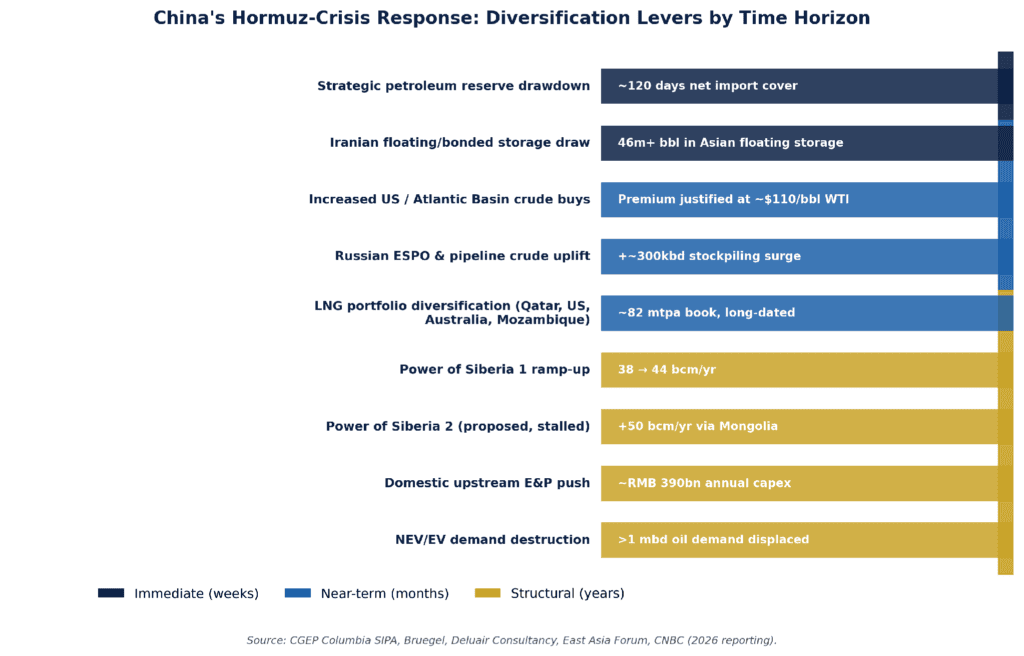
Figure 2: China’s response spans immediate reserve drawdowns, near-term substitution toward Atlantic Basin and Russian barrels, and structural pipeline, upstream and demand-side levers.
2.1 Tactical Crude Management: Reserves, Grade Substitution, and Non-Gulf Flows
- Deployment of Strategic Buffers: Leveraging approximately 120 days of net-import cover within its SPR and commercial stocks, Beijing maintains the capacity to navigate a multi-month blockage without implementing domestic rationing.
- Utilization of Sequestered Iranian Assets: The existence of 46 million barrels in Asian floating storage and bonded facilities provides an immediate supply cushion, mitigating the urgency for fresh transits through the chokepoint.
- Pivot to Atlantic Basin Liquidity: As WTI benchmarks surge toward $110/bbl, the security premium of non-Gulf barrels increasingly offsets logistics costs; high-level diplomatic signaling suggests an accelerated procurement of US, West African, and Latin American grades.
- Russian Pipeline and ESPO Integration: Moscow augmented its daily flows by 300,000 barrels during the early 2026 stockpiling phase, though its spare capacity remains insufficient to fully replace displaced Gulf volumes.
2.2 Natural Gas Dynamics: Infrastructure, Contracting, and Strategic Leverage
The architecture of China’s gas security diverges fundamentally from its oil profile, utilizing a genuinely mixed matrix of overland pipelines and maritime LNG rather than relying on a single-threaded tanker corridor. While domestic output satisfied the bulk of the 430 bcm consumed in 2025, the balance is managed through a resilient portfolio comprising Central Asian pipeline gas, Power of Siberia 1 flows, and an increasingly sophisticated LNG book that provides critical optionality during regional shocks.

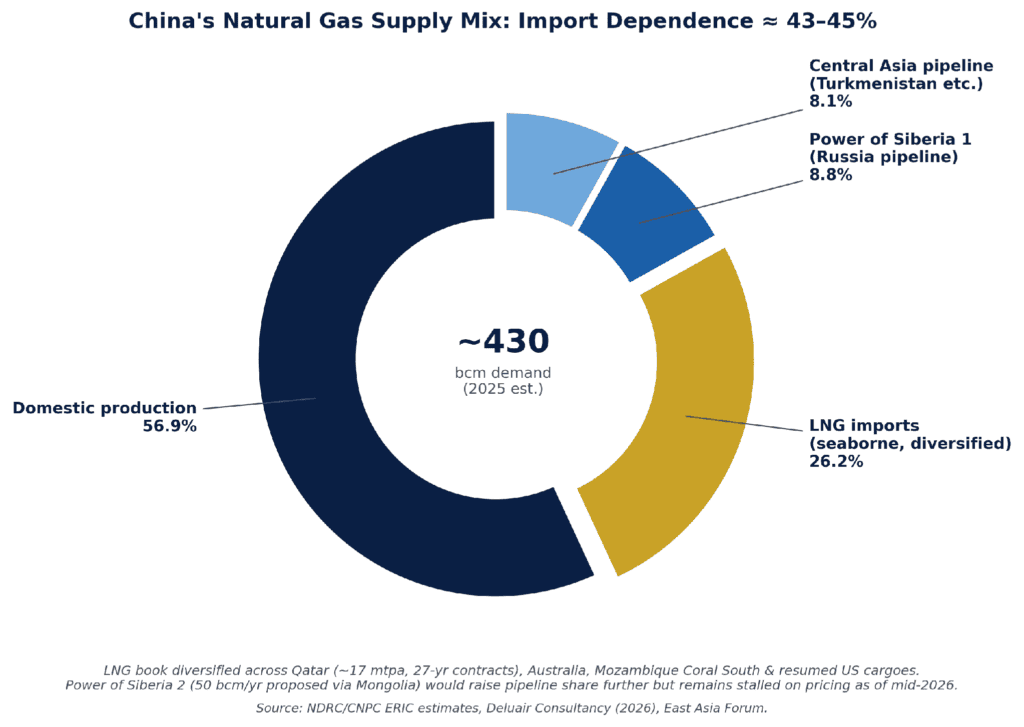
Figure 3: China’s gas supply mix leans heavily on domestic output and a diversified LNG book, giving it more flexibility than its oil position.
The anchor of Beijing’s overland strategy is the Power of Siberia 2 (PoS2) project, a projected 2,600-kilometre corridor designed to funnel 50 bcm annually from the Yamal peninsula through Mongolia. Despite a legally binding memorandum signed in late 2025 by Xi, Putin, and Ukhnaagiin Khürelsükh—which also boosted Power of Siberia 1 (PoS1) targets to 44 bcm—the project has reached a geopolitical impasse by mid-2026. Beijing’s valuation remains significantly below the $240–$280/kcm threshold established for PoS1, with Chinese officials reportedly signaling a moratorium on price discussions. This negotiation leverage is underpinned by a sophisticated LNG portfolio; as of 2025, this includes 17 mtpa in long-term Qatari off-take agreements with Sinopec and CNPC, alongside diversified flows from Mozambique’s Coral South, Australia, and a revitalized stream of American cargoes following a twelve-month hiatus.
- Robust Domestic Foundation: Conventional output, shale gas, and coal-bed methane collectively insulate approximately 57% of national consumption.
- Central Asian Expansion: Existing flows from Turkmenistan’s Galkynysh field are slated for augmentation via the proposed Line D, potentially adding 30 bcm of regional capacity.
- Russian Integration Dichotomy: While PoS1 scales toward its 44 bcm ceiling, the 50 bcm PoS2 expansion functions primarily as a tactical bargaining chip in Beijing’s procurement strategy.
- Agile LNG Portfolio: Maritime procurement offers superior tactical flexibility, with new supply agreements actionable within months, bypassing the decade-long lead times of pipeline infrastructure.
3. Comparing China’s Oil and Gas Import Dependence
China is simultaneously the world’s largest crude oil importer and its largest natural gas importer, but the two dependencies are not equivalent in scale, composition, or strategic risk. Understanding the difference is central to reading how exposed China really is to a Hormuz-style shock.

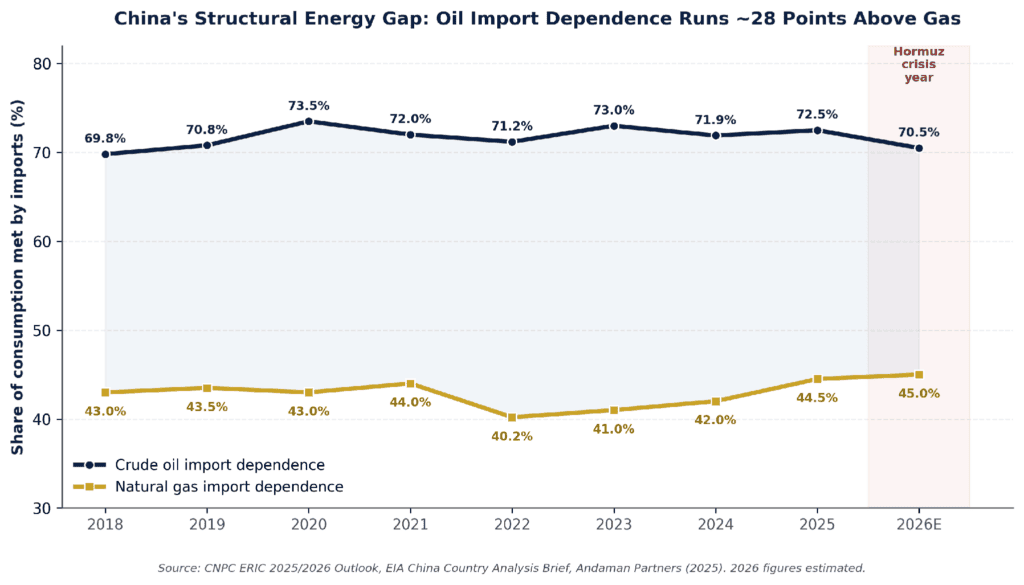
Figure 4: China’s crude oil import dependence has held in the 70–74% range since 2018, roughly 28 percentage points above its natural gas import dependence of 42–45%.
Oil import dependence has hovered around 70–74% of consumption for most of the past decade, and CNPC’s own 2025 industry outlook projects it will remain near 70% through the 2026–2030 period covered by China’s 15th Five-Year Plan, even as demand-side electrification erodes absolute consumption growth. Gas import dependence, by contrast, has moved in a narrower band around 40–45%, edging upward in 2025–2026 as LNG imports grow faster than domestic production.
The gap exists for structural reasons rather than policy choice alone. China’s proven oil reserves and production growth have plateaued relative to a refining base that is the world’s second largest, leaving a persistent and largely irreducible import gap that new exploration investment — roughly RMB 390 billion a year across CNPC, CNOOC and Sinopec — can only slow, not close. Gas, by contrast, benefits from three advantages oil lacks: a much larger relative domestic resource base (shale and coal-bed methane still in early development), a ready substitute in coal that still supplies more than half of China’s primary energy, and a delivery system split between pipelines and LNG that is inherently harder to disrupt at a single chokepoint than oil’s concentration in seaborne Gulf tanker flows.

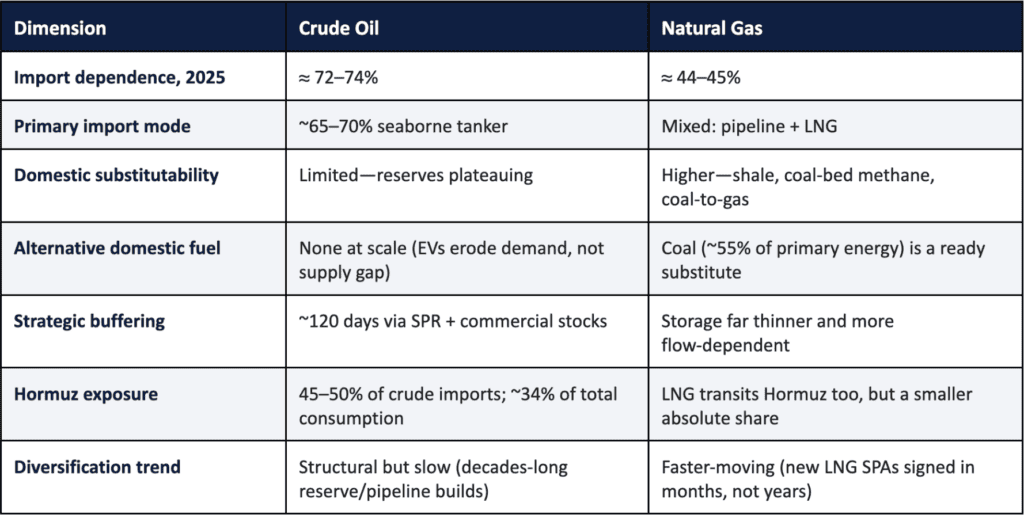
Table 1: Structural comparison of China’s oil versus gas import dependence and vulnerability profile.

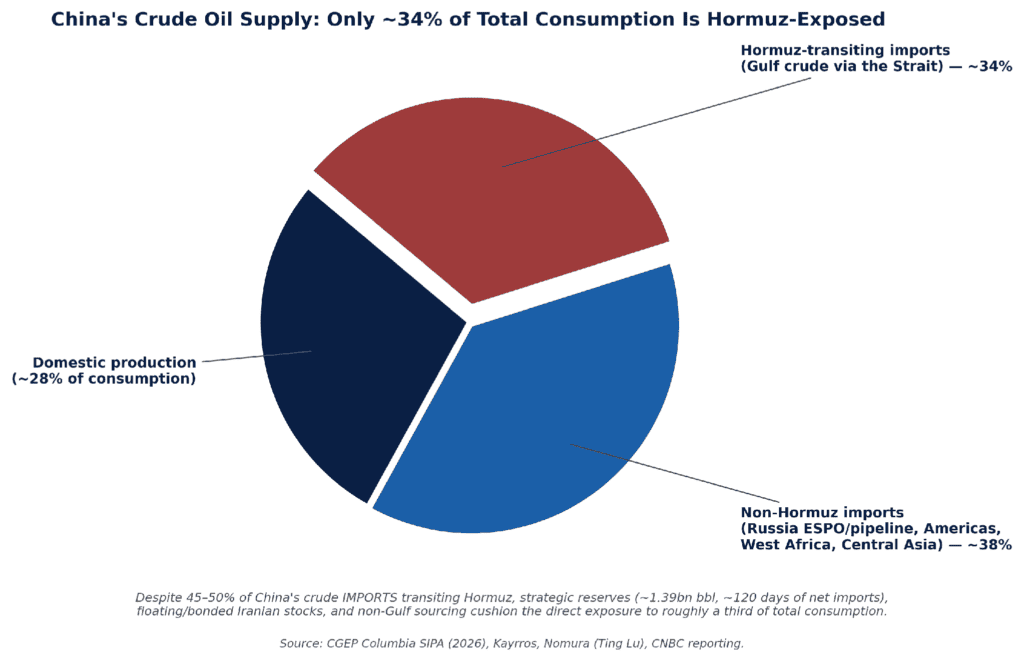
Figure 5: Even a full Hormuz closure would directly threaten only around a third of China’s total crude oil consumption once domestic production and non-Gulf imports are accounted for — though the shock to global pricing would still be felt economy-wide.
Nomura’s China economics team estimates that oil shipments through Hormuz account for only about 6.6% of China’s total energy consumption, with natural gas transiting the same route contributing a further 0.6% — a reminder that headline import-dependence percentages overstate the country’s vulnerability to any single chokepoint once the full energy mix, including coal and renewables, is considered. This is the analytical core of why China has weathered the 2026 crisis without the acute disruption seen in 2022’s European gas shock: its energy system, while import-heavy, was never single-threaded.
4. Outlook and Assessment
- Near-term (2026): China’s reserves and alternative sourcing should allow it to manage a continued partial Hormuz disruption for several more months without physical shortage, though refiners will face margin pressure and buying costs will remain elevated.
- Medium-term (2027–2028): Expect continued LNG contracting momentum (Qatar, US, Australia, Mozambique) to outpace pipeline gas growth, given PoS2’s pricing deadlock; a Mongolia-routed Russian pipeline deal remains possible but is not imminent.
- Structural (2030 horizon): Oil import dependence is set to stay near 70% through the 15th Five-Year Plan even as absolute oil demand growth slows, meaning the strategic vulnerability persists even as its economic weight (as a share of energy consumption) shrinks; gas import dependence will likely continue drifting toward 45–50% as coal-to-gas switching policy continues, partly offsetting the exposure oil is losing.
- Structural driver to watch: NEV penetration above 50% of new passenger vehicle sales has already displaced over 1 million barrels/day of oil demand — the most consequential long-run lever reducing China’s sensitivity to any future strait-of-Hormuz-style shock, oil-specific rather than energy-wide.