


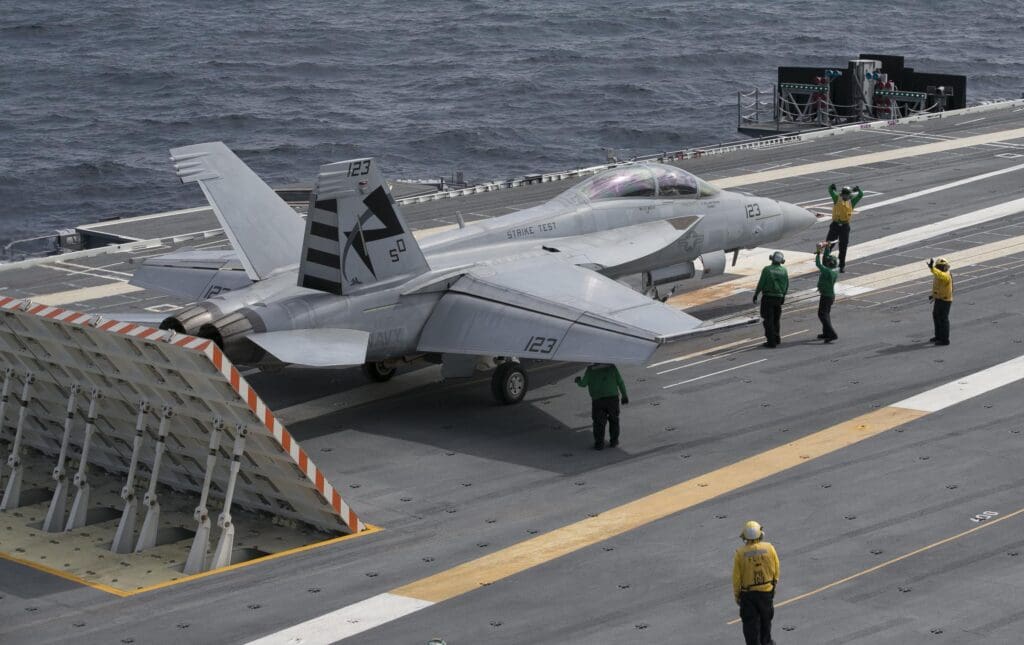
President Donald Trump has directed the U.S. Navy to return to steam-powered aircraft catapults for future aircraft carriers, reversing a central technological feature of the Ford-class program. U.S. officials said Trump signed a national security memorandum Thursday ordering the Navy to remove the Electromagnetic Aircraft Launch System, or EMALS, from future ships and replace it with traditional steam catapults. The change will begin with the future USS Doris Miller, CVN-81, while the first three Ford-class carriers will retain their existing electromagnetic systems.
The directive represents a significant change to the Navy’s long-term carrier construction plans. EMALS was designed as the launch system for USS Gerald R. Ford and subsequent Ford-class carriers, replacing the steam catapults used aboard the older Nimitz class. The Navy says EMALS is designed to launch a wider range of aircraft, from lightweight unmanned platforms to heavy strike fighters, while performing the same basic mission as a conventional steam catapult. USS Gerald R. Ford already operates EMALS, while the system has also been incorporated into the future USS John F. Kennedy and USS Enterprise.
The future USS Doris Miller had also been scheduled to receive EMALS. In 2023, the Navy awarded General Atomics a $1.204 billion contract modification covering production of EMALS and the Advanced Arresting Gear for CVN-81, including installation, engineering and certification support through 2032. The new directive will therefore require changes to a carrier whose launch-and-recovery equipment had already entered production planning, though the Navy has not publicly detailed the cost, construction delays or contractual changes that could result from redesigning the ship around steam catapults.
Trump has criticized electromagnetic catapults for years, arguing that steam systems are simpler and more reliable. The latest order moves that preference from public criticism into formal Navy procurement policy. The decision will not require retrofitting the first three Ford-class carriers, but it fundamentally alters the design path for later ships in the class and could reshape decades of planned carrier aviation infrastructure. Further guidance from the Navy and Defense Department is expected as officials determine how the directive will be incorporated into CVN-81 and subsequent carrier construction.


