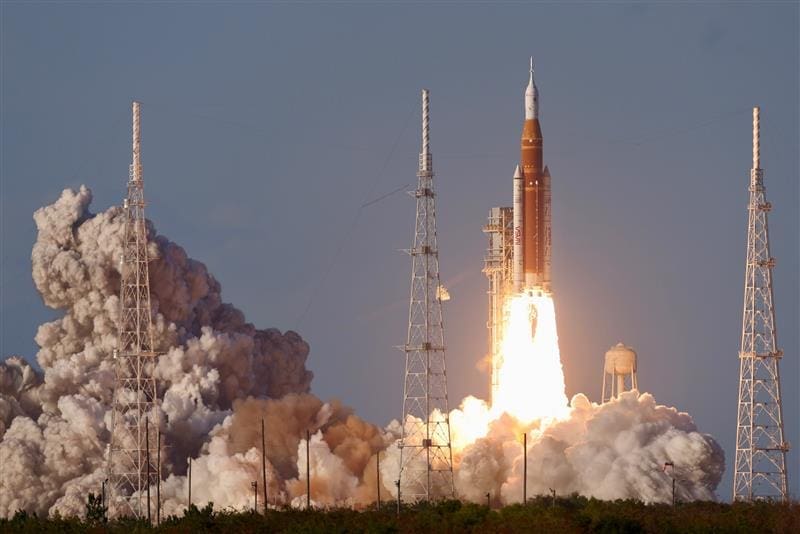
Incredible amounts of time, manpower, and resources have been devoted into developing the “next age” of rocketry. In 2017, SpaceX achieved something no other company or nation had ever achieved—the reuse of an orbital class rocket booster. This single achievement became a major catalyst in the global effort to reduce the cost of spaceflight, inspiring and setting the pace for private space firms and state-sponsored programs alike. In China, companies such as the government-sponsored LandSpace, are pursuing the same goal through reusable launch vehicles like Zhuque-3, helping push the country toward a new era of rocket reuse and far lower launch costs.
An Eagle That Screeches As Loud As A Rocket Engine
China and the United States want to fully exploit the dominance that leading the new space race can bring. Economic, military, and being a “first mover” is what drives both nations to further employ the assistance of the private sector to innovate. The United States is relying heavily on the use of private companies to push out military satellites, utilizing SpaceX, and soon Blue Origin.
“Full reuse is a game changer, and we can’t wait to fuel up and fly again.”
(Bezos, after Blue Origin’s first successful New Shepard booster landing in 2015.)“This is the key to getting life to be multi-planetary is to have reusable rockets. If you throw away the rockets every time, it’s crazy expensive to go to space.” (Musk, 2015.)
Both companies agree that the pursuit of reusability and eventual full reusability will be key to securing humanities future beyond the earth, space has so much potential for the human race and these two companies are planning not only for the next few launches in the future, but for the next hundreds of launches. This mindset of getting to space reliably but also quickly has sparked programs such as SpaceX’s Starship, and Blue Origins New Glenn have been making steady progress in developing into the worlds first super heavy class rockets. Starship, which is currently the worlds most powerful rocket is capable of delivering 150-200 tons of mass to LEO (Low Earth Orbit) while returning to it’s respective launch site to be refueled and reused.
Both companies have placed reusability at the center of their long-term launch strategies with the goals of making access to space both more reliable and cost-efficient. Rather than planning only for individual missions, SpaceX and Blue Origin are developing vehicles intended to support a much higher launch cadence over time. This approach has helped shape programs such as SpaceX’s Starship and Blue Origin’s New Glenn, two next generation launch systems designed to expand payload capacity while incorporating reusable hardware. Starship described by SpaceX in 2020 as “the most powerful launch system ever developed”, is being designed as a fully reusable super-heavy vehicle with projected capabilities commonly cited in the range of roughly 100-150 metric tons. New Glenn, meanwhile, is a partially reusable heavy-lift rocket, reusable first stage designed for repeated missions.
A Bold Look To The Future
As space activity increases, particularly in the low earth orbit market, investment in space infrastructure is becoming more important than ever. For space organizations such as SpaceX, Blue Origin, and the European Space Agency, the long-term goal is to develop heavy and super-heavy launch vehicles that can be reused efficiently and, eventually, fully. If successful, these systems could improve launch frequency, reduce long-term costs, and expand what is possible in space exploration. With new developments emerging across the industry each month, spaceflight is entering a period of renewed momentum and possibility, empowering the era for reusable rockets.