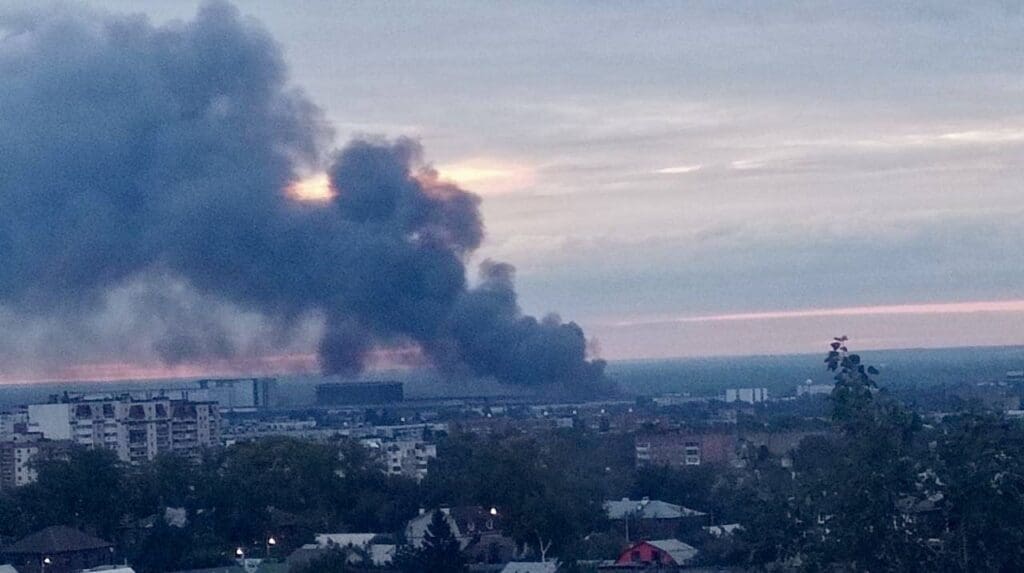
A strike hit a building directly between the Progress Rocket and Space Centre and the neighboring Aviakor aircraft plant in Samara early Saturday, placing the impact at the heart of one of Russia’s most important aerospace industrial zones.
Geolocated footage indicates the building sits between the two facilities and may serve both industrial complexes, though its exact function has not yet been established. The location is significant because Progress houses the production, design and testing infrastructure used for Russia’s Soyuz launch vehicles, while Aviakor is a major aircraft manufacturing and maintenance site, including maintenance for Tu-95s.
The extent of the damage remains unclear, but even a relatively contained strike in that area could have effects beyond the building itself. Rocket and aircraft production rely on highly specialized tooling, precision machinery, test systems, and calibrated equipment that can be difficult to replace quickly. Blast damage, fire or debris reaching adjacent workshops could interrupt work even if the main production halls remain standing.
Progress is responsible for developing and manufacturing the Soyuz-2 family of launch vehicles, which fly from Baikonur, Plesetsk and Vostochny on civilian, scientific, government and military missions. The Samara complex also includes specialized testing infrastructure needed to support rocket production.

There is no confirmed indication that Soyuz production has stopped, and Russian authorities have not disclosed what equipment or workshops were affected. Any immediate disruption is more likely to involve inspections, repairs and checks of nearby machinery before the broader effect on production becomes clear.
The strike also carries a secondary connection to the International Space Station. Soyuz-2 rockets built in Samara are used to launch Soyuz crew spacecraft and Progress cargo vehicles to the station, although the spacecraft themselves are produced elsewhere.
There is no indication of an immediate threat to ISS operations. Rockets already delivered to launch sites would not be affected by damage in Samara. A prolonged disruption at Progress, however, could eventually put pressure on future Russian crew or cargo missions and increase reliance on American launch providers to maintain access to the station.
For now, the importance of the strike lies in its precise location. Rather than hitting an isolated warehouse or peripheral industrial site, the attack struck a building positioned directly between two major aerospace facilities, potentially one used by both. If sensitive tooling, testing equipment or shared infrastructure was damaged, the consequences could be more significant than the visible footprint of the strike suggests.