


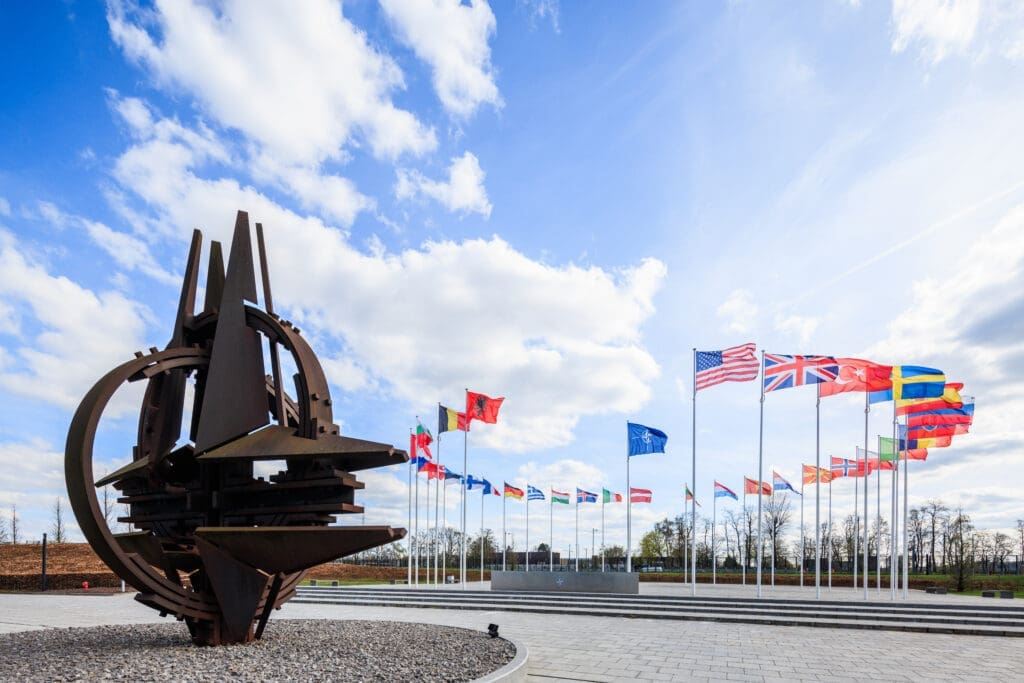
The 36th summit of the North Atlantic Treaty Organization (NATO) was held in Ankara, Türkiye, between July 7 and 8. Leaders of member states and non-NATO invitees gathered to discuss a wide span of topics, ranging from reiterating the organization’s unwavering stance as a defensive alliance to greenlighting future military investments. Although a yearly occurrence, this summit differed significantly in its nature, especially taking into account the recent hostilities between the U.S. and Iran, as well as the lingering mistrust within the alliance itself. Even though it is premature to claim the summit proved to be a breakthrough in melting the ice wall that has formed between member states, it undeniably represents a positive shift away from longstanding, distanced attitudes.
The 2026 summit convened in the shadow of two defining geopolitical crises: Russia’s aggression against Ukraine, which has been ongoing since 2022 after initially being dubbed a three-day ‘special military operation,’ and the U.S. standoff with Iran. The latter conflict has devolved into an irrational, normalized cycle of violence, where routine military strikes on strategic targets are frequently followed by premature declarations of peace from the Trump administration. Rather than a structured strategy to force Tehran to the negotiating table, the crisis has become a vicious cycle of escalation and retraction. While NATO leaders delved deeply into both of these theaters, the alliance ultimately adjourned without reaching a firm consensus or laying the groundwork for definitive strategic plans regarding both conflicts.
“We are ready to defend every inch of NATO, including our own territory… Of course we will defend the Kingdom of Denmark.”
— Danish Prime Minister Mette Frederiksen, denying U.S. President Donald Trump’s remarks regarding taking control of Greenland during the 2026 NATO Summit.
Beyond external crises, internal fractures within the alliance took center stage throughout the summit, underscored by the unusually blunt rhetoric of NATO heads of state. These public divisions dominated international media coverage, severely damaging the summit’s intended optics and projecting an image of deep-seated mistrust rather than collective defense. Yet, despite these glaring shortcomings, the Ankara summit managed to salvage a sense of renewed hope, signaling that a fundamental restructuring of the alliance may finally be on the horizon.
Time will tell whether these internal fractures can ever be fully mended. In the meantime, shifting focus back to broader regional theaters, U.S. President Donald Trump used his remarks to underscore the urgency of bringing both crises to an end. Trump, during the summit broadcast, outlined significant policy shifts: granting Ukraine the right to domestically produce Patriot missiles, withdrawing from the recently signed Memorandum of Understanding (MoU) between Washington and Tehran, and signaling a willingness to sell F-35 fighter jets to Türkiye. Despite vocal objections from Greece and Israel, this proposed arms sale signifies Türkiye’s role as a bastion guarding Europe — acting more as a strategic deterrent against further Russian ambitions than a mere diplomatic gesture, albeit at the risk of severely straining relations with Athens and Jerusalem in the near future.
The immediate aftermath of the summit provides a stark glimpse into the next phase of the Iran crisis, directly resulting from Washington’s high-stakes diplomatic wager. Almost immediately after the Ankara summit adjourned and world leaders began their journeys home, a massive wave of U.S. precision strikes commenced across Iran. Local sources and IRGC-affiliated media described the bombardment, which targeted over 90 strategic sites, as “one of the most intense strike packages” of the entire conflict. Among the sites targeted by the U.S. Air Force were the perimeter of the Bushehr Nuclear Power Plant, the IRGC’s naval base and port facilities in Chabahar, and various undisclosed targets across Konarak, Abu Musa Island, Qeshm Island, Jask, Agh Ghala, and Iranshahr.
In spite of the sheer intensity of the American bombardment, the vicious cycle of escalation remains unbroken. In immediate retaliation, the IRGC threatened to impose a renewed blockade on the Strait of Hormuz, hindering the gradual reopening process, and launched counter-strikes against U.S. military installations across the Gulf. These retaliatory measures notably targeted American assets in Kuwait, Bahrain, and Qatar, though the projectiles were largely intercepted before causing extensive damage.
Behind closed doors, it is reasonable to assume that talks to sway NATO leaders against Iran took place, given that the MoU was trashed and strikes against Iran were carried out just hours later. Guaranteeing the support of European leaders in tackling the Iran crisis will undoubtedly put Washington in a better strategic position. This holds true whether executed tactically, by garnering promises to help clear the Strait of Iranian mines and ensuring safe passage for transiting vessels, or at the negotiation table, squeezing the last drop of Iran’s income from Europe through sanctions. It is becoming increasingly apparent that while the conflict has reignited after a lengthy cooling-down period, further escalation beyond what was previously established remains out of the question for the time being — a likelihood significantly narrowed by the Trump administration’s current posture.


