
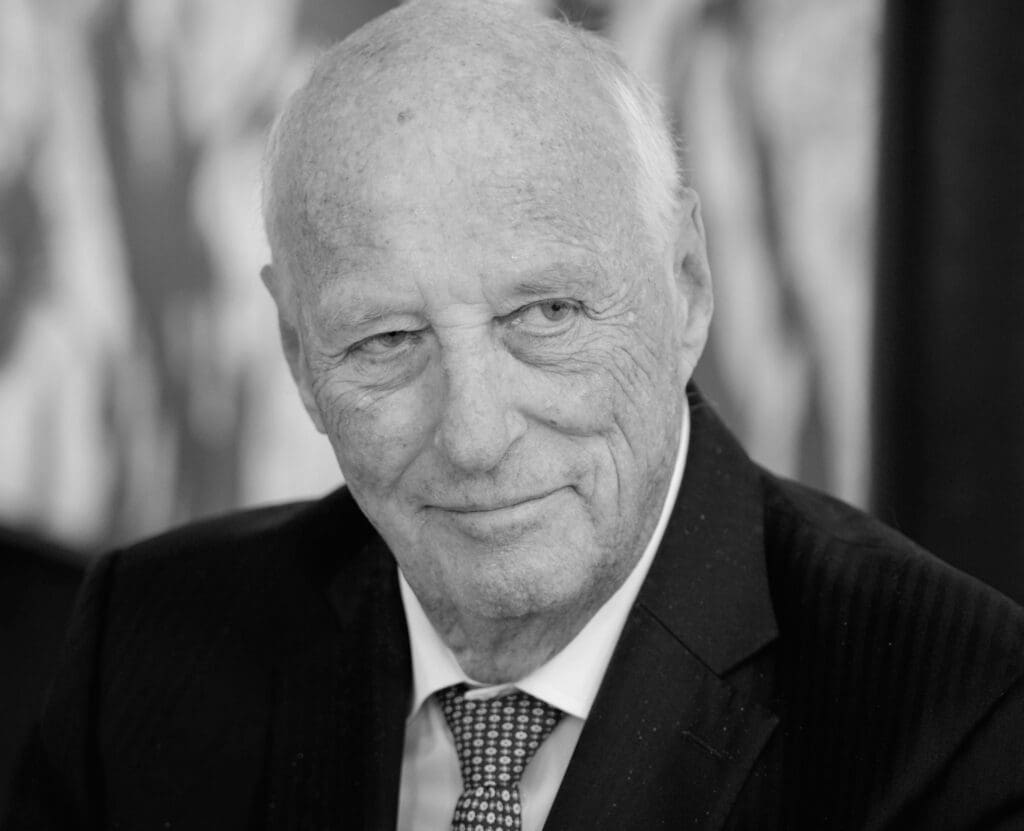
Norway’s 89-year-old King Harald V has died following a recent hospitalization in Oslo, bringing an end to a 35-year reign. The Royal Palace said Harald died peacefully at Oslo University Hospital Rikshospitalet at 6:35 a.m. Friday. Prior to his death, medical examinations revealed he had developed fluid buildup following cortisone treatment for hemolytic anemia, a blood disorder in which red blood cells are destroyed faster than the body can replace them. He was subsequently treated with antibiotics for a bacterial bloodstream infection as his condition deteriorated.
Born on Feb. 21, 1937, King Harald ascended the throne in 1991 following the death of his father, King Olav V, becoming the first Norwegian monarch since 1380 to have been born in Norway. Following the abdication of Denmark’s Queen Margrethe II in 2024, Harald became Europe’s oldest reigning monarch. His death Friday concludes a reign spanning more than 35 years. The throne passed immediately to his only son, Crown Prince Haakon, who has become King Haakon VIII.
His death follows a series of recent health struggles. Earlier in February, King Harald was admitted to a hospital in Spain’s Canary Islands for a skin infection on his leg and dehydration. A day after he was admitted, his personal physician, Bjørn Bendz, traveled to the facility in Tenerife to oversee his care before his eventual discharge.
Similarly, the late king faced another serious health complication in 2024 when he fell ill with an infection during a private holiday on the Malaysian island of Langkawi. The illness caused his heart rate to fall dangerously low, prompting doctors at a local hospital to implant a temporary pacemaker ahead of his medical evacuation to Norway. He later received a permanent pacemaker at Rikshospitalet in Oslo.
In the days leading up to his death, King Harald’s condition steadily deteriorated during his hospitalization, prompting members of the royal family to gather at his bedside and cancel official duties. Crown Prince Haakon had been serving as regent while his father was on sick leave. As Harald’s health worsened, members of the public began gathering to lay flowers outside Oslo’s Palace Square. Norwegian Prime Minister Jonas Gahr Støre also called off a planned diplomatic trip to Germany, addressing the nation to say, “The whole nation is with us as we send warm thoughts to the king and the rest of the royal family.”
Harald was born at the royal estate of Skaugum in Asker to then-Crown Prince Olav and Crown Princess Märtha. His birth carried unusual constitutional significance. His parents already had two daughters, Princess Ragnhild and Princess Astrid, but Norway’s succession rules at the time permitted only male heirs to inherit the throne. Harald was also the first prince born on Norwegian soil in 567 years.
His childhood was shaped by World War II. When Nazi Germany invaded Norway in April 1940, the three-year-old prince fled the country with his mother and sisters as the royal family sought to avoid capture. Crown Princess Märtha eventually took the children to the United States at the invitation of President Franklin D. Roosevelt. After briefly staying at the White House, the family lived at Pook’s Hill outside Washington, D.C., for much of the war. Harald later described the United States as a second home after spending five formative years there before returning to Norway following liberation in 1945.
Back in Norway, Harald attended Smestad School and later Oslo Cathedral School before beginning his military education. He graduated from the Norwegian Military Academy in 1959 and studied social science, history and economics at Balliol College at Oxford University from 1960 to 1962. He became crown prince in 1957 following the death of his grandfather, King Haakon VII, and increasingly took on official responsibilities alongside his father.
Harald also broke with royal convention in his personal life. He met Sonja Haraldsen, the daughter of an Oslo clothing merchant, in 1959, but their relationship remained politically sensitive because she was a commoner. The couple waited nine years before King Olav eventually approved their marriage following consultations with political leaders. Harald and Sonja married at Oslo Cathedral on Aug. 29, 1968, a match once viewed by some as a potential threat to the monarchy but which ultimately helped reshape the Norwegian royal family’s public image. They had two children, Princess Märtha Louise in 1971 and Haakon in 1973.
When King Olav died on Jan. 17, 1991, Harald immediately succeeded him as King Harald V. Four days later, he formally swore before the Storting to reign in accordance with Norway’s Constitution and laws. Harald and Queen Sonja were consecrated at Nidaros Cathedral in Trondheim on June 23, although Norway had abandoned formal coronations earlier in the century. Like his father and grandfather, Harald adopted the royal motto “Alt for Norge,” or “Everything for Norway.”
As monarch, Harald exercised little direct political power under Norway’s constitutional system, serving primarily as head of state and a national representative while formally presiding over meetings of the Council of State. Over three decades, he and Queen Sonja helped modernize the monarchy while retaining many of the traditions established by King Haakon VII following Norway’s independence in 1905. Harald cultivated a relatively informal public image and remained one of Norway’s most popular public figures even as the wider royal family faced growing scrutiny in his later years.
His role as a symbol of national unity became particularly visible following the July 22, 2011, terrorist attacks in Oslo and on Utøya, which killed 77 people. Harald joined survivors and grieving families in public mourning and repeatedly invoked democracy, equality and tolerance in the years that followed. In one of the defining speeches of his reign in 2016, he described modern Norway as a country belonging to people regardless of where they came from, whom they loved or what they believed, reinforcing an increasingly inclusive conception of the monarchy’s role.
Outside his royal duties, Harald was a lifelong sportsman and accomplished sailor. He represented Norway in sailing at three Olympic Games, in 1964, 1968 and 1972, and carried the Norwegian flag during the opening ceremony of the 1964 Tokyo Olympics. He later won a sailing world championship with his crew aboard Fram X in 1987 and continued competing in regattas into his 80s before ending his competitive sailing career in 2022. He was also a longtime advocate for conservation and served for two decades as president of the Norwegian branch of the World Wide Fund for Nature.
Despite recurring health problems, Harald repeatedly rejected the idea of abdication. After his 2024 illness and pacemaker surgery, the palace announced that he would permanently reduce his official workload, but Harald maintained that his oath as king was a commitment for life. His death makes Haakon VIII the fourth monarch of Norway’s modern royal dynasty, which began when Harald’s grandfather, Haakon VII, was chosen as king following the dissolution of Norway’s union with Sweden in 1905.
This story has been updated since its original publication to reflect new information, additional reporting, or subsequent developments.
