
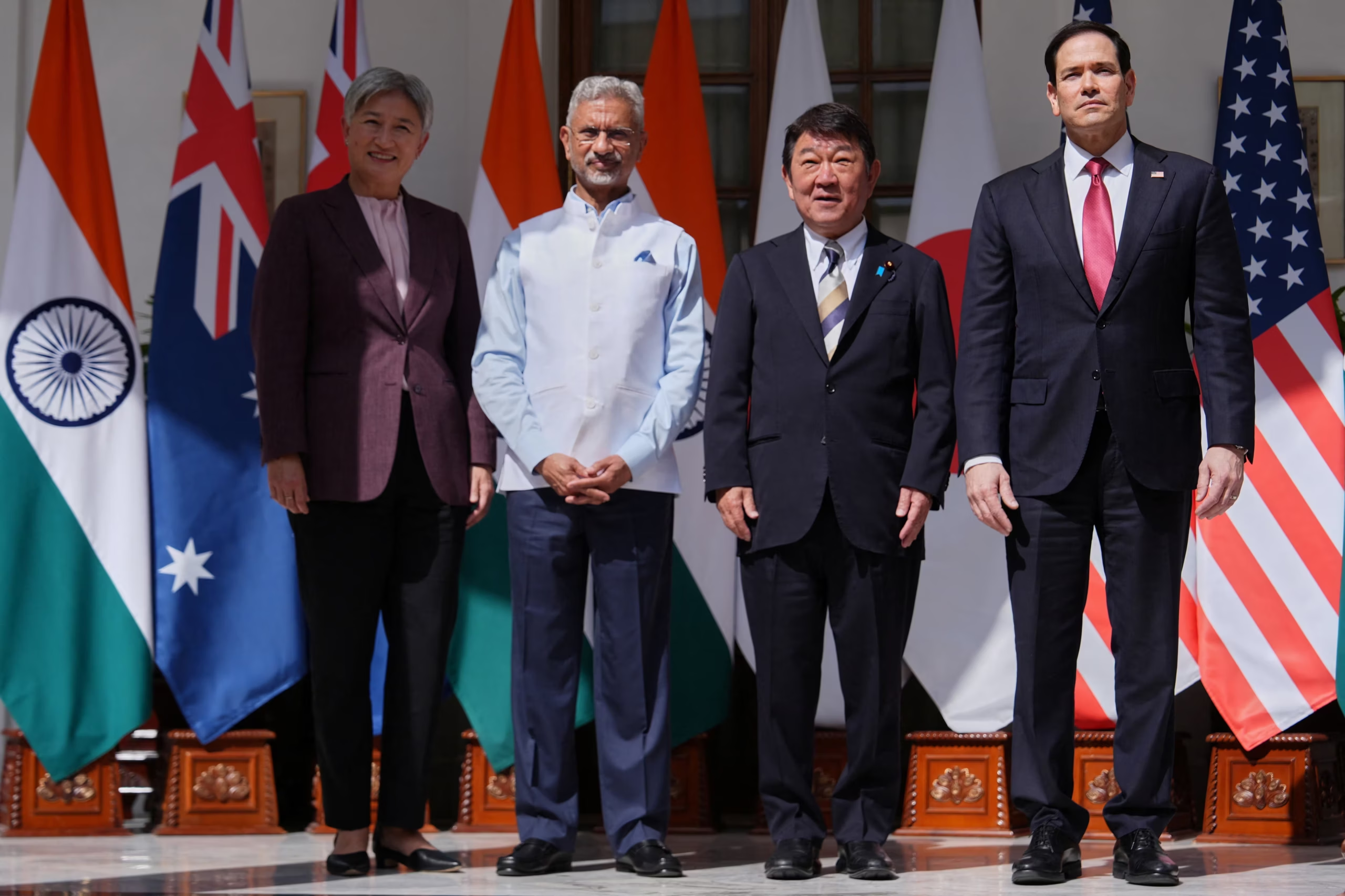
Maritime surveillance, a port in Fiji, and a critical minerals pact signal the Quad’s most consequential ministerial meeting in years and a clear message to Beijing that the four-nation grouping means business.
This significant meeting has drawn considerable attention from international analysts and policymakers. The implications of the decisions taken at this summit extend beyond mere agreements; they represent a strategic countermeasure to growing concerns about geopolitical shifts in the Indo-Pacific region.

Observations from geopolitical experts indicate that this assembly sets a precedent for future cooperation among member nations, illustrating a united front against external pressures. The Quad’s evolution from a declarative to an action-oriented partnership exemplifies its strategic importance in maintaining regional stability.
During the summit, leaders discussed various scenarios illustrating the necessity of maritime security, particularly in light of recent incidents involving territorial disputes in Southeast Asia. The collaboration on maritime surveillance is expected to play a critical role in enhancing the safety of shipping lanes essential for global trade.
As we reflect on the outcomes of this summit, it is clear that the Quad is evolving into a robust partnership capable of addressing the complex challenges of our time. Each initiative represents a step towards a more secure and prosperous future in the Indo-Pacific.
The Quad’s commitment to a free and open Indo-Pacific is not just a geopolitical slogan; it represents a vision for cooperative engagement that prioritizes stability, prosperity, and security for all nations involved. The successful implementation of the agreements made at the New Delhi summit will significantly impact not only the member nations but also the broader international community.
As member nations deepen their collaboration, the Quad’s initiatives will likely evolve to encompass new areas such as climate change, where collective action can yield significant benefits. By leveraging each member state’s unique strengths, the Quad can forge a more resilient and united front against global challenges.
Looking ahead, the role of the Quad in shaping the geopolitical landscape of the Indo-Pacific will be more crucial than ever. Continuous engagement and strategic cooperation will be essential for addressing the multifaceted challenges faced by the region.
At Hyderabad House this Tuesday, the foreign ministers of India, the United States, Australia, and Japan finalized a landmark assembly that signaled the grouping’s most significant operational pivot to date. This third ministerial since late 2024 moved decisively past the era of mere declaratory diplomacy, producing three major strategic deliverables and a joint statement that addressed regional anxieties with unprecedented clarity and purpose.
The New Delhi summit was distinguished by its granular operational focus, most notably through the inaugural announcement of a joint physical infrastructure project—a pilot port in Fiji. Alongside this venture, the ministers solidified a maritime surveillance framework, a critical minerals pact, and an energy security initiative, fulfilling Secretary of State Marco Rubio’s earlier insistence that the partnership evolve beyond a consultative platform into a vehicle for tangible, outcome-oriented action across the Indo-Pacific.
The Future of Quad Relations: Building a Resilient Indo-Pacific
Such integration of surveillance capabilities not only addresses security concerns but also facilitates information sharing among member states, allowing for prompt responses to potential threats. This initiative illustrates the Quad’s commitment to fostering a safe maritime environment for all nations in the region.
The implications of the port initiative in Fiji extend beyond logistical enhancements; it embodies a strategic shift in how regional infrastructure projects are approached. By establishing a presence in such critical areas, the Quad aims to counteract the influence of Chinese investments that have historically dominated the region.
This critical minerals pact is also Timely, given the global push towards green technologies, which is driving demand for these essential resources. By collaborating on the mining and processing of critical minerals, the Quad is positioning itself as a leader in sustainable resource management in the Indo-Pacific.
Furthermore, the importance of energy security cannot be overstated. As global energy demands increase, the Quad’s emphasis on cooperative energy strategies reflects a proactive approach to ensure that member states can navigate geopolitical uncertainties without compromising their energy supply.
The commitment to enhancing digital infrastructure through undersea cables will also foster greater connectivity, which is vital for economic growth. By improving communications, the Quad is not only strengthening its own ties but also empowering Pacific Island nations to engage more fully in the global economy.
KEY DELIVERABLES , QUAD FM, NEW DELHI, 2026
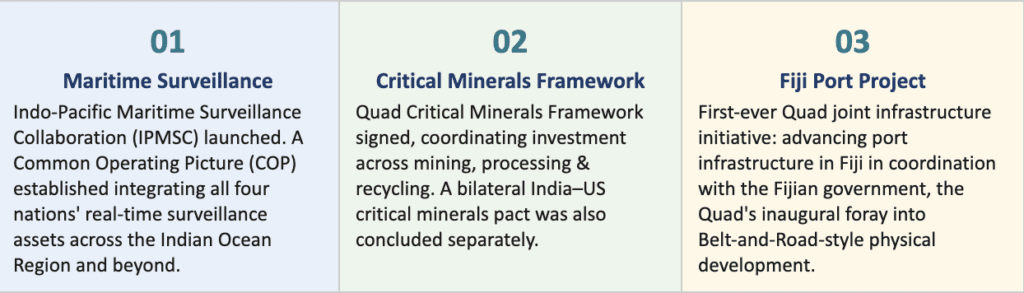
Regarding the maritime domain, the ministers solidified the Indo-Pacific Maritime Surveillance Cooperation Initiative, an effort designed to integrate national surveillance assets into a unified common operating picture across the region. This expansion of the current IPMDA framework directly counters a primary strategic anxiety: the accelerating expansion of China’s naval presence within contested maritime zones stretching from the South China Sea to the Pacific Islands.
The port initiative in Fiji serves as the most potent symbol of the summit’s success. Marking the grouping’s inaugural venture into joint physical infrastructure , a field traditionally dominated by Beijing’s Belt and Road projects, the project addresses critical logistical gaps in the Pacific. By providing a transparent alternative to Chinese financing, the Quad seeks to reduce the strategic leverage gained through such investments; additionally, a specialized panel will be established to evaluate port infrastructure across the wider Indo-Pacific.
Counterterrorism strategies discussed during the summit highlight the Quad’s readiness to respond to emerging security threats. The united stance on zero tolerance for terrorism signifies a commitment to safeguard the interests of member states and their allies.
The newly signed critical minerals framework emerges amidst heightened supply-chain vulnerabilities, specifically following China’s decision to limit exports of essential materials for the aerospace and semiconductor sectors. The Quad’s strategic response , which synchronizes policy across mining, processing, and recycling , signals a collective determination to mitigate the risks of over-reliance on any single competitor for vital resources.
“Quad Foreign Ministers are focused on driving momentum and delivering meaningful outcomes for our people and for the Indo-Pacific.”, Australian FM Penny Wong, May 26, 2026
What Else Was On the Table
QUAD STRATEGIC PILLARS , SCOPE OF THE NEW DELHI AGENDA
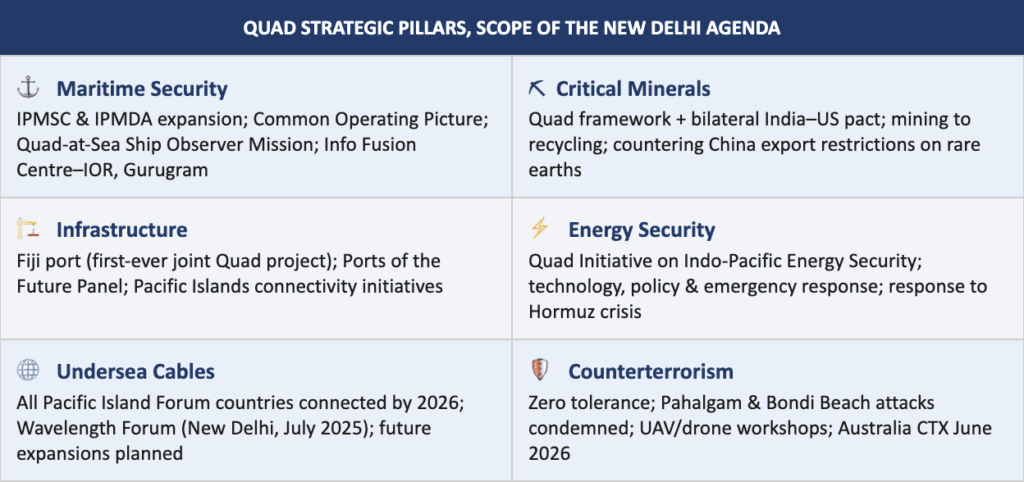
In addition to the primary agreements, the assembly introduced the Quad Initiative on Indo-Pacific Energy Security, a comprehensive framework encompassing technological collaboration, policy alignment, and crisis-response simulations. This initiative underscores a collective acknowledgment that the integrity of energy corridors through the Straits of Hormuz and Malacca remains a fundamental requirement for the economic stability of the member nations.
The communique further emphasized ongoing advancements in undersea cable connectivity, highlighting that every nation within the Pacific Island Forum will be integrated into the network by 2026. By signaling their commitment to future expansion projects, the ministers reinforced the grouping’s position as the lead architect and guarantor of resilient, secure digital infrastructure throughout the maritime theater.
The agenda also featured a robust focus on counterterrorism, with Minister Jaishankar articulating a policy of absolute zero tolerance. He formally affirmed that states targeted by such violence possess an inherent right to self-defense, a declaration clearly intended to address the strategic fallout from the Pahalgam assault and cement the alliance’s shared resolve against regional security threats.



No comment yet, add your voice below!