


In the early hours of February 28, 2026, the United States and Israel launched the largest combined air campaign in the Middle East since the 2003 invasion of Iraq. Forty days later, Iran declared victory. This is an attempt to explain why — and why that declaration is not simply propaganda.
Operation Epic Fury, as Washington named it, struck over 900 targets in its first twelve hours alone. B-2 stealth bombers, Tomahawk cruise missiles, and Israeli F-35s hit nuclear facilities at Fordow and Natanz, IRGC command centers, missile storage sites, and the leadership compound of Supreme Leader Ali Khamenei in Tehran. Khamenei was killed in the strike, along with members of his family. By the time a ceasefire was brokered 38 days later, over 5,000 targets had been hit, the country’s conventional military capacity had been gutted, and more than three million Iranians had been displaced.
And yet, on April 9, the new Supreme Leader Mojtaba Khamenei declared victory. He opened his address with a Quranic verse: “Indeed, We have granted you a clear victory.” He called the war “the third holy imposed defense” and described Iran’s endurance as “undoubtedly a divine blessing” delivered through “the blood of our martyred leader.” Vice President Mohammad-Reza Aref framed the outcome as “not merely a military victory, but a turning point in changing strategic equations.” The regime was battered, its former Supreme Leader was dead, its founder’s son was communicating through handwritten notes to avoid assassination. It called this a triumph.
To most Western observers, these declarations look delusional — the bluster of a regime in denial. But this reading misses something fundamental. Iran’s leadership is not ignoring reality. It is interpreting reality through a theological and historical framework that genuinely redefines what victory means. Understanding that framework is not optional for anyone trying to make sense of this conflict. It is the whole ballgame.
The Wound That Never Closed: Iran’s History of Righteous Suffering
The story begins, in a meaningful sense, on August 19, 1953, when the CIA and British intelligence overthrew Iran’s democratically elected Prime Minister, Mohammad Mossadegh, after he nationalized the Anglo-Iranian Oil Company. The coup reinstalled the Shah and ushered in 25 years of authoritarian rule backed by American money and a CIA-trained secret police. Mossadegh spent the rest of his life under house arrest. The United States did not formally acknowledge its role until 2013.
The suspicion this planted in Iranian political consciousness never faded. It became bedrock. When students stormed the American embassy in 1979, they did so explicitly because they believed it would be used, as it had been in 1953, as a staging ground for another coup. Ayatollah Khomeini would later justify his uncompromising stance by invoking this history directly. The message was consistent: the great powers had always conspired against Iran, and only iron resolve could survive their interference.
Then came the war that forged everything. On September 22, 1980, Saddam Hussein invaded Iran, targeting the oil-rich province of Khuzestan. What followed was eight years of industrialized slaughter that killed, by most scholarly estimates, between 500,000 and 750,000 Iranians. Iraq used chemical weapons — mustard gas, tabun, and sarin — on Iranian troops and civilians, the first verified combat use of nerve agents in modern warfare. Western governments not only knew about this; they actively supported Iraq with intelligence, money, and equipment. The UN Security Council refused, across seven wartime resolutions, to name Iraq as the aggressor.
Iran’s regime called this the “Imposed War” and the “Sacred Defense” (Defa-e Moqaddas), and it built an entire national mythology around it. The Basij, a volunteer militia, mobilized men and boys as young as thirteen for frontline service. Soldiers wore slogans giving them “special permission to enter Heaven.” Military operations were named Karbala-4, Karbala-5, Karbala-6. The dead were not called casualties. They were called martyrs. Their names were inscribed on mosques, schools, and street signs. The landscape of Iran was reorganized around the geography of sacrifice.
When the war finally ended in 1988, Khomeini accepted the UN ceasefire with words that still echo through Iranian politics: “Taking this decision is more deadly than drinking from a poisoned chalice.” And then the critical thing happened: the Islamic Republic survived. It did not collapse, reform, or moderate. As Steven Simon analyzed in War on the Rocks, the regime “nursed its wounds, rebuilt its Revolutionary Guard, and spent the next three and a half decades constructing the very proxy network and missile arsenal that the United States and Israel are now trying to destroy.”
The lesson the regime drew was theological as much as strategic: survival under pressure is proof of divine favor. The world conspired against the Islamic Republic with invasion, chemical weapons, and sanctions. The Republic endured. That endurance became the evidence.
The Grandson Who Chose Death: The Story at the Heart of Everything
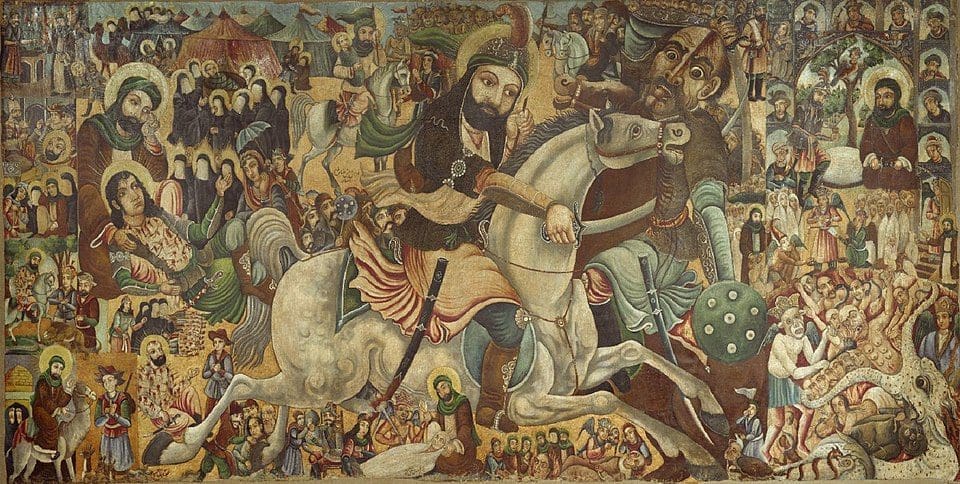
To understand why Iran’s leaders think this way, you have to understand one story. It is not a modern story. It happened in 680 CE, in the desert plains of Karbala, in what is now Iraq, and it is the emotional and spiritual core of everything.
Hussein ibn Ali was the grandson of the Prophet Muhammad. When the Umayyad caliph Yazid assumed power, Hussein refused to pledge allegiance to a ruler he considered illegitimate and tyrannical. He set out from Mecca with his family and roughly 72 companions. But Yazid’s forces intercepted the caravan before it could reach its destination. At Karbala, Hussein’s small band was surrounded by an army of thousands. The Umayyad troops cut off their access to water. For days, Hussein’s followers, including women and children, suffered under the desert sun. On the tenth day of the month of Muharram, the day now called Ashura, his companions fell one by one. His sons and nephews were killed. Finally, Hussein himself was slain and beheaded. The survivors were paraded as prisoners to Damascus.
Karbala was the event that created Shia Islam as a distinct religious tradition. Hussein’s choice — righteous death over submission to tyranny — became the paradigm through which Shia Muslims interpret history, politics, and the meaning of suffering. Every year during the first ten days of Muharram, Shia communities worldwide reenact the events in public processions, passion plays called ta’ziyeh, and rituals of mourning that have no precise equivalent in Western Christianity except perhaps the Stations of the Cross. As scholar Vali Nasr, author of The Shia Revival, has described, the attachment to the narrative of Karbala runs so deep it shapes how Shia communities understand justice, power, and the nature of history itself.
What Khomeini did in 1979 was take this ancient narrative of mourning and turn it into a call to action. Traditional Shia theology had counseled quietism: mourn Hussein, wait for divine justice, do not rebel against the powers of this world. Khomeini reversed this with a single political stroke. He called the Shah “the Yazid of our time” and told Iranians that waiting was itself complicity with injustice. The revolutionary slogan that swept Iran captured it perfectly: “Every land is Karbala, every month is Muharram, every day is Ashura.”
In that single sentence, Karbala stopped being a historical event and became a permanent condition — an eternal present that every generation of Iranians is asked to inhabit.
Dying Is Not Losing: The Theology of Martyrdom as Political Doctrine
In Twelver Shia Islam, the dominant branch practiced in Iran, there are twelve divinely appointed Imams descended from the Prophet Muhammad. The twelfth, Muhammad al-Mahdi, went into a state of “occultation” — divine hiding — in 874 CE. Believers hold that the Mahdi is still alive, sustained by God, and will return at the end of times to establish perfect justice. The present age is, in this theology, an age of patient endurance while awaiting his return.
Khomeini built his political system on this theological gap. His doctrine of Velayat-e Faqih — the Guardianship of the Islamic Jurist — holds that in the Mahdi’s absence, a senior cleric should govern the state as a kind of deputy, maintaining divine order until the Imam returns. This idea broke sharply from centuries of Shia tradition, in which senior clergy had generally steered away from direct political rule. But Khomeini enshrined it in Iran’s constitution after the revolution, fusing religious authority with state power in a way that gave the Islamic Republic a claim to legitimacy no other modern government possesses: its leader governs on behalf of the Hidden Imam himself.
This system produces a very specific understanding of martyrdom. In Shia theology, the Arabic word shahid means “witness.” To die for the cause is not to lose. It is to bear the ultimate witness to truth. The Quran promises martyrs a direct path to paradise: “Think not of those who are slain in God’s way as dead. Nay, they live, finding their sustenance in the Presence of their Lord.” This is not metaphorical decoration applied to recruitment posters. It is doctrinal conviction that fundamentally changes the cost-benefit calculus of conflict. Death in righteous struggle is victory in its truest form. The Islamic Republic institutionalized this conviction with systematic thoroughness: the Foundation of Martyrs and Veterans Affairs provides monthly stipends, housing subsidies, and priority university admissions to martyrs’ families. Streets are named after the fallen. Murals of dead soldiers cover buildings in every city. Estimates suggest that up to ten percent of children’s textbook content features themes of death and sacrifice.
When unmarried soldiers died during the Iran-Iraq War, wedding tables were set above their graves — a tradition linked to a companion of Hussein killed before his wedding at Karbala. Having a martyr in the family confers social status, even social mobility. The message is consistent and total: to give your life for the Islamic Republic is the noblest thing a person can do.
The Iran-Iraq War was the crucible that forged this doctrine from theory into lived national experience. As a December 2025 analysis in Small Wars Journal traced in detail, after Iran recaptured the city of Khorramshahr in 1982 at the cost of 30,000 casualties, the regime internalized a lesson that would define its strategic culture for decades: “Losses no longer signaled failure; they became proof of righteousness and resistance.” This was not spin. It was a genuine restructuring of what the word “victory” means.
How Theology Becomes Strategy: The Resistance Axis and Forward Defense
This worldview does not stay in the mosque. It walks directly into the war room.
Iran’s Resistance Axis — the network of allied armed groups stretching from Hezbollah in Lebanon to the Houthi movement in Yemen to Shia militias across Iraq — is not merely a strategic alliance of convenience. It is, as scholar Afshon Ostovar documents in Vanguard of the Imam, an extension of the revolutionary mission. The IRGC is constitutionally defined not as a conventional military but as an “ideological army” tasked with safeguarding and exporting the revolution. Its Quds Force built proxy forces designed as client armies in Iran’s image, bound together by the Karbala narrative: the righteous few standing against unjust power, willing to absorb punishment, treating endurance as proof of moral superiority.
Iran’s forward defense doctrine flows from the same source. The operational logic is straightforward: fight enemies as far from Iran’s borders as possible, through proxies if necessary, so that any eventual battlefield — Lebanon, Syria, Gaza, Yemen, Iraq — is never Iranian soil. But this is also justified to domestic audiences in the language of Karbala: we must confront injustice wherever it manifests, or we are complicit in it. As Chatham House analyzed in March 2026, this forward defense ultimately became “a strategic boomerang” — the same proxy network that Iran built as a defensive buffer gave the United States and Israel the justification and the targeting map for the 2026 campaign.
But the deepest strategic implication is the regime’s definition of victory itself. The framework is disarmingly simple: if the Islamic Republic still stands, then God’s will has been served, and the enemy has failed. Territory, infrastructure, even military capacity are secondary. Survival is the metric. And when that survival is achieved at great human cost, the cost does not undermine the argument — it reinforces it. The suffering proves the righteousness. The righteousness justifies the suffering.
The regime reinforces this logic with a Quranic concept called istidraj, which analysts at Georgetown University’s Institute for the Study of Diplomacy describe as “divine luring” — the idea that an adversary’s apparent victories are divine tests that will ultimately lead to the aggressor’s downfall. The enemy’s strength is itself evidence of coming judgment. When combined with sabr, the Quranic concept of patient endurance that appears over 90 times in the text, a picture emerges of a strategic culture built to outlast rather than outfight. Patience is not weakness. It is sacred discipline.
The major RAND Corporation study of Iranian strategic culture captured the paradox well: “Ideology and bravado frequently mask a preference for opportunism and realpolitik.” Iran’s leadership is not suicidal. It negotiates, maneuvers, and sometimes retreats. Khamenei himself coined the term “heroic flexibility” to justify the 2015 nuclear deal. But the regime operates within boundaries set by a theological system that treats compromise as tactical and endurance as sacred.
The Third Imposed Defense: How Iran Is Framing 2026
When Operation Epic Fury began, the regime did exactly what its theology predicted it would do. It absorbed the blow and immediately mapped it onto the Karbala narrative.
Mojtaba Khamenei, speaking on the fortieth day of mourning for his father, drew explicit parallels to the enduring spirit of Ashura. Vice President Aref invoked “Husseini Iran” — a direct reference to Hussein’s martyrdom at Karbala. The regime labeled the conflict the “third holy imposed defense,” placing it in direct lineage with the Iran-Iraq War. Across the Resistance Axis, Iranian-backed militias in Iraq and Yemen called it the “new Battle of Karbala.” Senior ayatollahs issued a fatwa calling vengeance against America “the religious duty of all Muslims.”
The killing of Khamenei himself, far from demoralizing the regime, gave it the most potent raw material its theology could ask for: a supreme martyr. State media designated his death as shahadat. Forty days of national mourning were declared. His son proclaimed that “every member of the nation who is martyred by the enemy becomes an independent case for revenge.” As The Conversation noted in its analysis of Khamenei’s death, this plays directly into Shiite Islam’s reverence for martyrs — though notably not for all Iranians, many of whom received the news with something far closer to relief than grief.
Even the ceasefire itself was claimed as victory. Press TV declared Iran had achieved a “historic victory” and that the United States had been “forced to accept Iran’s proposal.” These claims were, by any independent assessment, substantially overstated. Small Wars Journal’s analysis of the coercive architecture of the campaign placed the outcome firmly in Washington’s favor militarily. But the regime’s domestic audience was not evaluating the claims by the standards of Western fact-checking. It was hearing them through the Karbala filter: we suffered, we survived, therefore we prevailed.
Al Jazeera’s analysis of the conflict identified the central irony: “In a secular strategic imagination, violence weakens by destroying capacity. In a political-theological imagination, violence can strengthen by confirming sacred purpose.” By striking Iran hard enough to wound it but not hard enough to collapse it, the United States and Israel may have, paradoxically, handed the regime the narrative of Karbala reborn.
The Problem Western Policymakers Cannot Solve
The strategic implication of all this is not that Iran is invincible. It plainly is not. Its military was devastated, its infrastructure damaged, millions of its citizens displaced. The regime faces ongoing internal opposition, economic collapse, and a shattered proxy network. It is weaker by any material measure than it was on February 27, 2026.
But material measures are not the only ones that matter. As Time magazine observed in March 2026, the Islamic Republic is “ideological” in a way that distinguishes it from ordinary authoritarian states. A kleptocracy can be bought off. A secular dictatorship can be deterred by the credible threat of destruction. But a system that has theologically encoded suffering as proof of righteousness — that venerates a seventh-century grandson of the Prophet who chose annihilation over submission — does not respond to pressure the way Western deterrence theory assumes it should. Pressure does not weaken the narrative. It feeds it.
The Georgetown analysts put it plainly: “Iran is not irrational. It is rational according to different logic.” This does not mean diplomacy is pointless. Iran has shown, repeatedly, that it can negotiate when the costs of confrontation become unbearable. Khomeini’s “poisoned chalice” in 1988 proved that. The 2015 nuclear deal proved it again. The regime’s theology makes room for tactical retreat. “Heroic flexibility” is a real doctrine. But any strategy premised on the idea that sufficient force will compel Iran to capitulate or abandon its self-understanding is operating on assumptions the Islamic Republic does not share.
And this is the challenge that outlasts any single military campaign. As analysts writing on Iran’s Mahdist ideology and the 2026 conflict have argued, the eschatological framework means that the regime can genuinely interpret every catastrophe as a step toward ultimate vindication. The Mahdi is coming. The present suffering is the proof. The enemy’s power today is the precursor to the enemy’s judgment tomorrow.
You cannot bomb a country into abandoning a 1,300-year-old story about the meaning of suffering. And as long as the Islamic Republic can point to its own survival — however damaged, however diminished — it will stand in front of its people and say what it has always said, in the language of Karbala: we are Hussein. They are Yazid. We are still here. The story always ends the same way.
Key Sources and Further Reading: Iran’s Memory of War, Foreign Affairs • From Khorramshahr to Hezbollah, Small Wars Journal • Iranian Strategic Culture, RAND Corporation • Iran’s Forward Defence, Chatham House • Operation Epic Fury, CSIS • Iran’s Strategic Decision-Making, Georgetown ISD • War and Eschatology: Iran’s Mahdist Ideology, Hungarian Conservative • Vali Nasr, The Shia Revival (W. W. Norton, 2006) • Afshon Ostovar, Vanguard of the Imam (Oxford University Press, 2016)


