


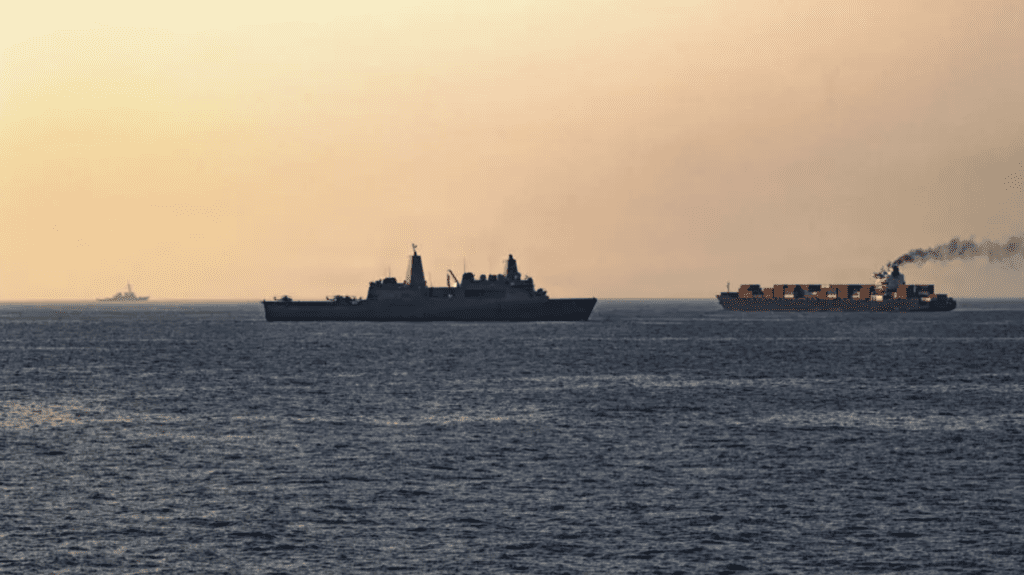
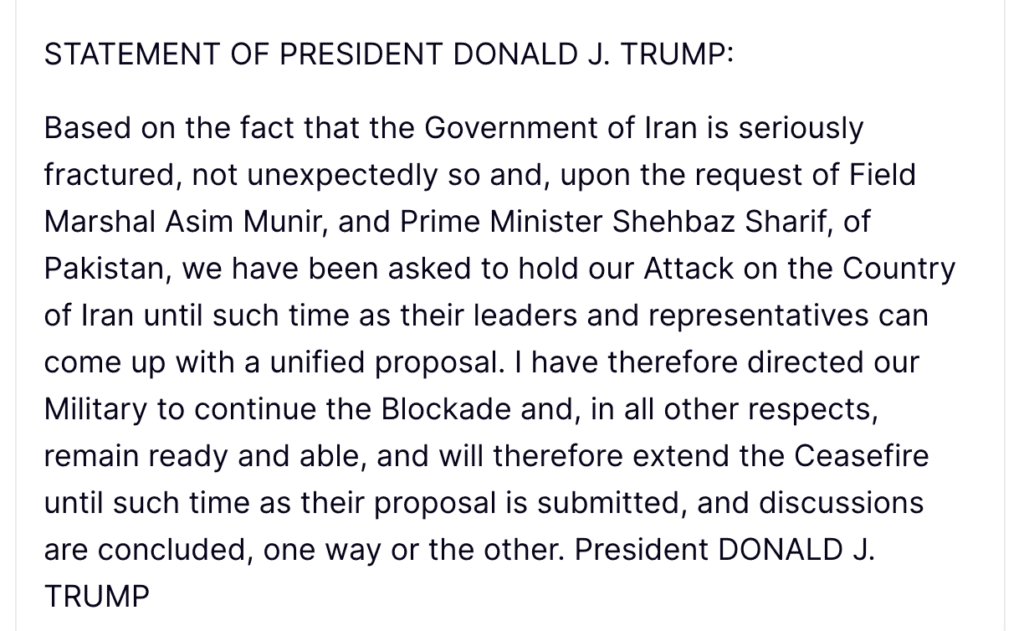
The Trump administration extended the ceasefire indefinitely on April 21, 2026, while keeping the US naval blockade of the Strait of Hormuz in place. This quiet decision may prove to be the most lethal coercive move ever made against the Islamic Republic, precisely because it is not a war.

THE MIDDLE EAST – Since CENTCOM’s naval cordon took effect on April 13, Iranian seaborne exports have collapsed from roughly 1.85 million barrels per day to near zero. The regime is hemorrhaging an estimated $400 to $500 million per day in lost oil revenue. This is more dangerous than open war because it strips Tehran of the “Sacred Defense” rally narrative that kept it alive through the 1980s, the 2018-21 maximum pressure campaign, and the Twelve-Day War of June 2025, while sharpening the physical strangulation that active combat never delivered.
The historical template is Imperial Germany in 1918, when the Allied blockade continued through the armistice and helped produce revolution within weeks. Iran enters this phase with a decapitated leadership, nationwide unrest across all 31 provinces, and a proxy network in ruins. It looks structurally weaker than Wilhelmine Germany did in November 1918.
An Economy Built on a Single Chokepoint
Roughly 80% of Iran’s oil exports and over 85% of all seaborne trade transit through or past the Strait of Hormuz.[1] The only bypass, the Goreh-Jask pipeline, carries about 300,000 bpd and terminates inside CENTCOM’s intercept zone. Under a physical blockade, it is useless.
Oil and gas generate about 25% of GDP, 57% of export earnings, and roughly half of the state budget.[2] The IRGC’s Khatam al-Anbiya conglomerate and the bonyad foundations control 30% to 50% of the economy and process about half of all oil exports through opaque front entities. This blockade is not merely a fiscal shock. It is a direct strike on the patronage machinery that purchases elite loyalty.
The baseline was already catastrophic. The IMF projects a 6.1% GDP contraction for 2026, the largest downward revision of any country. Inflation hit 68.1% in February, the highest since the Second World War, with food inflation at 105%. The rial has cratered from 1,420,000 to the dollar before the war to as low as 1,750,000 on the black market.[3] Reserves sit near $34 billion, with another $100 to $120 billion frozen abroad.[4]
The critical clock is reservoir damage. Iran has roughly 90 million barrels of onshore storage, enough for two to three months of continued production without exports before operators must shut wells in. Extended shut-in risks permanent reservoir damage through water coning and formation compaction, a once-in-a-generation loss.[5] Beijing’s own strategic petroleum reserves mean China can comfortably wait Iran out.[6]
Why Ceasefire Plus Blockade Is Worse Than War
The Islamic Republic’s most reliable political tool since 1980 is converting external pressure into domestic solidarity. The eight-year war with Iraq produced the Sacred Defense narrative that legitimized the revolution, built the IRGC and Basij, and gave every subsequent crisis a framework of martyrdom and foreign aggression.
A ceasefire breaks that frame. When Israel stops bombing and the US stops striking, the regime can no longer tell Iranians that empty shelves are the price of resistance. As TIME reported, analysts noted the regime’s legitimacy is more fragile than ever. By December 2025, protests had spread to all 31 provinces with chants directly repudiating Sacred Defense logic.[7] Khamenei’s attempt in January 2026 to rebrand domestic unrest as a new phase of the war was, Israeli ICT analysts note, a tacit admission that the regime needs active war to mobilize.
The blockade also closes the escape hatches that sustained Iran through the first-term maximum pressure. Between 2018 and 2021, Iranian exports fell from 2.5 million bpd to under 400,000 bpd, yet rebounded to 1.38 million bpd to China by 2025 via a dark fleet of roughly 400 tankers using AIS spoofing, ship-to-ship transfers, and Chinese teapot refineries outside the dollar system.[8] That architecture defeats financial sanctions. It cannot defeat sixteen US warships and the rules of engagement demonstrated in the April 19 seizure of the M/V Touska.
Compare the negative cases. Saddam survived 13 years of near-total embargo. Cuba weathered 60 years. Venezuela lost 80% of GDP and 7.7 million emigrants but Maduro held power. In every case, the regime retained a physical trade valve: smuggling routes, tourism, continued oil flow. A Hormuz blockade denies Iran that valve entirely. There is no Iranian equivalent of the 38th parallel.
How Iran Could Collapse
Iran enters the blockade with a succession crisis unseen since 1979. Operation Epic Fury killed Supreme Leader Khamenei, IRGC commander Pakpour, Defense Minister Nasirzadeh, and Chief of Staff Bagheri.[9] The Assembly of Experts, under IRGC pressure, elevated Mojtaba Khamenei as Supreme Leader on March 9. He has not appeared in public, is reportedly wounded, lacks senior religious credentials, and is widely rejected by the reformist camp and much of the clerical establishment.[10]
The December 2025-January 2026 protest wave, triggered by bazaar strikes in Tehran and spreading to all 31 provinces and over 280 locations, was met with the deadliest crackdown in modern Iranian history. The UN documented at least 5,000 killed, possibly up to 20,000.[11] Bazaari defection is the historically decisive signal. The merchant class’s withdrawal of support toppled the Shah in 1979, and the regime has already paid that cost.
The blockade compounds the pressure on multiple fronts. Iran’s wheat harvest came in 12% below the five-year average. The country depends on $1.9 billion annually in pharmaceutical imports, with cold-chain products like vaccines, insulin, and oncology drugs the first to fail when maritime imports stop.[12] The IRGC’s patronage machine runs on oil revenue. Cut the hard-currency inflows and the Guards must either print rials, accelerating hyperinflation toward the 3,000% range some economists have warned about, or cut loyalist living standards.[13]
The proxy network is in terminal decline. Hezbollah was decapitated in late 2024, Assad fell in December 2024, senior Houthi leadership was killed in August 2025, and Quds Force cash transfers have been choked off.[14] Without Iranian financing, only the self-sufficient Houthis survive independently. Meanwhile, Kurdish armed factions have issued joint strike calls, Sistan-Baluchestan and Khuzestan remain volatile, and Iran ranks first globally in brain drain, losing 150,000 to 180,000 skilled emigrants per year.[15]
Iran’s Counter-Options Are Narrower Than They Appear
Physical alternatives do not exist at scale. The Goreh-Jask pipeline sits inside the intercept zone. The Iraq-Turkey pipeline has been suspended since 2023. The Iran-Pakistan pipeline remains unbuilt on the Pakistani side. The North-South Transport Corridor’s critical rail link is not scheduled to open before Q3 2027 and cannot handle the volume Iran needs to replace Hormuz.[16]
Financial workarounds extend survival time without breaking the blockade. Iran’s crypto ecosystem processed $7.78 billion in 2025.[17] CIPS and digital-yuan pilots provide some settlement capacity outside SWIFT. But cryptocurrency can move money. It cannot import wheat or insulin.
China is not rescuing Iran. The Russia-China veto of the April 7 UNSC Hormuz resolution was political cover, not a military commitment.[18] No serious analyst expects China to escort Iranian tankers. Beijing can substitute Saudi and Russian barrels at a modest premium. The more likely Chinese move is pressure on Tehran to settle.[19]
Asymmetric military escalation is Iran’s only real lever, and it is self-defeating. The tools are real: mines, coastal missiles, midget submarines, fast-attack craft, and Shahed drones. CSIS identifies Houthi reactivation of Bab al-Mandab attacks as Iran’s key remaining card.[20] But every one of these moves invites resumption of the air campaign, with Iran’s air defenses and senior leadership already degraded. Escalation converts blockade back into war, and war is the one scenario where the regime’s rally narrative works again. Washington knows this. That is why the ceasefire was extended.
The Pincer the Regime Cannot Escape
A renewed war would hand the regime its most valuable political asset: a framing of national sacrifice that has extended the Islamic Republic through every previous crisis. The ceasefire-plus-blockade configuration does the opposite. It inflicts compounding, irreparable economic damage while denying the regime the mobilizing narrative that makes Iranians willing to endure it.
Two caveats remain. Regimes under extreme pressure more often survive than collapse. Saddam, the Kims, Maduro, and the Castros all demonstrate that coercion plus patronage plus a tolerant great-power neighbor can absorb enormous economic pain. And the humanitarian cost will be severe, disproportionately borne by ordinary Iranians, generating real moral pressure on Washington to relent.
But the decisive variable is relative, not absolute. Compared to resuming the war, the indefinite ceasefire plus blockade makes collapse more likely, not less, because it denies the regime the one narrative that has kept it alive through every previous squeeze. Tehran’s April 21 demand to lift the blockade first and negotiate second is a confession of its own strategic logic. The regime understands, more clearly than most outside observers, that it can survive another war but probably cannot survive another quarter of this.


