FAYTUKS NETWORK | October 13, 2026
As the Iran-backed Houthis continue their advance toward the encircled city of Taiz against Yemen’s internationally recognized government forces, a parallel front against Saudi Arabia has witnessed devastating scenes, with hundreds of civilians targeted last week. With Yemen’s third-largest city effectively besieged and Saudi aviation severely disrupted, Riyadh’s next move could prove decisive in shaping the trajectory of Yemen’s internal conflict, threatening to ignite a powder keg that has lain dormant for months.
Entangled in a full-blown, decade-old civil war, Yemen crumbled under the clash of vastly differing ideologies, while the nation’s trajectory was dictated almost entirely by the ambitions and foreign policies of its neighbors. In essence, while foreign intervention accelerated Yemen’s demise, the conditions for catastrophe were in the making long before the involvement of external actors like Iran’s IRGC, Riyadh, and Abu Dhabi. In 1992, the roots of the conflict emerged when Ansar Allah, more commonly known as the Houthis, was founded in Saada. At first, the group was less an organized insurgency than a movement resisting Yemen’s regime amid deteriorating living conditions and defending Zaidi Shiites against discrimination. Surfacing as a social-oriented movement, the Houthis rapidly garnered support from opposition voices, propelling their swift gains and eventually bringing down Ali Abdullah Saleh’s government, which was widely condemned for systemic corruption and human rights violations.
For years on end, the Houthis rode the revolutionary wave of the 2011 Arab Spring, first taking complete control over Saada, and then helping oust Saleh’s government as part of a broad anti-government coalition composed of Islamist factions and nationalists protesting Western influence, rampant unemployment, soaring prices, and widespread food insecurity. Although Yemen’s authoritarian regime was dismantled and initial momentum stalled, 2014 marked a turning point as a localized insurgency transformed into a full-scale civil war spanning the entire country. Triggered by severe fuel shortages, popular protests erupted anew, and violent clashes with government forces took center stage. Meanwhile, the Houthis — armed and backed by Iran during this interim period — moved swiftly, seizing much of the northwestern countryside and, most significantly, the capital city of Sana’a, which became Ansar Allah’s central operational hub and the de facto capital of Houthi-controlled Yemen.
Following the fall of Sana’a under the presidency of Mansour Hadi, who had assumed office in 2012 after Ali Abdullah Saleh’s resignation, the Houthis acted quickly to consolidate political and military power across their newly acquired territories, negotiating with local tribes and former Arab Spring factions. Meanwhile, President Hadi attempted to push through a new federal constitution and foster national reconciliation. However, these efforts collapsed in early 2015 when the Houthis rejected the draft constitution, placed Hadi under house arrest, and dissolved his government. Forced to retreat to Aden, the remnants of Yemen’s internationally recognized government began mobilizing loyalist forces to counter expanding Houthi influence in northwestern Yemen.
Alongside the Aden-based government’s initiative to rally loyalists under a single banner, Riyadh and Abu Dhabi also intervened, though both states harbored vastly different strategic objectives while backing Hadi. That same year, as Yemen’s government was forced to relocate to Aden, a Saudi-led coalition was formed to eradicate Houthi influence. Nonetheless, coalition members were far from aligned on this core objective. Riyadh viewed the Houthis as a direct threat to Saudi sovereignty, citing their integration into Iran’s proxy network and potential to act on Tehran’s orders. Abu Dhabi, in contrast, was less focused on the immediate threat posed by the Houthis and more interested in shaping Yemen’s south to secure its own strategic interests by backing cooperative local factions. These divergent goals quickly manifested in a rift, resulting in a fragmented counter-campaign that often saw coalition-backed factions turning their weapons against one another rather than presenting a unified front.
Among anti-Houthi factions, the Southern Giants Brigades stand out as one of the most formidable forces on the ground. Equipped with heavy weaponry, backed by UAE funding and tactical advice, and fueled by a large contingent of Salafi fighters, the group has secured major victories against Ansar Allah since 2015, most notably breaking the Houthi siege of Aden. Over the years, the Giants Brigades mirrored the Houthis by heavily investing in offensive capabilities and incorporating hard-won battlefield experience into their tactics. In 2017, two years after defending Aden, the group launched a full-scale offensive along Yemen’s western coast to liberate the littoral zone. Their advance pushed deep into Houthi territory before halting outside the Red Sea port city of Hodeidah, the country’s primary lifeline, handling nearly 80 percent of imported food, fuel, and medical aid, following a UN-mediated ceasefire between the Aden government and Houthi-led Sana’a. While originally aligned with the Southern Transitional Council (STC) and committed to an independent South Yemen, the group’s secessionist ambitions gradually shifted after gaining a seat on the Presidential Leadership Council (PLC) in 2022. Following the formal dissolution of the STC in early January, the faction fully committed to a unified front against Ansar Allah.
Another dominant faction in Yemen’s civil war was the STC, a political organization and secessionist force also backed and funded by the UAE, with a primary objective aligning closely with the Southern Giants Brigades: achieving independence for South Yemen. Similar to Yemen’s other anti-Houthi armed groups, STC forces skirmished regularly with Houthi troops along the mountainous border regions of Lahj and Abyan, though the fronts remained locked in a stalemate with back-and-forth advances. Unlike the Southern Giants Brigades, however, the STC heavily relied on a combination of political leverage and military pressure to gain the upper hand over the PLC and force the Aden government into granting southern sovereignty. Subsequently in 2025, as the rift between Riyadh and Abu Dhabi widened, the STC launched a major offensive, retaking much of the former territory of South Yemen from PLC control. Although the offensive was initially heralded as a breakthrough for the separatists, a subsequent counter-push by the PLC, backed by Saudi airpower, erased all the STC’s gains. Just months later, in early January, the STC formally dissolved after losing virtually all its territory, eroding Abu Dhabi’s influence in Yemen and leaving Riyadh as the sole dominant external player orchestrating opposition forces.
Caught between the aggression of the STC and Ansar Allah, the PLC rose to prominence in 2022 when Mansour Hadi transferred his executive powers to an eight-member council, whose chairman holds supreme authority over Yemen’s government forces and the power to appoint or dismiss high-ranking officials. The PLC’s origins can be traced back to 2015, when Hadi was forced to relocate his government to Aden, where the seeds of a new governing apparatus were sown. Today, the Riyadh-backed PLC and the Southern Giants Brigades remain the primary active actors on the ground, resupplied by coalition allies and supported by Saudi air sorties targeting strategic Houthi positions.
Yemen’s descent into a theater for Gulf rivalries presented Ansar Allah with an unprecedented opportunity. Unimpeded by “unified” opposition, the group forged a war economy driven by smuggling, taxation, foreign support, and state-monopolized enterprises across its territory. This economic base enabled the Houthis to develop a domestic arms industry, a critical milestone in their evolution from an unorganized militia into a structured armed force combining conventional tactics, a clear command hierarchy, and asymmetric warfare experience that proved pivotal to their longevity. As a result, the group could adapt rapidly on the battlefield and reorganize even if its central military leadership were targeted. Eventually, Riyadh’s assessment that the Houthis posed a direct threat to the Kingdom proved accurate as the group achieved significant operational autonomy, even while maintaining overarching alignment with Tehran.
On the ground, the Houthi advance continues toward Taiz’s urban center, with the fortified position of Al-Misrakh on the outskirts reportedly falling to the insurgents. Despite the Houthis inching closer, PLC forces carried out four strikes in Al-Dhabab and another five in Al-Misrakh on Tuesday, targeting Houthi personnel, equipment, and vehicles. At the same time, PLC media in Taiz reported that an effort to push back Houthi forces along the Al-Shaqab front is underway. The Aden government has not yet commented on the situation in Taiz, and casualties on both sides remain unconfirmed. While the situation in Al-Misrakh remains obscured by the fluid nature of the conflict, if the position has indeed fallen to Ansar Allah, there remain only a few PLC-held mountaintop positions overseeing the city, leaving no major garrison beyond the forces defending Taiz itself.
Simultaneously, as the Houthis harden their siege on Taiz, Yemen’s Southern Giants Brigades and PLC forces are pushing along the Bab el-Mandeb Strait to retake the fallen coastal districts of Mocha and Dhubab, with clashes concentrated around Dhubab’s strategic airport. Mocha — a major military hub and coastal port situated near the Bab el-Mandeb — gives any controlling faction a decisive advantage, especially given Iran’s blockade on the vital maritime chokepoint of the Strait of Hormuz and Gulf nations redirecting their energy exports. Similarly, the coastal town of Dhubab holds immense strategic weight, functioning as a vital supply hub stretching across Yemen’s rural interior and connecting directly to Taiz. Whether government forces retake the two key coastal hubs before the Houthis capture Taiz remains an open question, but what is certain is that both sides are racing against time to consolidate gains and deliver a crippling blow.
What is currently unfolding in Yemen threatens to dismantle what little legitimacy the Aden-based PLC still retains. The fall of Taiz into Houthi hands would not only embolden Houthi fighters and demoralize coalition-backed forces, but it would also deprive the PLC of one of its last three urban strongholds, leaving only Marib and Aden under government control. Compounding this loss of territorial control, the impending displacement of more than one million residents from Taiz threatens to cripple the PLC’s governance, a humanitarian influx that neither Marib nor Aden can absorb, as both cities are already overwhelmed by earlier waves of displaced Yemenis fleeing Houthi-controlled northern territories. Encircled by Houthi forces, Taiz faces an acute crisis, as the city has nearly exhausted its fuel and medical stocks, disabling hospital generators and paralyzing basic healthcare services, according to local health officials.
The parallel front opened against Saudi Arabia witnessed dramatic scenes over the course of the week. After declaring a blockade on the Kingdom’s airspace, Houthi forces began directly targeting airports across Saudi Arabia with precision-guided ballistic missiles. In response, Saudi-led coalition forces retaliated against Houthi-controlled oil fields, ballistic missile launch sites, and hundreds of positions in the occupied city of Sana’a, ranging from warehouses and checkpoints to production facilities. As the threshold for escalation rose, the Houthis diverted significant resources to the Saudi front, resulting in hundreds of casualties across the Kingdom and prompting foreign embassies, including those of the U.S., Canada, the UK, and Australia, to issue urgent travel advisories warning against non-essential travel.
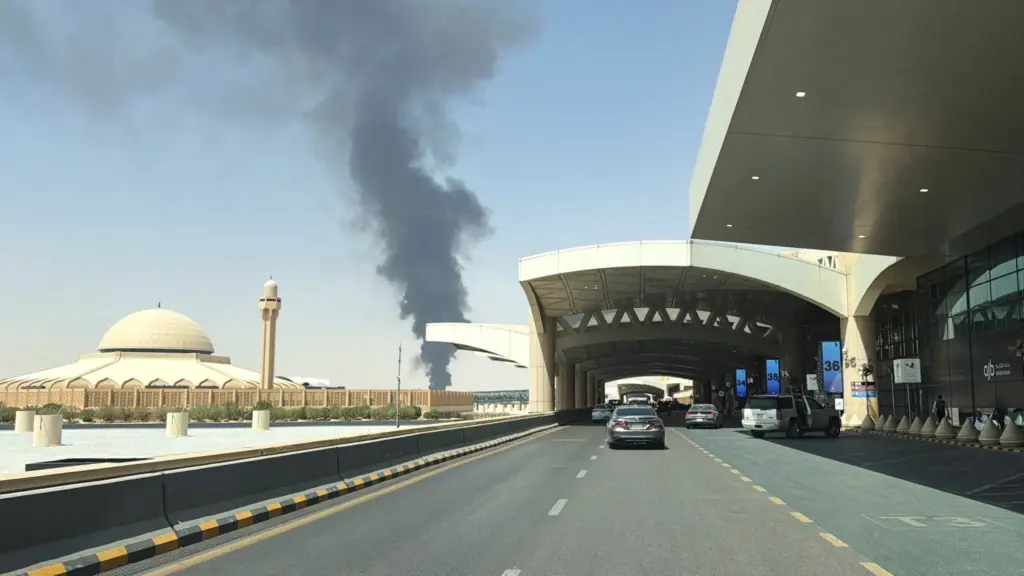
The previous Tuesday saw the first barrage of ballistic missiles targeting Saudi territory, with strikes on the airports of Najran and Jazan leaving three people wounded. Over the following days, Houthi forces escalated the intensity of their attacks, inflicting hundreds of casualties. October 7 and 8 brought back-to-back strikes on Saudi Arabia’s King Khalid International Airport, leaving six people dead, including a commercial airline pilot, and more than 30 injured. Plumes of smoke rose from the tarmac after a Houthi missile struck a commercial airliner, rendering the aircraft inoperable and killing its pilot. On October 10, the group executed one of the deadliest strikes on Saudi soil since the 2015 mosque bombings when a missile hit Terminal 3 at King Khalid International Airport, killing 13 people and injuring more than 300 domestic and foreign travelers. CCTV footage released by Saudi state media showed that among the casualties were travelers wearing pilgrimage attire as they prepared to board flights back home. Houthi military spokesperson Brig. Gen. Yahya Saree claimed responsibility for the attack, warning that their response would continue to intensify if the Saudi-led coalition persists in pushing back Houthi forces in Yemen.
Condemnations followed shortly after the Houthi strike on King Khalid International Airport, with UN Secretary-General António Guterres denouncing the attack in a statement, declaring, “These attacks must cease immediately.” In a joint statement reinforcing the UN’s warning, Egypt, Pakistan, and Türkiye, three of the four regional powers comprising the R4 group alongside Saudi Arabia, reaffirmed their solidarity with the Kingdom on Sunday, describing the attack as a “dangerous escalation that cannot be justified or accepted under any pretext.” Coalition forces vowed to retaliate following the strike that left hundreds injured, initiating air raids against Ansar Allah’s energy infrastructure. The initial strikes targeted the Yemeni Oil Company in Houthi-controlled Dhamar, alongside unconfirmed reports of Saudi airstrikes hitting the Al-Sabaha oil facility in Sana’a earlier Tuesday.
As both sides continue to climb the escalation ladder, setting aside diplomatic resolution in a bid to neutralize each other’s regional influence, Yemen remains a powder keg on the verge of ignition. A renewed, full-blown conflict threatens to emerge — reminiscent of the opening phase of the U.S. campaign against Iran — where critical civilian infrastructure is treated as a legitimate target, human lives are discarded, and both belligerents engage in a relentless cycle of violence for gains across Yemen’s scorched chessboard.