




Drone from Iran downs US Army helicopter in Strait of Hormuz
- The downing of an Army Apache over the Strait of Hormuz — hours after Iran declared a halt to its operations — set off American strikes, Iranian retaliation across three Gulf states, and a question neither government can answer in public.
- By Ethan E
- • June 11 2026
- •
- 6 minutes
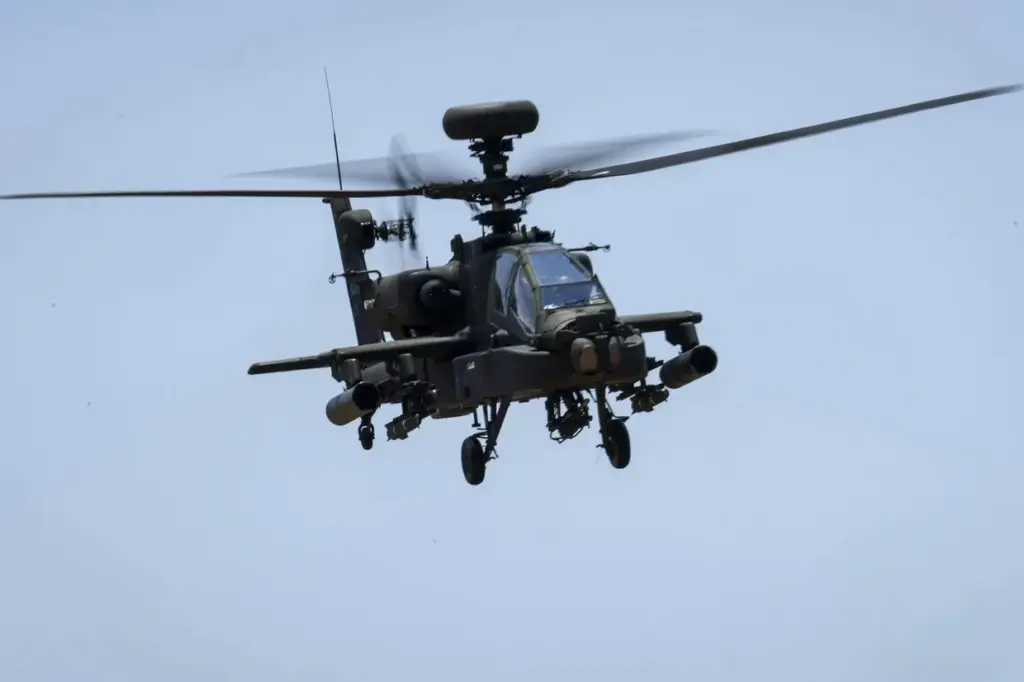
- A U.S. Army Apache helicopter on May 26, 2016. Photo via WDEF-TV / CBS.
For roughly two hours early Tuesday morning, Gulf time, two American soldiers floated in the dark waters off the coast of Oman, their AH-64 Apache attack helicopter somewhere beneath them.
What found them first was a machine.
A Saronic Corsair — a 24-foot unmanned boat operated by Task Force 59, the Navy’s experimental drone unit in Bahrain — located the two crew members and pulled them from the sea at 7:33 p.m. Eastern on Monday, according to United States Central Command. A command spokesman called it the first time maritime drones had performed such a rescue in a real-world operation.
What brought them down, US officials say, was also a machine: an Iranian Shahed drone.
This is plausibly the first air incident in history in which unmanned systems both downed an aircraft and rescued its crew — machines at either end, two human beings treading water in between. That alone should earn June 8 a place in military history. Yet the drones aren’t even the most consequential part of the story.
Monday, June 8th. The day began as an exercise in de-escalation. A weekend of Hezbollah rocket fire, Israeli strikes on Beirut’s southern suburbs, an Iranian ballistic missile salvo — Tehran’s first against Israel since April—and Israeli strikes on Iran had pushed the cease-fire to the edge. Trump posted early Monday that both sides wanted the fighting stopped immediately. Minutes later, Iran’s joint military command, Khatam al-Anbiya, declared a halt: “The cessation of armed forces operations is announced.” The declaration carried a condition, reported by The Times of Israel: that Israel end its attacks, including in southern Lebanon.
The condition did not survive the hour. Israeli aircraft struck the southern Lebanese city of Tyre less than an hour later, killing five people according to Lebanon’s Health Ministry. Iran’s missiles stayed in their silos; its civil aviation authority reopened the country’s airspace instead.
Then, at roughly 5:30 p.m. Eastern — a figure derived from CENTCOM’s own timestamps, which place the rescue at 7:33 p.m., about two hours after the aircraft went down — the Apache was hit. The downing came some six to eight hours after Iran’s military command publicly declared its operations over.
The critical question becomes: what was that drone doing there? There are three broad possibilities, and none of them are comfortable.
The first is that the strike was ordered — that Tehran declared a cessation in the morning and deliberately downed a manned American aircraft in the evening. There is precedent for fire during the cease-fire; Revolutionary Guards naval forces targeted American destroyers in the strait as recently as May 7. But deliberately destroying a manned aircraft hours after a cessation declaration would be a different category of act, and it would give operational weight to a statement made that very morning by Iran’s parliamentary speaker, Mohammad Bagher Ghalibaf, who declared that American and Israeli assets in the region had become “legitimate targets,” according to CNBC. On this reading, the declaration found its target within hours.
The second reading is, in some ways, more unsettling: the strike was real but unordered — a local operator or an autonomous system engaged an American helicopter at precisely the moment Iran’s leadership was trying to stand its forces down. Iran has saturated the Gulf with unmanned systems since the war began in February. If those systems cannot be relied upon to hold fire during Tehran’s own announced cessations, then what, exactly, is Iran’s signature on a cease-fire worth? The problem wouldn’t be bad faith. It would be bad command and control. And for negotiators, that should be scarier than deliberate escalation, which at least implies someone is steering.
The day before the downing, Trump told NBC’s “Meet the Press” that he did not consider American troops in the region to be in danger: “We have the best offense anyone’s ever seen.” Within roughly 30 hours, two of those troops were in the water. The Apache, conducting combat air patrol (CAP), changed its position, because the asset that was hit belonged to the force he commands. Central Command began what it called self-defense strikes against Iran at 5 p.m. Eastern on Tuesday, describing the mission as “a proportional response to unjustified Iranian aggression.” The official target set is the tell: air defenses, ground control stations, surveillance radar — the infrastructure that flies and guides drones.
The observed geography, however, ran wider than the official framing. OSINT sources tracked three distinct American waves — the first along Iran’s coast between 5 and 6 p.m. Eastern, a second around 7:20, and a third near 8 that reached into western Iran — plus a strike around 5:35 on a communications tower in Kashan, deep in central Iran and a long way from the strait CENTCOM’s statement emphasized. Iranian media, for their part, reported explosions on Qeshm Island and around Bandar Abbas, Sirik and Jask; outlets in Hormozgan said water-storage tanks in Sirik were destroyed, cutting drinking supplies. And one item in the open-source record deserves particular attention: three explosions were reported in Kerman, central Iran, around 3:45 p.m. Eastern — more than an hour before CENTCOM’s announced start time. Preliminary reporting from Faytuks Network identifies the target as a radar site. If that holds, the anomaly resolves into something more pointed than mystery. Striking radar first is textbook suppression-of-air-defenses sequencing: blind the early-warning network, then send the strike waves. A radar in Kerman, hundreds of kilometers from the strait, watches Iran’s central corridor — the approach paths to sites hit in later waves of the attack. Which would mean the operation’s first act came before its announced start time, and the “proportional response” began by switching off the lights — possibly in preparation for operations beyond the ones announced.
Iran’s answer came before dawn Wednesday, and it traced the outline of a new deterrence doctrine: strikes near the strait will be answered not at the strait, but across the breadth of the Gulf. Nor was it a single salvo. OSINT sources count successive waves through the night — at least three separate missile-and-drone attacks on Bahrain, home of the U.S. Fifth Fleet’s headquarters, two on the Ali Al Salem base in Kuwait, and a ballistic missile attack on the Azraq base in Jordan — alongside Iranian claims, unverified, of downing at least two American drones. The Revolutionary Guards put their total at 21 targets, including what Iranian state television claimed were shelters housing F-35s, another unverified claim. Jordan said it intercepted five missiles without casualties; a US official told The New York Times that nearly all the projectiles were intercepted and no Americans were hurt. The wave structure matters: this was not a token volley fired for optics, but a sustained, hours-long demonstration that was nonetheless engineered to be intercepted. Pressure without bodies, built to leave the off-ramp open.
By Wednesday morning, both militaries were signaling that the round was over. The president wasn’t. Trump continued to warn that Iran would pay a price for taking too long to negotiate a deal he has spent weeks calling imminent; Tehran’s spokesman said Iran would now “reassess” talks with the United States, per ABC News, while Israel struck Tyre yet again overnight. And just hours ago, Trump said on live television that American strikes on Iran would continue today.
Two soldiers are home safe, lifted from the night ocean by a machine. We were told the machines would make war more precise. What this week showed is that they’ve made it more ambiguous — and ambiguity, in skies this crowded, is its own kind of trigger.
More Stories
from the Faytuks Newsroom.
Share this Story
From Faytuks Network

Saudi air defenses intercept and destroy a Houthi drone attempting to enter restricted airspace over Mecca, coalition says.
The aircraft was downed south of the holy city at 18:50 local time Tuesday. Spokesman describes it as the second such attempt after a 2017 ballistic
Several explosions were heard on Iran's Qeshm Island, with local sources saying the sounds came from the sea, according to IRNA
Support Faytuks Network
Faytuks Network is built by volunteers and powered by its community. Contributions help cover the hosting, security and infrastructure costs that keep the site running. Plus, exclusive Discord and X benefits!
Contribute




No comment yet, add your voice below!