THE MIDDLE EAST, Apr. 20 – With a fragile two-week ceasefire between Iran and the United States still largely holding, much of the Middle East has been given brief and uneasy relief from a campaign of Iranian strikes that reached across the region. From the outbreak of war on February 28th until the ceasefire in principle took effect on April 8th, Iran carried out sustained waves of missile and drone attacks against both military and civilian targets, leaving governments across the region bracing for the possibility of further escalation. Reporting on April 20 indicates the ceasefire remains in place but under growing strain, with the agreement set to expire on April 22.
In a retaliatory campaign Tehran dubbed “Operation True Promise IV,” Iran launched thousands of missiles and unmanned aerial vehicles toward the territory of sixteen different countries, as well as foreign military facilities in five others, according to the attack data compiled by the Faytuks Network Intelligence Team. The scale of the barrage underscored how quickly the conflict widened, with the target package eventually including energy and water facilities, airfields, military compounds, port infrastructure, and other strategic sites that both provide regional security and power the global economy.

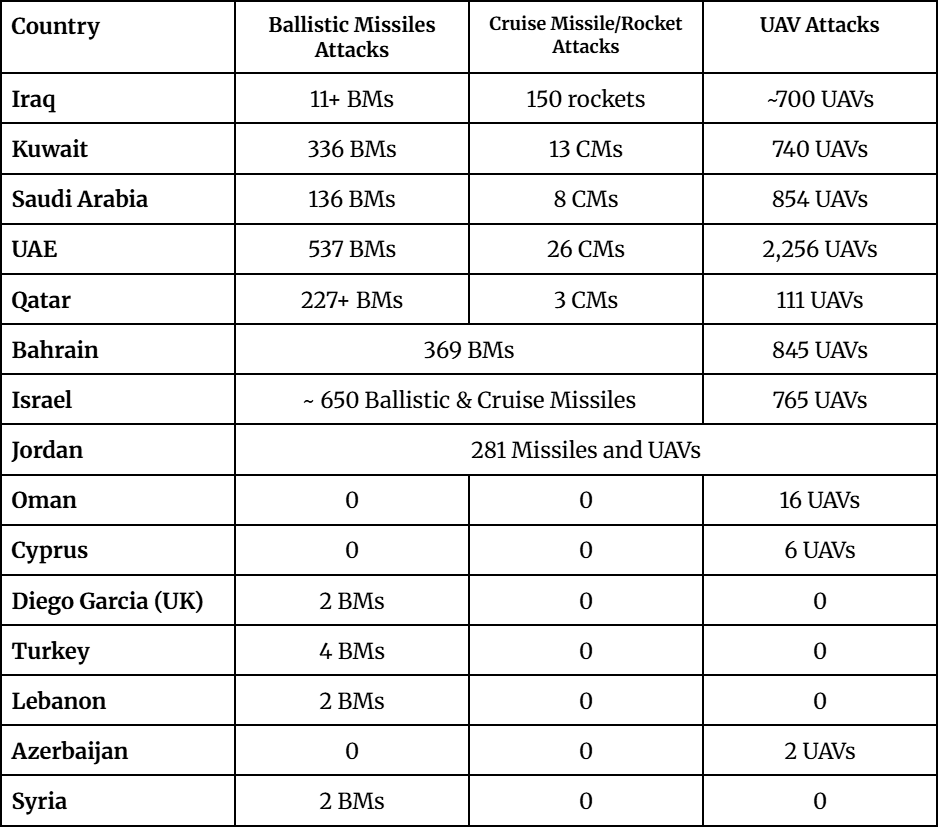
The table shows the UAE absorbed by far the largest volume of Iranian attacks, including 537 ballistic missiles, 26 cruise missiles and 2,256 UAVs, making it the most heavily targeted country in the dataset. It was followed by Israel, Bahrain, Saudi Arabia, Kuwait and Qatar, underscoring that the main weight of the campaign fell not just on Israel, but across Gulf states central to regional military posture and energy infrastructure.
The result was a first round of war that did not remain confined to Iran, Israel, or U.S. forces alone. It became a regional contest fought in the skies above multiple states, with drones and missiles negating the protectiveness often provided by distance and straining the neutrality of the Gulf states. Both military bases and civilian infrastructure all emerged as part of the battlespace, while the wider petro-economy was thrown into renewed uncertainty. Even with the cease fire in effect for now, the strategic aftershocks of that first phase are still being felt.