


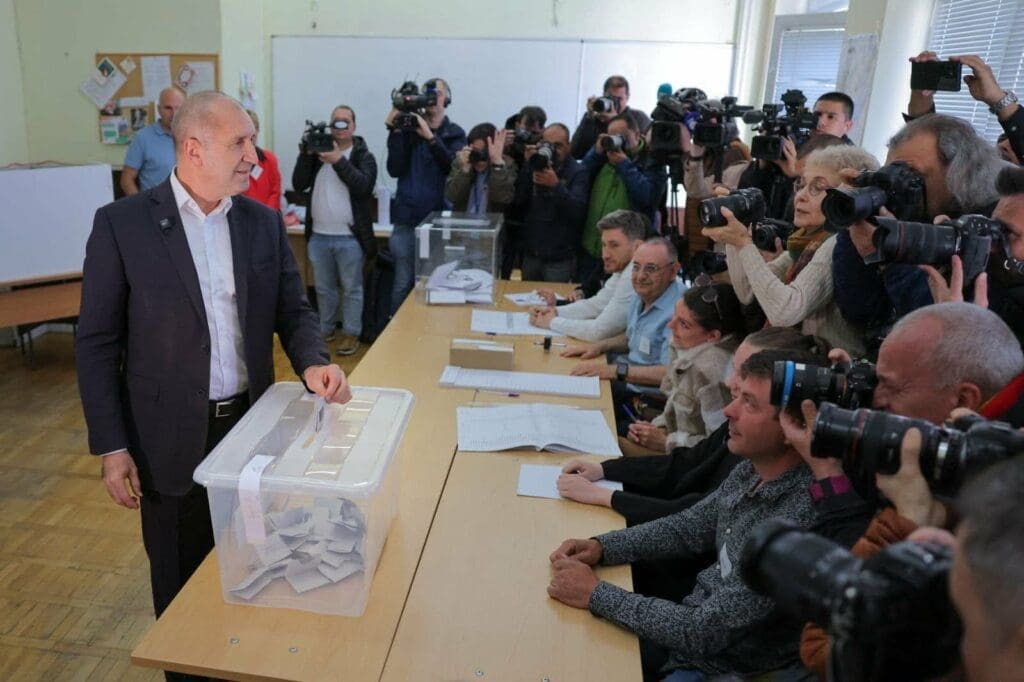
Bulgaria held its eighth consecutive parliamentary election since 2021 on Sunday, with former President Rumen Radev’s Progressive Bulgaria coalition securing a parliamentary majority.
Over the last five years, Bulgaria has failed to form a lasting government capable of leading the nation until the next scheduled elections. Riddled with deep divisions among parties in the ruling coalitions and futile anti-corruption investigations launched against members of parliament, the political landscape prompted Radev to vow to lead the nation, ultimately stepping down from his position as president of Bulgaria in favor of forming the Progressive Bulgaria coalition.
Whether Radev’s leadership will bring stability to the Bulgarian political climate remains to be seen, in spite of recent positive remarks welcoming his landslide victory. Congratulating Radev in a post on X, European Commission President Ursula von der Leyen stated, “Bulgaria is a proud member of the European family and plays an important role in tackling our common challenges,” emphasizing that she is “looking forward to working together.” Similarly, former Bulgarian Prime Minister Boyko Borissov commended Radev’s landslide victory, albeit adding that “winning elections is one thing, governing is another.”
Sunday’s parliamentary election in Bulgaria concluded with Radev’s Progressive Bulgaria securing at least 130 of the 240 available seats, achieving the necessary number to form a majority government. The election also marks the first time in the last five years that voter turnout stood at a projection of 50 percent, placing it just behind the turnout rate of the April 2021 election.
Having held the office of the Bulgarian presidency for nine years, Radev resigned from his post in January to launch his own political movement. With his movement taking shape, Radev quickly amassed support from spheres weary of the country’s volatile political climate, frustrated by deteriorating living conditions, and angered by the government’s inability to address the corruption scandals that have plagued the nation for over five years. Reacting to the initial exit polls, Radev remarked, “This is a victory of hope over distrust, a victory of freedom over fear, and finally, if you will, a victory of morality.”
Even though Radev’s campaign centered on rooting out corruption embedded within Bulgaria’s political establishments, critics frequently characterize him as a Russia-leaning figure. He has previously called for re-establishing ties with Moscow and repeatedly opposed providing military support to Ukraine, which, despite not being mentioned as a part of his electoral campaign, could trigger a swift change in Bulgaria’s foreign policy—a new policy that attempts to maintain an equal distance from both Europe and Russia.


