




The Dragon Returns to Pyongyang

After seven years of studied distance, Xi Jinping’s state visit to North Korea on June 8–9 signals far more than a diplomatic reset. It is Beijing’s formal acknowledgment that the peninsula’s geopolitical gravity has shifted — and that China cannot afford to be an absentee patron any longer.
When Xi Jinping stepped off his plane at Pyongyang International Airport on June 8, 2026, he was greeted by the full pageantry of the Kim regime: a 21-gun salute, ranked formations of the Korean People’s Army, thousands of flag-waving schoolchildren, and a city adorned with portraits of his face and banners proclaiming “eternal friendship.” It was theatre, certainly. But beneath the choreography lay a visit of acute strategic necessity, one that reveals as much about China’s anxieties as it does about North Korea’s audacity in the new geopolitical order.
The timing was deliberate and dense with signal. Just weeks earlier, Xi had hosted U.S. President Donald Trump in Beijing for a three-day summit, followed almost immediately by Russian President Vladimir Putin for a two-day visit that produced more than twenty bilateral agreements. Pyongyang thus became the third leg of a diplomatic triangle that China is working furiously to balance and, where possible, to dominate. That Xi chose North Korea as his very first international destination of 2026 was a statement few analysts missed.
“The fact that Xi has decided to make his first overseas trip of 2026 to North Korea reflects the level of significance that Beijing attaches to the attempt to shore up ties,” said William Yang, Crisis Group’s senior analyst for Northeast Asia. The significance cuts in both directions: it is a mark of how important Pyongyang has become and of how precarious Beijing’s hold on it now feels.
A relationship that was never simple
The West often shorthands China and North Korea as a monolithic bloc, united by ideology and mutual interest. History tells a far messier story. The two states are bound by a 1961 Treaty of Friendship — China’s only formal mutual defense pact with any nation — yet that treaty has coexisted with periods of profound suspicion, open hostility, and near-rupture.
The roots of the relationship stretch to the Korean War, when Mao Zedong dispatched hundreds of thousands of Chinese People’s Volunteers to save Kim Il Sung’s regime from collapse in 1950. Mao famously described the two countries as “as close as lips and teeth.” But even that early solidarity masked tensions: Kim resented China’s dominant role and immediately set about reducing dependence on both Beijing and Moscow through the doctrine of juche — self-reliance — which he articulated in 1955, less than five years after Chinese blood was shed for his survival.
By 1956, the fractures were visible. When Kim purged pro-Chinese and pro-Soviet officials from the Korean Workers’ Party, Mao dispatched a joint Sino-Soviet delegation to intervene. Then, in a 1960 meeting in Moscow, Soviet leader Nikita Khrushchev revealed to Kim Il Sung a transcript of Mao’s 1956 comments to the Soviet ambassador — in which Mao had suggested Kim be overthrown. The damage to trust was permanent. Kim Il Sung harshly criticized Chinese interference in internal Korean party affairs for decades afterward.
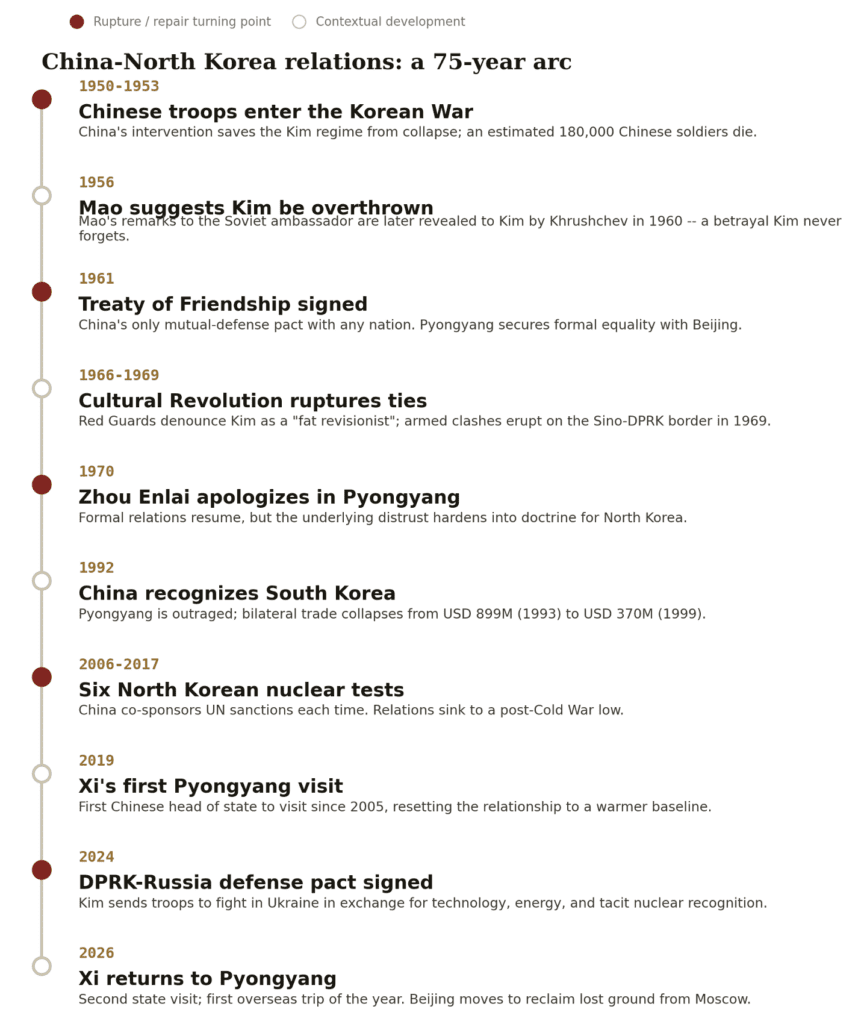
Figure 1. Seventy-five years of rupture and repair between Beijing and Pyongyang.
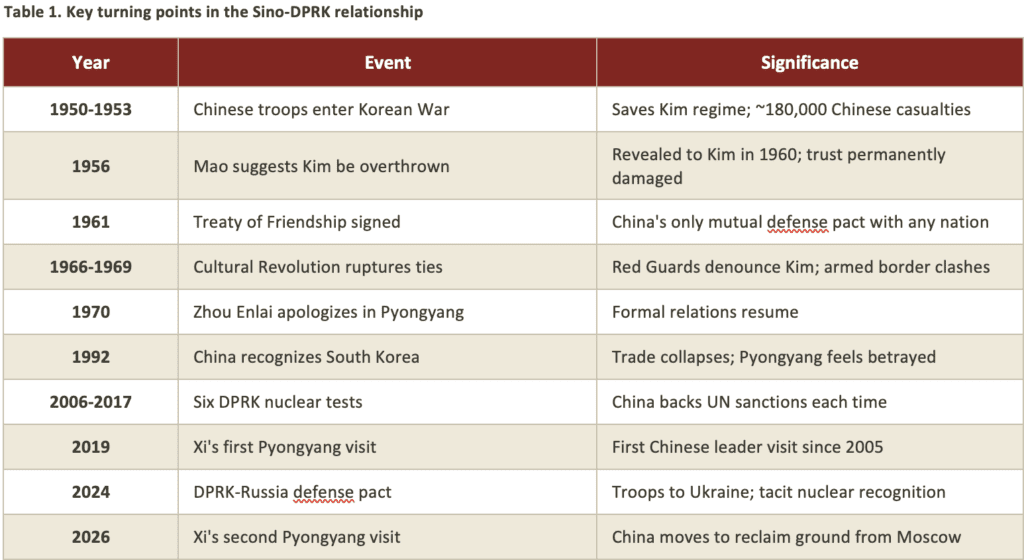
The pattern that emerges from this history is one that fundamentally shapes the present: North Korea has never allowed itself to become a simple client state of China, and every time Beijing has attempted to exercise leverage — through sanctions support, diplomatic pressure, or by cultivating Seoul — Pyongyang has responded by finding alternative patrons or deepening its own strategic capabilities. The lesson Kim Jong Un learned from his grandfather and father is as clear as it is ruthless: nuclear weapons and great-power triangulation are the twin pillars of North Korean sovereignty.
What Russia changed
If the 2019 Xi visit marked a partial warming between Beijing and Pyongyang, Russia’s invasion of Ukraine in 2022 reshuffled the board entirely. The war transformed North Korea from a sanctioned pariah into a valued, indeed indispensable, military supplier for Moscow. Kim dispatched troops — estimates put the number at over ten thousand — to fight alongside Russian forces in Ukraine, and provided substantial ammunition and artillery that observers credit with materially sustaining Russia’s war effort.
The returns to Pyongyang were transformative. In June 2024, Putin visited North Korea and signed the Treaty on Comprehensive Strategic Partnership — a mutual defense pact that, significantly, saw Russia privately acknowledge North Korea’s nuclear status. Moscow provided financial assistance that helped insulate the Kim regime from the bite of international sanctions. And crucially, Russia extended to Pyongyang something Beijing had withheld for decades: peer-level recognition, the treatment of Kim as a genuine great-power partner rather than a troublesome vassal.
“China doesn’t want Russia and North Korea off in a corner planning anything between themselves. Beijing wants to be the control rod — they want to stabilize things and prevent them from getting out of hand.”
— ROBERT CARLIN, ANALYST, STIMSON CENTER
From Beijing’s perspective, this posed a structural threat. For decades, China had held a near-monopoly on North Korea’s external economic relationships, providing the overwhelming majority of its trade, energy, and food aid. That position of economic centrality translated into diplomatic leverage — the ability to calibrate pressure on Pyongyang through sanctions, the ability to position itself as the indispensable broker in any peninsular diplomacy. Russia’s emergence as an alternative patron eroded both.
Worse, from China’s vantage, the Russia-North Korea partnership carried distinct military dimensions that Beijing did not control and could not easily monitor. A North Korea deepened into Moscow’s orbit — learning from Russian military operations, receiving advanced technology in exchange for troops and shells — is a North Korea that Beijing’s traditional economic leverage can no longer fully restrain. China has always preferred a stable, predictable North Korea — a buffer state, not a spark. The Russia relationship threatened that calculus precisely because Moscow, embroiled in a grinding war of attrition, had every incentive to encourage Pyongyang’s military assertiveness rather than restrain it.
The strategic logic of the June 2026 visit
Against this backdrop, Xi’s Pyongyang visit on June 8–9 was not a routine diplomatic call. It was an intervention — an attempt to reassert Chinese influence before the structural drift toward Moscow became irreversible. Several interlocking imperatives drove it.
First, the diplomatic sequence mattered enormously. Xi had just hosted Trump in mid-May and Putin days later. The White House readout of the Trump-Xi summit claimed the two leaders had a “shared goal to denuclearize North Korea.” Beijing’s readout was notably more vague, saying only that the two “exchanged views” on the peninsula. Then Putin visited and signed agreements that included, in the joint statement, Chinese and Russian opposition to international sanctions on North Korea. Xi had just spent two weeks shuttling between the two powers most directly invested in Korean Peninsula dynamics, and then flew directly to Pyongyang carrying the weight of those conversations.
Second, the economic hook remained China’s strongest card. Kim Jong Un’s flagship domestic initiative — a “20×10” development project aimed at rapidly industrializing twenty localities — requires Chinese economic engagement and investment to have any chance of success. Russian assistance, while valuable, is primarily military and energy-focused. Xi arrived in Pyongyang able to offer what Putin cannot: genuine economic development partnership, trade expansion, and the prospect of relief from the sanctions regime that has strangled North Korea’s formal economy.
Third, Beijing sought Pyongyang’s political alignment on Taiwan. Kim reaffirmed North Korea’s support for China’s “one China principle,” and analysts noted that both leaders’ language suggested ambitions extending beyond the Korean Peninsula.
Fourth, and perhaps most critically, China needed to manage the risk of nuclear escalation. Just days before Xi’s arrival, North Korea unveiled a new uranium enrichment facility, and Kim announced plans to expand the country’s nuclear forces “at an exponential rate.” These were not coincidental disclosures — they were Kim’s opening position for the summit: a demonstration that North Korea’s strategic autonomy was not for sale, and that the price of Chinese partnership would have to include, at minimum, Beijing’s tacit acceptance of North Korea’s nuclear status.
The nuclear silence: Beijing’s most consequential concession
The most significant development of the Xi-Kim summit may be what was not said. At every previous high-level meeting — including Xi’s own 2019 visit — Chinese leaders had referenced their commitment to “denuclearization of the Korean Peninsula.” At the June 2026 summit, neither Xi nor any Chinese official publicly used the word. Xi focused instead on China’s “firm commitment to safeguarding the shared interests of the two countries and preserving a favorable strategic environment.” He called for strengthened cooperation, including in the military sphere. He said nothing about nuclear weapons.
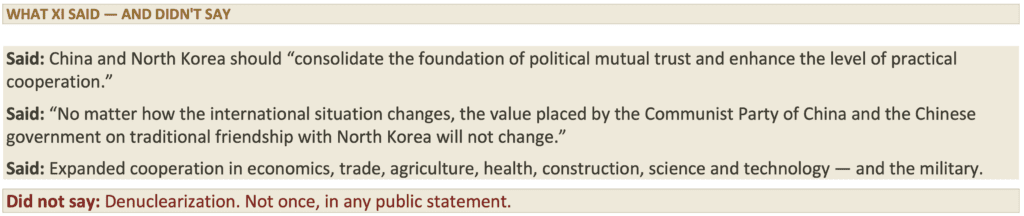
Tong Zhao, a senior fellow at the Carnegie Endowment for International Peace, called this a major policy shift: “China appears to downplay the issue of North Korea’s nuclear weapon program in order to prioritize improving bilateral relations, making a very significant policy change to tacitly accept the reality of a nuclear North Korea.”
The implications are profound. For years, the nominal framework of international pressure on North Korea rested on a putative consensus among the UN Security Council’s permanent members that a nuclear-armed Pyongyang was unacceptable. That consensus was always more rhetorical than real — China and Russia had long resisted the tougher end of sanction regimes — but it provided the diplomatic architecture within which the United States, Japan, and South Korea could operate. Xi’s nuclear silence in Pyongyang pulls a foundational brick from that architecture.
The Russia-China tug of war: an asymmetric competition
To frame the current dynamic simply as a Russia-China competition for North Korean loyalty misses the asymmetry at its heart. Russia and China are not equivalent patrons offering equivalent goods. They are offering different things to a regime that has learned, across three generations, to extract maximum benefit from exactly this kind of great-power rivalry.
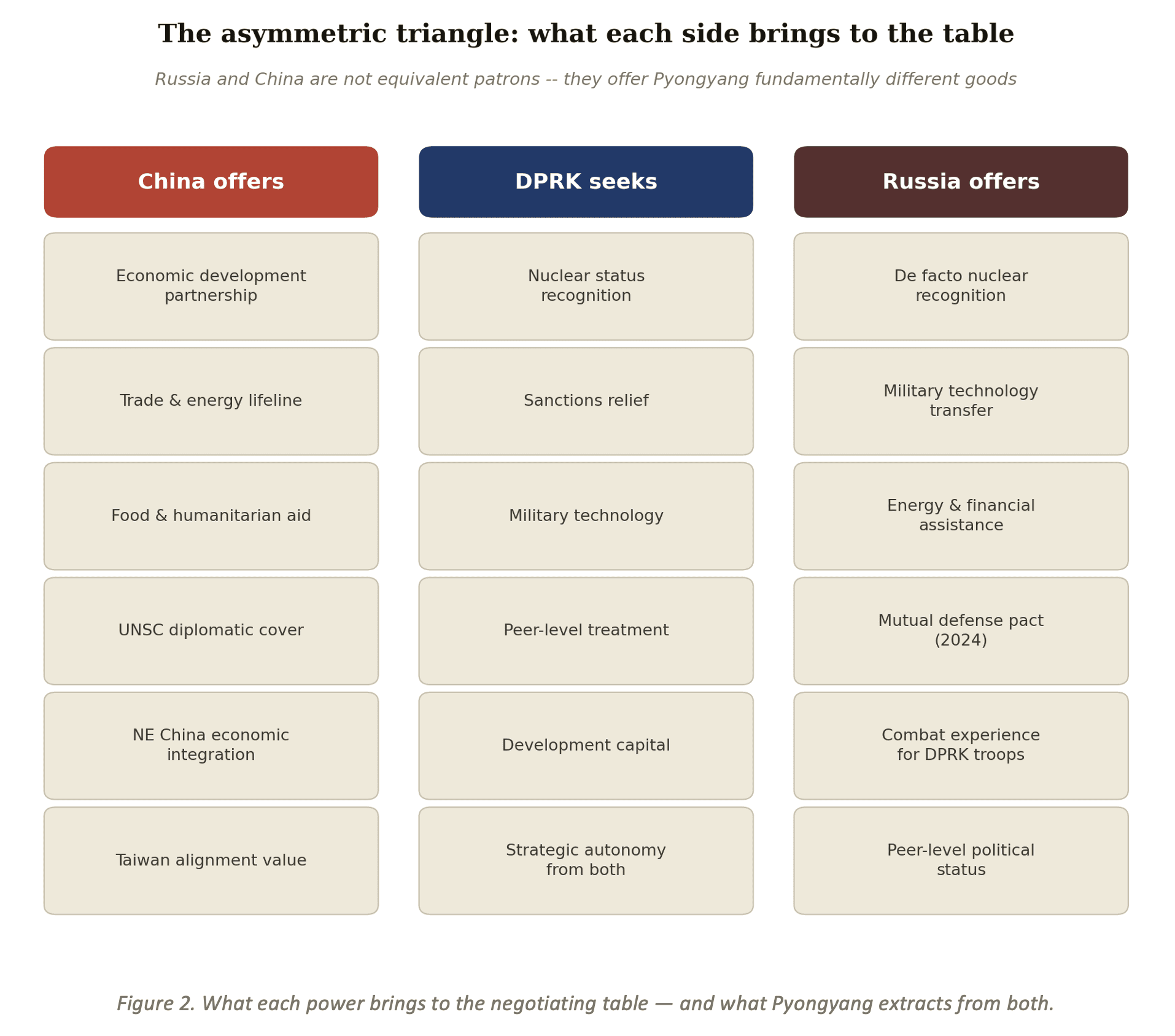
Figure 2. What each power brings to the negotiating table — and what Pyongyang extracts from both.
Russia’s advantage in the current moment is that its offer is primarily military and strategic — precisely what Kim Jong Un has spent his entire tenure prioritizing. The 2024 mutual defense pact, the flow of military technology, the treatment of North Korean soldiers as genuine combatants rather than auxiliary labor, Moscow’s willingness to publicly recognize Pyongyang’s nuclear status — all of these speak directly to Kim’s core objective of cementing North Korea as an irreversible nuclear power that the international community must engage on its own terms.
China’s advantage is structural and long-term. An estimated 90 percent or more of North Korea’s trade runs through China. The Chinese border is the only viable avenue for most of North Korea’s economic activity. Kim Jong Un’s development ambitions — the high-rises, the tourist zones, the special economic areas — cannot happen without Chinese capital, construction expertise, and access to markets. Russia can provide guns; China provides the economic environment within which a functioning state can exist.
Kim Jong Un has displayed a sophisticated awareness of this dynamic. He told Xi directly during the June summit that ties with China are “the most important and primary strategic undertaking” of North Korea — flattery calibrated for the moment. But analysts noted that Kim simultaneously took care to demonstrate, in the days before Xi’s arrival, his continued nuclear assertiveness: visiting the new enrichment facility, announcing exponential nuclear expansion, inspecting cruise missile production. The message was diplomatic in form and strategic in substance: you cannot take us for granted, and your partnership must come without the traditional preconditions.
Crucially, Kim is aware that Russia’s leverage over him is time-limited. “Kim no doubt knows that Russian leverage will probably run out if and when the Ukraine war ends,” observed Al Jazeera’s Jack Barton, “because Russia will no longer need North Korean troops or weapons.” The current moment — in which Pyongyang is genuinely needed by Moscow — gives Kim an unprecedented negotiating position with both great powers simultaneously. He is using it skillfully.
The broader geopolitical frame: fracture lines in the post-American order
Xi’s Pyongyang visit is best understood not in isolation but as one element in a larger project of regional architecture. China, Russia, and North Korea now represent an informal axis of revisionist states — united less by ideology than by a shared opposition to the U.S.-led international order and a shared interest in degrading the institutional structures that underpin American power.
In Northeast Asia, that project has specific geographic stakes. The United States, Japan, and South Korea deepened their trilateral security cooperation at Camp David in 2023 — a move that enraged Beijing. South Korea is now moving to develop nuclear-powered attack submarines with U.S. cooperation, a development Xi and Kim almost certainly discussed in Pyongyang. Japan has significantly expanded its defense budget and capabilities, a shift China frames as a revival of Japanese militarism. Washington’s alliance architecture in Northeast Asia has, in Beijing’s view, tightened uncomfortably around China’s maritime approaches.
Against this backdrop, North Korea functions as a useful disruptor for both China and Russia. A nuclear-armed, conventionally provocative Pyongyang consumes American diplomatic bandwidth, strains U.S.-Japan-South Korea alliance management, and periodically destabilizes a peninsula that Beijing regards as critical buffer space.
“Beijing appears to be quietly moving in a similar direction to Moscow — tacitly accepting the reality of a nuclear North Korea. This leaves Washington increasingly isolated in its insistence that denuclearisation can still be pursued.”
— SOUTH CHINA MORNING POST, JUNE 15, 2026
Xi-Kim Summit and the uneasy Russia-NK-China Triangle
The Xi-Kim summit produced no formal written agreements of the kind Putin-Kim delivered in 2024. The outputs were primarily declaratory: pledges of “strategic coordination,” commitments to expand cooperation across economics, trade, agriculture, health, construction, science and technology, and the military. But reading outcomes against stated interests reveals a relatively clear scorecard.
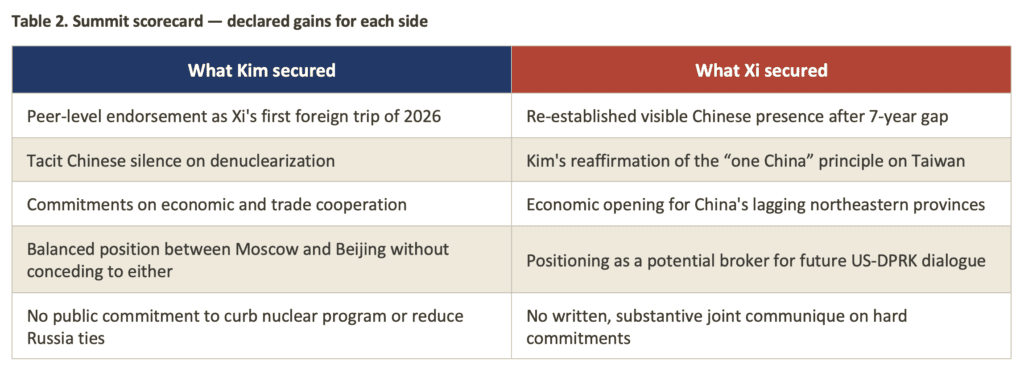
What Xi did not get was equally telling. He did not obtain any public commitment from Kim to restrain North Korea’s nuclear program, to reduce military cooperation with Russia, or to participate in any form of denuclearization framework. The absence of a joint communique with substantive commitments suggests the two sides reached broad understandings rather than specific agreements.
An uneasy triangle
The structural forces that drove Xi to Pyongyang have not been resolved by the visit — they have merely been managed for a season. What the visit achieves is the re-entry of China as an active player in the triangular dynamics of Pyongyang’s patron management. Kim Jong Un now has explicit leverage over both Beijing and Moscow — each power aware that the other is competing for influence, each therefore incentivized to offer more rather than demand more.
For the United States, the implications are uncomfortable. The Trump administration has signaled interest in restarting diplomatic contact with Kim, who has expressed conditional openness — provided Washington abandons denuclearization as a precondition for talks. With China now effectively silent on denuclearization and Russia having explicitly recognized North Korea’s nuclear status, the international framework that once supported U.S. pressure no longer exists in any meaningful form.
Xi’s forthcoming visit to the United States in September 2026 will likely include North Korean diplomacy as a key agenda item. Xi will arrive in Washington having just visited Pyongyang, positioning himself as an indispensable intermediary between Kim and any prospective U.S.-North Korea engagement — a position China has coveted for decades and has now actively rebuilt the credibility to occupy.
For Japan and South Korea, the visit accelerates an already acute security dilemma. A China that has abandoned public opposition to North Korean nuclear development, combined with a Russia that actively supports it and a United States that may negotiate around it, leaves Seoul and Tokyo in a strategic environment their existing postures were not designed for.
In the end, Xi Jinping’s return to Pyongyang was an act of strategic repair, not transformation. The relationship between China and North Korea — forged in the crucible of the Korean War, fractured by ideology and pride across the decades, and now tested by Russia’s seductive embrace — remains irreducibly complicated. The lips and teeth metaphor, however poetic, has never quite captured the reality: these two states have always needed each other more than they have trusted each other.
What has changed is the strategic environment in which that ambivalence must be navigated. The multipolar world emerging from the fracture of American primacy is one in which Kim Jong Un’s regime has more room to maneuver than it has had since the 1960s, when Kim Il Sung played Moscow and Beijing against each other with comparable skill. The dragon has returned to Pyongyang, but the terms of the relationship are being written, for the first time in a long time, largely in Pyongyang.
