Israel has now rejected the very ceasefire roadmap it once agreed upon, and Hamas continues to condition its disarmament on an Israeli withdrawal that Netanyahu has explicitly ruled out.
Progressive Abdul El-Sayed edged Rep. Haley Stevens in Michigan’s Democratic Senate primary, the biggest result from a night of voting that set key November races in five states.
Three fires have destroyed at least 700 buildings and forced about 67,000 people to evacuate around Spokane. A 37-year-old man is accused of starting the Old Trails Fire, while the causes of two other fires remain under investigation.
The MSV Faize Noore Oliya capsized off Yemen after being struck by a projectile. Thirteen Indian nationals and one other crew member were taken safely to the port of Mokha.
The Iran War is once again underway. What initially began as a series of limited exchanges between the United States and Iran has escalated into a renewed military conflict. U.S. strikes targeting strategic military and dual-use infrastructure across southern and western Iran have been met with Iranian missile and drone attacks centered on American military bases and allied facilities across the Gulf. A visual investigation by the Faytuks Network Intelligence Team has identified damage to several U.S. military facilities in the Middle East.
What’s happened so far?
The saga began last Wednesday when U.S. President Donald Trump ordered retaliatory airstrikes on Iran following its attack on three vessels in the Strait of Hormuz. U.S. Central Command (CENTCOM) carried out the strikes in a multi-day operation intended to pressure Iran into conceding to U.S. demands over shipping through the Strait, a key issue in the negotiations at the time.
What followed was a brief lull in the fighting as the United States informed Iran that it had until Saturday to publicly declare the Strait of Hormuz open. Iran, however, rejected the demand during negotiations with Oman on Saturday. In response to the U.S. ultimatum, Iran struck a cargo vessel in the Strait as the deadline expired and formally declared the Strait of Hormuz closed. Days of intense fighting followed, with the United States launching airstrikes across Iran while Iran carried out missile and drone strikes against U.S. military bases and Gulf nations across the region.
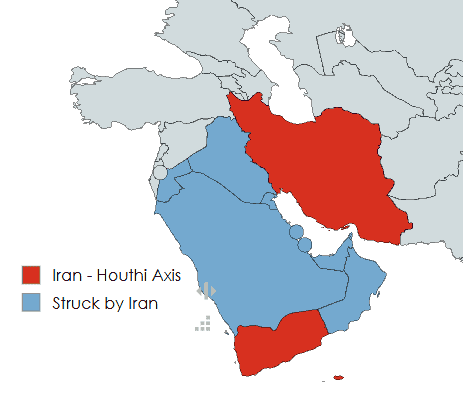
Here’s a map of the countries that Iran has attacked in the past week:
Iran has launched drone and missile attacks on targets in Iraq, Kuwait, Bahrain, Qatar, UAE, Oman, Saudi Arabia, and Jordan in the past few days. The attacks in this latest round of fighting have primarily targeted American military installations and economic infrastructure across the Gulf. Iran has achieved mixed success in these attacks, landing some hits while most others are intercepted. Among those hits though, are several U.S. military bases.
Strikes on U.S. Military Bases
Several U.S. military bases have sustained light damage by Iranian strikes in recent days. The Faytuks Network Intel Team has performed an in-depth satellite imagery analysis of some of these facilities and created easy-to-understand visuals.
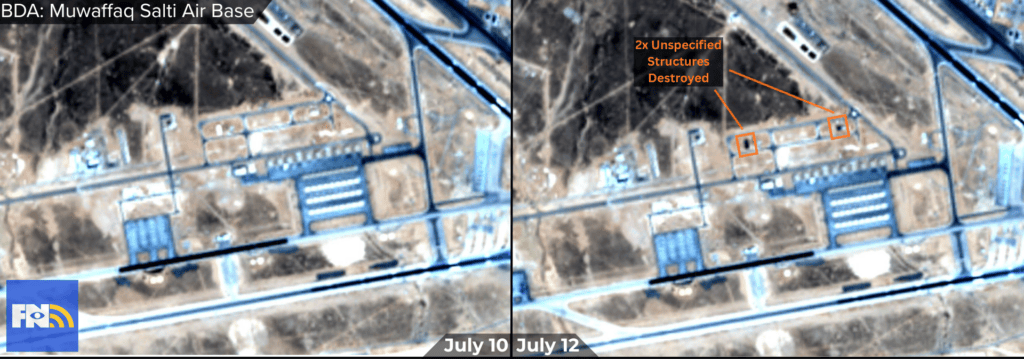
Muwaffaq Salti Airbase – Muwaffaq Salti Airbase is a critical piece to the current U.S. force projection in the Middle East. It houses several U.S. fighter squadrons including the workhorse F-15s and the vaunted F-35s. Its importance to combat operations in the region has made it a focal point for Iranian attacks, experiencing repeated missile attacks almost every night. Satellite imagery from July 12th reveals that the base received two new hits to facilities north of some aircraft shelters. The structures appear to have been destroyed and it remains unclear what purpose they served.
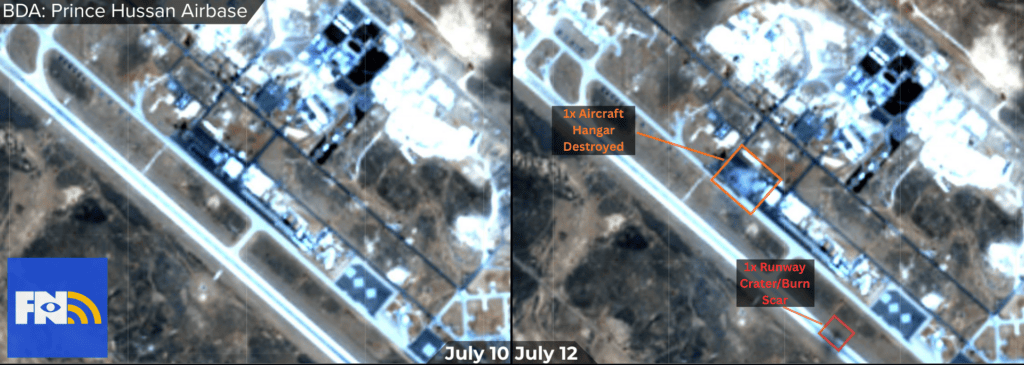
Prince Hussan Airbase (H5) Prince Hussan Airbase, also known as H5 airbase is another Jordanian airbase that houses U.S. forces and aircraft. It has been another focal point of Iran’s attacks on Jordan. Satellite imagery from July 12th reveal that the base has suffered at least 2 missile impacts in recent days. The strikes, while limited in number will have an impact on operations at the base. One structure, believed to be an aircraft hangar was destroyed by missile fire. It is unclear what aircraft, if any was in the hangar at the time of the strike. Another Iranian missile also caused damage to the runway area at the airbase. Though the impact crater is not directly on the runway and rather to it’s immediate edge, it has still caused damage to the adjacent central part of the runway as seen by a burn scar in imagery. The location of the damage has likely rendered the runway unsuitable for larger aircraft like the C-17 Globemaster, the C-5 Galaxy, or any other large aircraft, all of which would require long strips of runway to land and takeoff from. However, flight operations from smaller aircraft like fighter jets or light aircraft, which need smaller portions of runway to operate, are likely still able to operate out of the base.
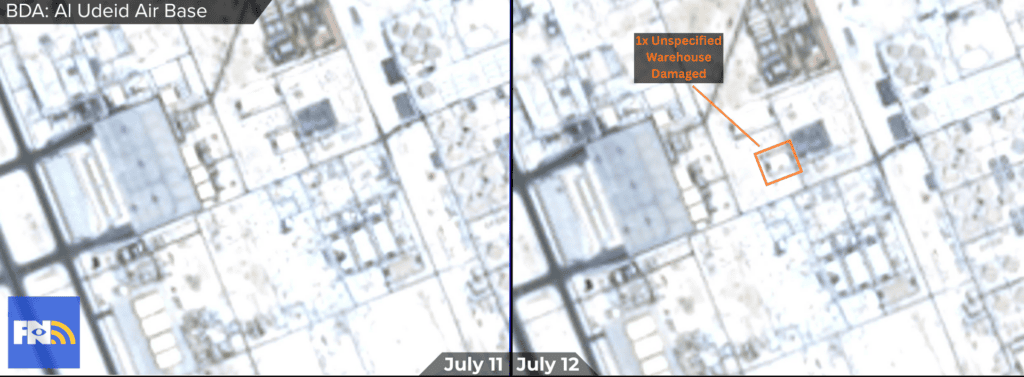
Al Udeid Airbase – Al Udeid Airbase had previously been the largest U.S. airbase in the Middle East. It was home to dozens of tanker aircraft and was a critical logistics hub for the region. However, its proximity to Iran has made it a frequent target for Iranian attack, and it was thus evacuated of most of its aircraft and personnel prior to the start of hostilities. The base was once again brought back to its returned to its pre-war operating posture in the weeks between the signing of the Memorandum of Understanding between the U.S. and Iran, only to go back to its evacuated posture last week as hostilities once again ramped up. Since then, the base has been attacked multiple times by Iranian missiles and drones. Satellite imagery from July 12th reveals that a suspected logistics warehouse at the base was hit in overnight Iranian strikes on July 11th. The facility appears to have been damaged rather than destroyed, suggesting that the strike’s impact will be minimal.
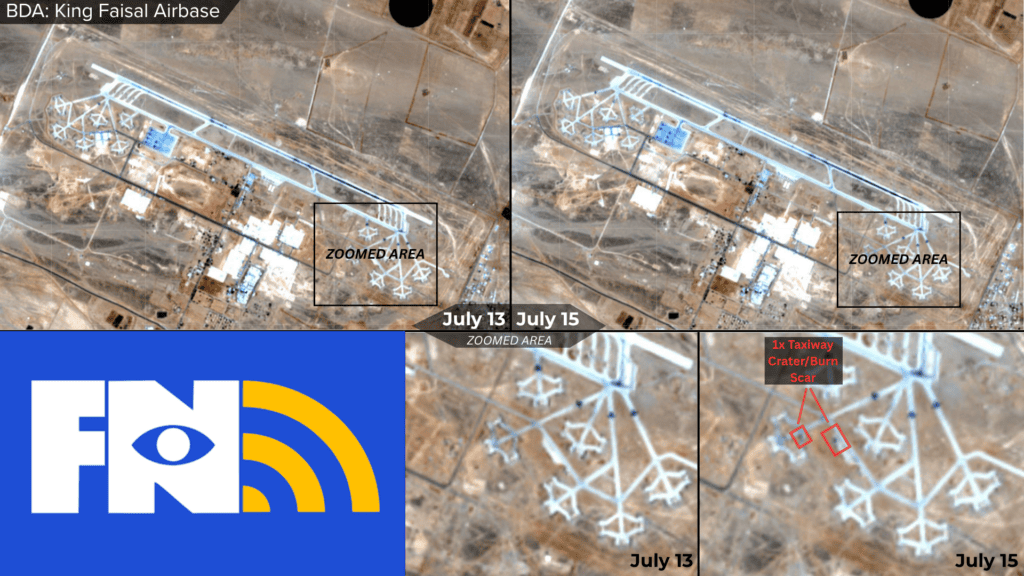
King Faisal Airbase – King Faisal airbase, a major military airbase in Southern Jordan that has hosted U.S. and British special forces prior to the outbreak of the war. It is currently home to several combat search and rescue teams (CSAR) and some ground forces. On the night of July 14th, the base was subject to a heavy missile attack by Iran. Satellite imagery from July 15th reveals that at least 2 projectiles hit the base, creating craters and burn scars on the airfield’s ramp where aircraft are typically parked. The impacts from the attack are minimal, with no facilities or aircraft being damaged. Operations are unlikely to be significantly affected at the base and the damage to the ramp can be easily repaired.
Unverified footage, claimed to have been filmed near the base overnight, appears to show several missiles or missile debris penetrating local air defenses and impacting areas in and around the installation. Faytuks Network geolocators were unable to independently verify the video’s claimed location, though they assessed there to be a moderate probability that it was filmed near the base.
Unverified footage shows at least four Iranian ballistic missiles hitting King Faisal Airbase, Jordan, overnight.
The interception rate is embarassing, every single air defense missile can be seen failing. pic.twitter.com/hh7GpIxyJw
Iran’s strikes on U.S. bases in the past one week have intensified and so has the damage from their strikes. While most projectiles have been intercepted and damage has remained minimal at most gulf bases, the same cannot be said in Jordan. Despite attempting to intercept, Iranian missiles have repeatedly struck their targets in Jordan nearly every night in the past few days since hostilities ramped up. The pattern is concerning and may suggest that local air defense batteries in Jordan are becoming saturated and experiencing shortages of interceptor missiles, an issue that would result in air defense crews firing fewer interceptors interceptors per missile and therefore achieving a lower intercept rate.
The attacks on Muwaffaq Salti and Prince Hussan airbase appear to be more significant than the rest, with multiple structures damaged and a crater adjacent to the runway. Meanwhile, most of Iran’s other attacks on U.S. military facilities have been largely unsuccessful, limiting their impact to operations in the region.
NOAA engineers are restarting GOES-19 after the agency’s main eastern weather satellite entered a protective safehold mode, cutting off satellite imagery and other data used to monitor storms across the eastern United States and Atlantic Ocean.
President Volodymyr Zelenskyy has removed Defense Minister Mykhailo Fedorov after six months in office, exposing a deep dispute over military reform and triggering rare wartime protests. No successor has been approved.
Yemen’s Houthi movement has warned it could shut the Bab el-Mandeb Strait if fighting escalates, threatening a major oil and trade route as shipping through the Strait of Hormuz remains disrupted.
The 36th summit of the North Atlantic Treaty Organization (NATO) was held in Ankara, Türkiye, between July 7 and 8, convened in the shadow of two defining geopolitical crises.
For the second time in four months and the first recorded time in the islands history, a Category 5 Super Typhoon is forecasted to strike Guam and Northern Mariana Islands, causing citizens and the military to prepare yet again for powerful winds and potential power outages.
Back in April, Super Typhoon Sinlaku struck Guam and the Northern Mariana Islands, with estimated windspeeds of up to 150mph (~130kts) causing an estimated $1.5 Billion in Damage, killing 17. While the islands have been recorded to have been struck 94 times, and on average gets affected by at least 6-7 typhoons yearly.
As of July 4th, at 7 PM ChST Bavi was approximately 390 miles east of Guam, moving west at 8 mph (13 km/h), with Maximum sustained winds of 165 mph (143 kts). A slight shift toward the west-northwest and a slight increase in speed is expected through Monday. The National Weather Service in Tiyan has issued a Typhoon Warning, which is in effect until Tuesday Night. Along with the Typhoon Warning, a Flood Watch is also in effect until late Tuesday, with rainfall amounts ranging from 12-20 inches possible as Bavi passes. Conditions are expected to deteriorate starting in the early afternoon on Sunday. With the 7 PM ChST Advisory, the forecast track is expecting Bavi to be between Guam and Saipan Monday morning. According to Warning Coordination Meteorologist Landon Aydlett “Bavi is coming. We’re going to feel it. Be ready,”
As of 5 AM CST, Guam remains in a Condition of Readiness (COR) level 3, which means that “A typhoon may possibly hit the island within 48 hours.” At 10 PM ChST, the Governor will declare COR 2, which means “A typhoon is expected to hit the island within 24 hours.” Once COR 2 is put into place, all government offices will close until COR 4 (Normal Day to Day) is put into place. Multiple shelters on the island are opening at 7 AM. Those who are seeking shelter have been told to bring at least 7 days worth of food. At 2 PM, all beaches on Naval Base Guam closed. Guam Memorial Hospitals have suspended elective appointments, procedures, as of July 4th at 3 pm. All commercial vessels greater than or equal to 200 gross tons have been ordered to evacuate port in Guam and Northern Mariana Islands by the U.S. Coast Guard.
In Saipan, the capital of the Northern Mariana Islands, Water is to be shut off starting at 12 PM on Sunday in tank-fed areas, with the entire system anticipated to be shut down by 6 PM. In Rota, Water Pressure is already out in the higher elevations. The Northern Mariana Islands are in Typhoon Condition III, which means “Damaging winds are possible within 48 hours or less.” and a Declaration of Significant Emergency has been issued by the Governor. The Commonwealth Healthcare Corporation has closed all Outpatient Pharmacies for Sunday July 5th, and will remain closed until an all clear is issued. D-NAP (Disaster Nutrition Assistance Program) operations have been postponed until it becomes safe to do so. Shelters are already open on all three islands within the commonwealth.
The Faytuks Weather Network will be following Super Typhoon Bavi throughout the weekend, and will update once new information is available.
We use cookies to ensure that we give you the best experience on our website. If you continue to use this site we will assume that you are happy with it.AcceptPrivacy Policy