The New Consulate
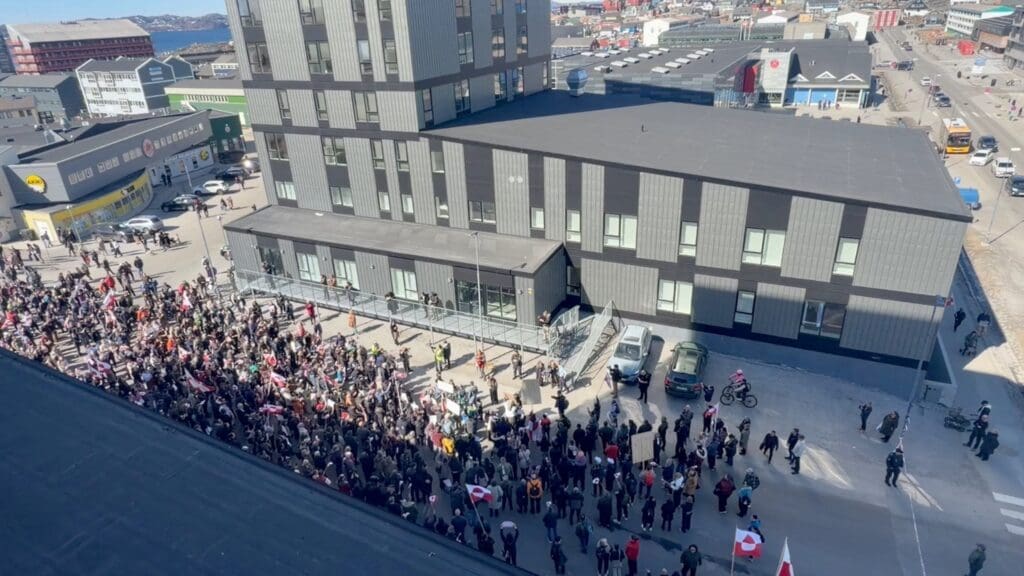
The relocation on May 21 of the American consulate in Nuuk to a significantly expanded three-storey facility building prompted a rare demonstration in Greenland. It comes amidst an ongoing and recently intensified campaign of influence by the Trump administration. upwards of 500 people attended the march despite it being organised on social media channels only a few days prior. The climax of the march involved protestors turning their backs on the consulate and holding a two minute silence. A visual rejection that aligns with local polling from January 2025 showing that 85% of Greenlanders strictly oppose absorption into the United States.
What was intended by Washington as a public demonstration of American soft power, regional investment and diplomatic outreach was met with immediate local resistance. Numerous invitations extended to Greenlandic officials in the preceding days were systematically declined, most notably by Prime Minister Jens-Frederik Nielsen. Ken Howery, US ambassador to Denmark led the opening ceremony but Jeff Landry, U.S. Special Envoy and Louisiana Governor had already left the island prematurely the day earlier.
Landry’s visit: The Charm Offensive
The trip marked the special envoys first trip since his appointment to the role. From the outset, the missions stated object, as reiterated by the White House, was to foster friendship and strengthen economic ties between the two countries, a soft power change in tack from the threatening campaign in the months prior.
Landry held a close-door meeting with Nielsen the day after his arrival. At a following press conference Nielsen described the meeting as taking place in a “good tone”. The main topic was Greenland’s self determination which was repeated by the PM in strong terms. A day later Nielsen conceded that the nature of a special envoy turning up uninvited was ‘disrespectful’. The central criticism from Nuuk is that Washington’s unilateral envoy strategy actively undermines the formal, trilateral diplomatic frameworks painstakingly established between Greenland, Denmark, and the United States earlier this year, of which according to a recent statement by Greenland’s foreign minister Múte B. Egede, progress is yet to be made.
The perceived institutional overreach stems from the fact Landry lacked an official state invitation. What had been rumoured as the central reason for his visit, the Future Greenland Business Fair, Landry instead attended as a standard, self-funded participant, remaining for only the first 30 minutes to observe Nielsen’s opening remarks. One later speech during the fair criticised the Trump administrations hostile rhetoric which according to local media TV-2 received a standing ovation.
Landry’s time was otherwise spent visiting Nikolaj Heinrich, former Nuuk mayor between 2007-2009, who in an interview with local newspaper Sermitsiaq lamented the lack of exploitation in Greenland’s resources as leaving the country dormant. Landry otherwise mentioned having met numerous business owners of which remain undisclosed. Because Greenland possesses some of the world’s largest untapped deposits of rare-earth minerals, critical assets for U.S. defense manufacturing and the technology sector, this highly insular itinerary fueled local anxieties that Washington views the island’s natural resources as a mere global commodity rather than the sovereign assets of a self-governing people.
Howery’s Presence: Tech diplomacy
Ken Howery, who opened America’s new consulate, is a core member of Silicon Valley’s powerful ‘PayPal Mafia’ and co-founder of Peter Thiel’s multi-billion-dollar venture firm Founders Fund, Howery represents a massive nexus of tech-oligarch wealth. His personal proximity to the world’s richest elites is well-documented; The Wall Street Journal previously reported that Elon Musk spent a year staying at Howery’s multi-million-dollar Austin estate, a detail later denied by Musk.
According to investigative reports by Reuters and The Guardian, Ambassador Ken Howery has taken a serious interest in proposals by tech-startup Praxis to establish a ‘Freedom City’ on the island. Backed heavily by billionaire Peter Thiel, Howery’s former venture capital partner, Praxis bills itself as an ‘internet-native nation’. Its founder, Dryden Brown, has openly scouted Greenland to build a corporate charter city designed to extract resources and act as a terrestrial prototype for Mars colonization. By placing Howery at the center of Greenland negotiations, the administration has seamlessly merged federal state power
American Daybreak: The Trans-Atlantic Populist Network
Landry’s visit was largely possible because of Thomas Emanuel Dans, a former U.S. Arctic Commissioner and Heritage foundation member whose brother, Paul Dans, directed the initial policy frameworks for project 2025. Thomas Dans operates American Daybreak, a non profit policy think tank aimed at accelerating closer ties between the Insisted States and Greenland. Dans is familiar with the Arctic having navigated the tumultuous business landscape of mid 90s Russia and the wider Arctic during which he worked in close proximity to figures who would later lead Russia’s Direct Investment Firm (RDIF). This proximity positions him as a pragmatic navigator of Arctic power dynamics, but it sits awkwardly alongside an administration that publicly justifies its Arctic expansion as a vital bulwark against Russian and Chinese influence.
This connection between American conservative networks and Eastern European illiberal movements is structurally institutionalized. The Heritage Foundation maintains a formal cooperation agreement with Hungary’s once state-funded Danube Institute. The Danube Institute has served as a documented ideological incubator, directly hosting Project 2025 architects to coordinate policy blueprints. Placed in this context, American Daybreak’s aggressive operations in Greenland are not isolated instances of Arctic interest, but part of a highly coordinated, globalized effort to bypass traditional democratic channels and expand populist-nationalist spheres of influence.
American Daybreak’s ambitions extend far beyond the Arctic circle; the organization functions as an operative arm in a broader transatlantic push to export right-wing populist policies. During the highly polarized 2025 Romanian presidential election, Dans traveled to Bucharest to actively campaign on behalf of far-right nationalist candidates. This intervention signaled a deliberate alignment of interests that Dans has frequently articulated across mainstream populist media platforms in the United States.
The trip signaled a distinct convergence of interests that Dans frequently articulated on mainstream MAGA platforms. Dans has been a guest on Steve Bannon’s War Room podcast, where he explicitly linked Greenland’s geopolitical fate to the rise of European nationalism. In a March appearance, Dans framed the Eastern European elections and the Arctic push as part of a singular global shift: ‘This is one of the key first steps in a movement from east to west in Europe of populist-nationalist movements coming to power.’ On Bannon’s platform, Dans repeatedly characterized the island not as an independent partner, but as American property, stating: ‘Greenland is the front door on our east coast… Right now, Greenland is ours to lose.’
A central figure during Landry’s visit, also paid by American Daybreak to campaign for Simion in Romania, was local bricklayer Jørgen Boassen, a Trump mega fan who now serves as “Greenland Director” for American Daybreak. His efforts were also employed in 2024 during the visit of Charlie Kirk and Trump Jr. The visit was widely viewed as a publicity stunt, with one Greenland minister describing it as “staged”. According to a hotel CEO in an interview to the Guardian, a key episode involved promising homeless individuals a free hotel lunch, later stating the meal as attended by Trump supporters. This was echoed in Trumps own floated strategy to give each Greenlander $100,000 in order to accept American control.
Geopolitical Context: The Donroe Doctrine
In an interview with the Greenlandic newspaper Sermitsiaq, Special Envoy Jeff Landry offered a familiar ideological justification for Washington’s aggressive posture, asserting that President Trump’s acute interest in Greenland stems primarily from its location within the Western Hemisphere. Trump’s self-styled “Donroe doctrine”, a deliberate, twentieth-century echo of the Monroe Doctrine designed to assert exclusive geopolitical hegemony over the Arctic frontier.
Yet, the administration’s unilateral assertions sit in stark contrast to actual regional security mechanisms. Just one day following Landry’s departure, the Arctic states of Canada, Faroe islands, Iceland, Norway, Sweden, Finland, Denmark, and the USA pledged to increase military presence in the region. On the very day Landry arrived in Nuuk, nine NATO member states launched their routine, annual anti-submarine warfare exercise across the vital Greenland-Iceland-United Kingdom (GIUK) gap. The operation taking place in the exact maritime waters of a country Trump had dismissively labeled a “poorly managed piece of ice” only weeks prior, was conducted under “Dynamic Mongoose.” The exercise fell under the umbrella of Arctic Sentry, NATO’s unified strategic framework established in February to counter Russian and Chinese maritime incursions.
Furthermore, the same business fair Landry departed from early also revealed Denmark’s further commitment to Greenland’s security. During the fair Denmark announced a multi-billion-euro military investment package focusing heavily on air, sea, and electronic surveillance. This procurement includes deploying advanced Reaper drones, commissioning new Arctic patrol vessels, and establishing next-generation radar installations. Crucially, Denmark pledged the construction of a highly secure, state-of-the-art military headquarters in Greenland to house the Joint Arctic Command.
The Contradiction: A Policy Undermining Itself
There is an apparent lack of tact in Landry’s rhetoric, one such example was the idea of putting “America’s footprint” back on Greenland. The imagery depicts Greenland as more of a carpet than a proud nation to be protected from China and Russia. Trump’s declining patience for Greenland has resulted in a classic unorthodox scuttling of the diplomatic routine, conducting what some may see as brazen influence operations rather than waiting the closed doors negotiations to conclude.
Ultimately, the two tracks undermine each other: official diplomatic pressure (consulate expansion, Arctic security pledges, established trilateral channels) running simultaneously with an unofficial influence network (American Daybreak, Boassen, a Heritage Foundation operative with historic Russian business ties) that Greenland’s own PM describes as disrespectful and destabilising. Neither track is working. An administration that floated $100,000 per citizen and sent an envoy who paid for his own conference ticket, leaving Greenland early in embarrassing circumstances even posting a photo on X of his arrival plane rather than the nondescript Gulfstream in which he quietly departed, is not winning hearts in a country where opposition to American annexation is near-unanimous and hardening.