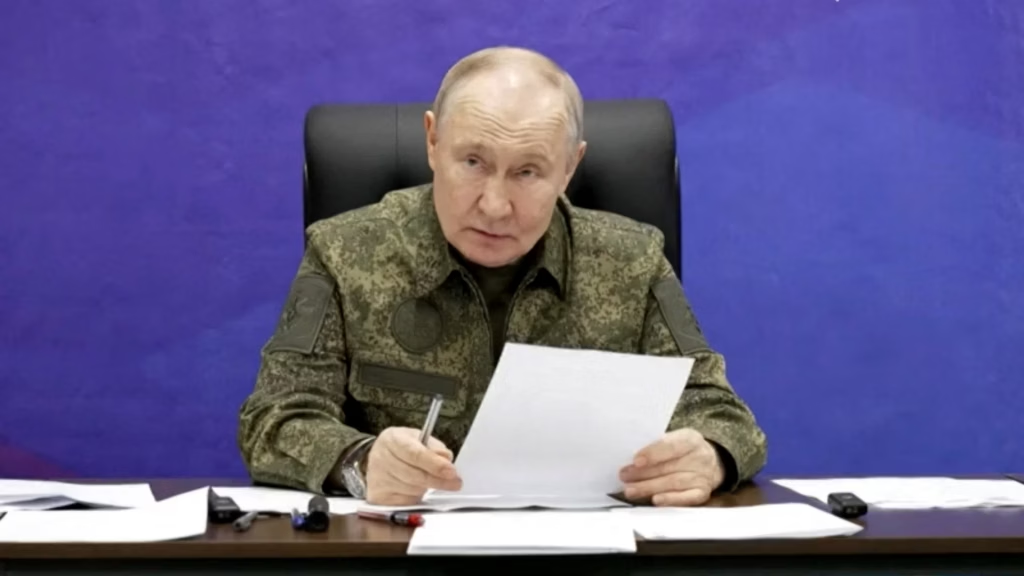
U.S. intelligence agencies assess that Russian President Vladimir Putin may be increasingly willing to authorize provocative actions extending onto NATO territory, raising concerns that Moscow could attempt to test the alliance’s willingness to respond without deliberately triggering a broader war.
Officials briefed on the assessments said potential Russian actions could include cyberattacks, sabotage, hybrid operations and other measures designed to preserve plausible deniability. The assessment represents a shift in Putin’s perceived tolerance for risk compared with earlier this year, though officials do not believe Moscow necessarily intends to initiate a conventional military conflict with NATO.
Instead, U.S. officials assess that such operations could be intended to probe divisions within the 32-member alliance and gauge Washington’s response if a member state were targeted. NATO’s Article 5 collective-defense provision states that an armed attack against one member is considered an attack against all, though the nature of any response depends on circumstances surrounding an incident.
The concerns follow a series of incidents across Europe involving suspected sabotage, cyber operations and incursions into NATO airspace. U.S. officials have also assessed that an explosives-laden drone discovered at an airport in Leipzig, Germany, earlier this week was of Russian origin. NATO says hostile activity against alliance members, including airspace violations, cyberattacks and sabotage, has increased in frequency.
The U.S. intelligence community’s public 2026 threat assessment similarly warned that Russia uses cyberattacks, disinformation, military intimidation and sabotage as tools below the threshold of direct armed conflict. The assessment said continued fighting in Ukraine increases the risk of either deliberate or accidental escalation between Russian and NATO forces.
Russia has repeatedly denied that it intends to attack NATO territory and has accused Western governments of exaggerating the threat posed by Moscow to justify increased military spending and deployments.
NATO has nevertheless expanded its military posture along its eastern flank, maintaining multinational battlegroups in nine member states and increasing air, maritime and cyber defenses. Alliance officials say the deployments are defensive and intended to deter potential aggression while reducing the risk that limited or ambiguous actions could escalate into a wider confrontation.