
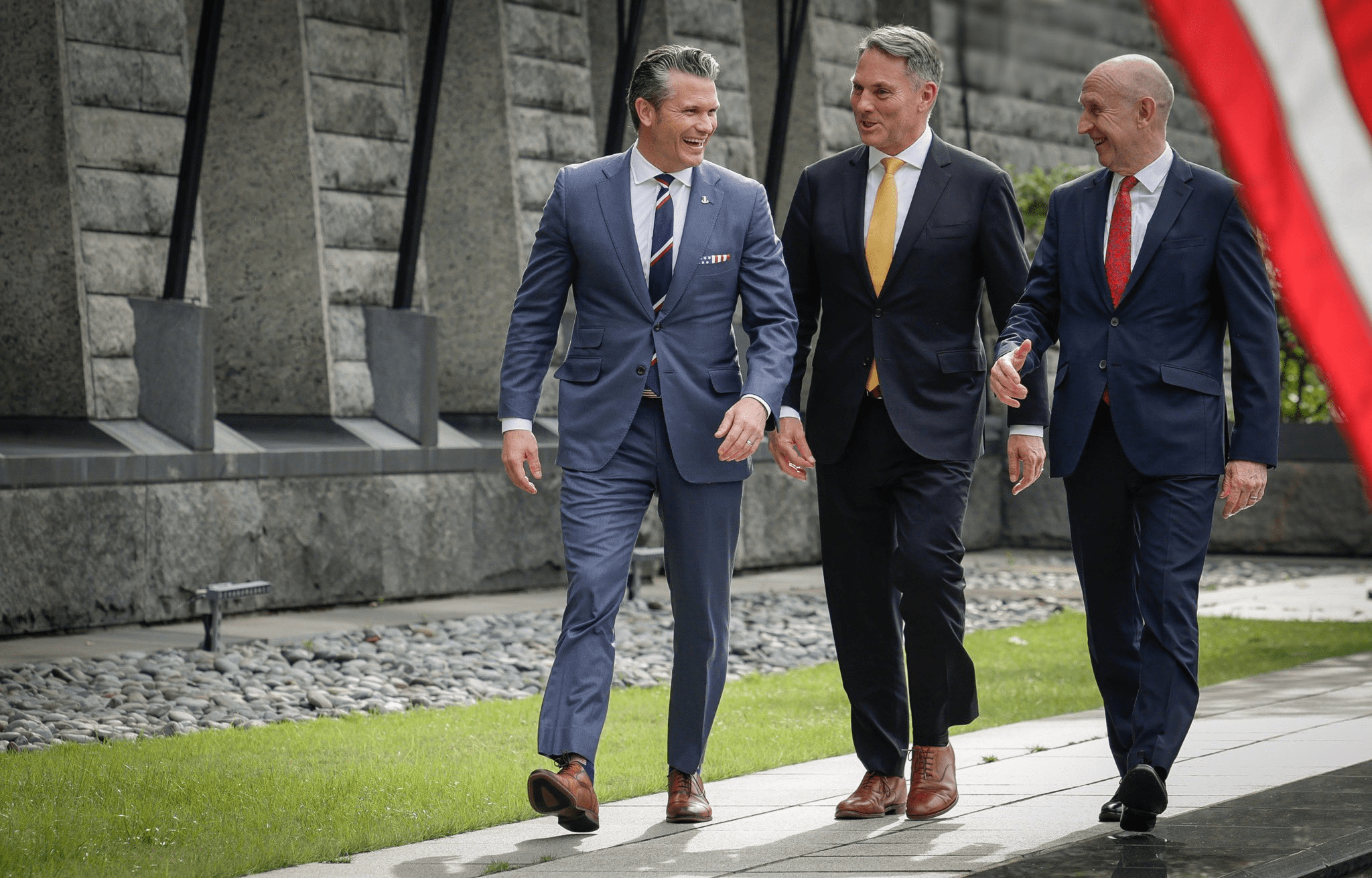
On May 30, the Australian Minister for Defense, Richard Marles, the United States Secretary of War, Pete Hegseth, and the British Secretary of State for Defense, John Healey, met at the U.S. Embassy in Singapore, where the ministers reaffirmed their commitment to the AUKUS security pact and announced several new initiatives focused on accelerating the partnership between the three countries.
The meeting was held on the sidelines of the Shangri-La summit, signalling that the pillars of the AUKUS agreement were very much an important focus for Britain, Australia, and the United States. While there has been much focus on the status of Australia’s future nuclear-powered submarine fleet under Pillar 1, the ministers highlighted the progress made across the partnership and unveiled the first official Pillar 2 Signature Project.
Under Pillar 1, the ministers confirmed that key milestones are on track to be met on time to support Australia’s acquisition of conventionally armed, nuclear-powered submarines. They also announced that all necessary arrangements for establishing the Submarine Rotational Force-West (SRF-West) at HMAS Stirling Naval Base in Western Australia have been completed ahead of its planned 2027 activation. Secretary Hegseth confirmed that the U.S. Navy authorized support personnel this month and that they will begin the first rotation of personnel to Stirling later this year. The SRF-West initiative will see both American and British submarines operating from the naval base, helping to increase allied presence in the Indo-Pacific while also helping to sustain Australia’s defense industrial base required for its future submarine fleet.
The ministers also praised a streamlined approach to supporting Australia’s acquisition of Virginia-Class submarines. Under the revised plan, Australia would gain three in-service submarines rather than a mix of new and existing submarines, a move to help Australia acquire submarines faster and reduce strain on U.S. shipbuilding struggling to meet procurement timelines.
The most significant announcement, however, was under Pillar 2. The ministers revealed that the first official AUKUS Pillar 2 Signature project would focus on developing advanced payloads and enabling systems for Uncrewed Undersea Vehicles (UUVs). The initial deliveries of these vehicles are expected to start in 2027. According to the factsheet that accompanied the joint statement of the ministers, the project will concentrate on the technologies that are carried by unmanned underwater systems and the networks that allow them to operate alongside both crewed and uncrewed platforms across the American, Australian, and British navies. This project is meant to strengthen trilateral capabilities in undersea surveillance, intelligence gathering, strike operations, anti-submarine warfare, electronic warfare, mine countermeasures, and protecting underwater critical infrastructure. Such a project will help improve AUKUS interoperability as the partnership increasingly focuses on next-generation technologies like autonomous systems, AI, quantum computing, and much more.
Beyond joint capability development, the ministers supported the expansion of the AUKUS license-free defense trade agreement by reducing barriers to technology sharing and increasing cooperation between their respective defense industrial bases.
All together, the announcements made by the ministers suggest that AUKUS is entering a new phase that does not just focus on delivering nuclear-powered submarines; the partnership is producing near-term capabilities and operational outcomes. With the new Pillar 2 announcement, as well as the SRF-West rotation approaching, Australia, The United Kingdom, and the United States have all committed to expanding both the scope and pace of the AUKUS partnership to secure an everlasting Free and Open Indo-Pacific.
No comment yet, add your voice below!