
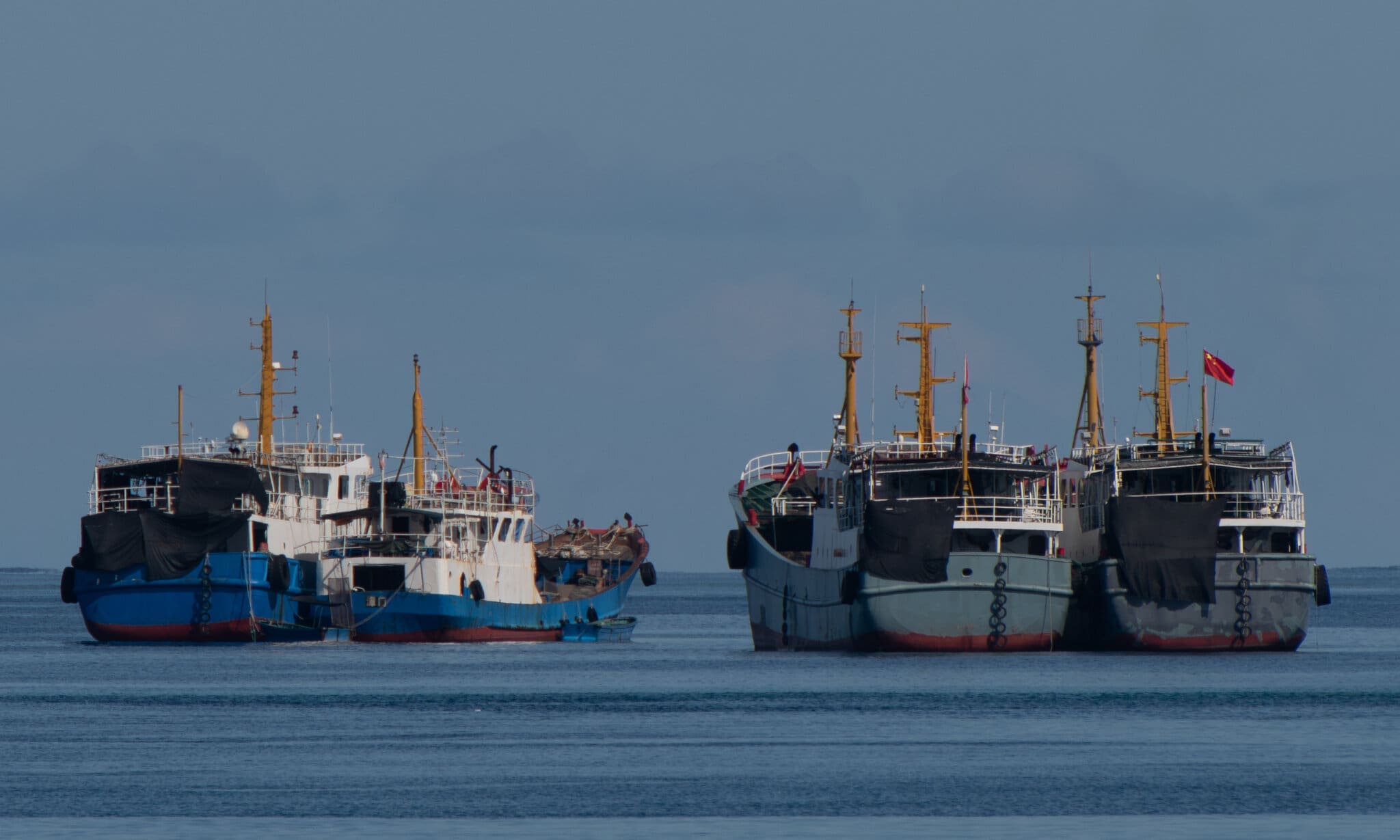
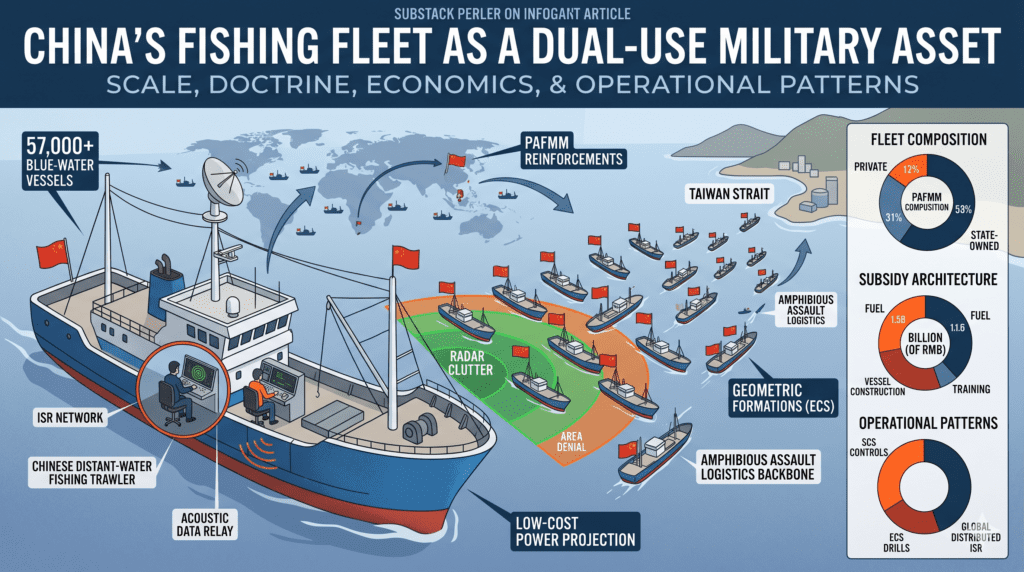
China has engineered the world’s most consequential maritime gray-zone instrument by weaponizing its civilian fishing fleet. Numbering more than 57,000 blue-water-capable industrial vessels and backed by an opaque, multi-billion-dollar state subsidy architecture, China’s Distant-Water Fishing (DWF) fleet simultaneously functions as a sovereign food-security shield, a geopolitical coercion tool, a globally distributed ISR network, and the indispensable logistical backbone of future high-intensity military campaigns—most critically, a prospective amphibious assault on Taiwan.
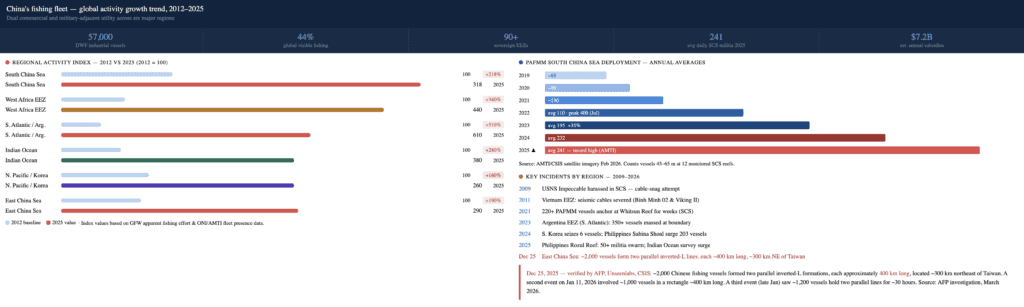
The People’s Armed Forces Maritime Militia (PAFMM), the institutional sinew binding this civilian fleet to the People’s Liberation Army (PLA), has broken deployment records consecutively in 2024 and 2025. Satellite imagery analyzed by the Asia Maritime Transparency Initiative (AMTI) documented a daily average of 241 militia vessels in contested South China Sea waters throughout 2025. Meanwhile, in December 2025 and January 2026, approximately 2,000 and 1,000 Chinese fishing boats, respectively, assembled in precise geometric formations spanning 400 kilometers across the East China Sea—events that senior analysts at CSIS described as having “no clear precedent in publicly available data.”
The central strategic insight of this assessment is economic: a fishing trawler costs a tiny fraction of a naval combatant to build, crew, fuel, and maintain, yet it can perform persistent ISR, generate crippling radar clutter, provide amphibious lift, conduct acoustic data relay, and enforce area denial — all with near-complete legal impunity under the civilian-vessel protections of UNCLOS. This makes the fishing fleet, per dollar of state investment, arguably the most cost-efficient tool of blue-water power projection in the history of maritime warfare.
| Metric | Figure | Source / Date |
|---|---|---|
| DWF fleet size (industrial vessels) | ~57,000 vessels | ONI / Global Fishing Watch 2024 |
| Share of global visible fishing activity | 44% | Oceana / GFW 2022-2024 |
| Nations with Chinese fleet presence | 90+ | Select Committee on CCP, Jan 2026 |
| Avg. daily PAFMM vessels (SCS, 2025) | 241 (record high) | AMTI, Feb 2026 |
| Peak PAFMM deployment (Jul 2022) | ~400 vessels (SCS) | Wikipedia / AMTI |
| East China Sea formation (Dec 25, 2025) | ~2,000 vessels, 400 km lines | AFP / CSIS / ingeniSPACE |
| Civilian logistics ships earmarked for PLA mobilisation | 5,000+ ships (2015 baseline) | CMSI Maritime Report No. 13 |
| Chinese central government subsidies (2018 est.) | USD 7.2 billion | ORF, 2026 |
| DWF fuel subsidies at peak (2011) | CNY 2.68 billion (~USD 380M) | Oceana / Mallory et al. |
| SBFV daily subsidy (>1,200 kW, Spratlys) | ~USD 3,700 per vessel per day | CSIS / Poling 2021 |
The Domestic-to-Distant-Water Pivot
China’s domestic fishing fleet peaked at an estimated 1,072,000 vessels in 2013 before being deliberately reduced by roughly 47 percent through capacity-reduction guidelines and seasonal moratoriums issued by the Ministry of Agriculture and Rural Affairs. By 2023-24 the domestic fleet had contracted to approximately 564,000 vessels. This headline reduction, however, is deeply misleading. It masks a deliberate qualitative upgrade: the tonnage, engine power, and endurance of average vessels increased substantially, and the resources freed by domestic contraction were redirected toward aggressive expansion of the Distant-Water Fishing fleet. Today’s DWF fleet of roughly 57,000 industrial fishing vessels operates across the EEZs of more than 90 sovereign nations. Between 2022 and 2024 these vessels — most heavily subsidised — accounted for 44 percent of all visible fishing activity worldwide. Chinese marine catch as a share of global production surged from approximately 5 percent in the 1980s to 17 percent between 2010 and 2019, with DWF production alone reaching 2.33 million tonnes (roughly 18 percent of the national wild catch) by 2022.

The PAFMM’s Two-Tier Operational Structure
The institutional architecture binding this civilian fleet to PLA strategic objectives is the People’s Armed Forces Maritime Militia (PAFMM). It is not an informal grouping of patriotic fishermen but a state-organised, state-funded, and state-directed armed mass organisation that reports directly through local People’s Armed Forces Departments (PAFDs) up to Commander-in-Chief Xi Jinping.
The Wokou Tradition — Maritime Privateers as Strategic Instruments: The practice of using nominally civilian maritime actors as instruments of state power has deep roots in East Asian history. During the Ming Dynasty (1368–1644), the wokou (倭寇, “Japanese pirates”) — actually a mixed force of Chinese, Japanese, and Southeast Asian maritime actors — operated along China’s coastline in a zone of deliberate ambiguity between commerce, piracy, and politics. The Ming court, at different times, alternated between suppressing and co-opting these networks, ultimately deploying figures like the maritime entrepreneur Zheng Zhilong as instruments of state maritime power who provided plausible deniability while achieving strategic objectives. The Qing Dynasty’s use of civilian maritime auxiliaries in the conquest of Taiwan (1683) — when Shi Lang‘s fleet was supplemented by locally recruited fishing and transport vessels that provided logistical capacity and local maritime knowledge — offers another direct historical precedent. The contemporary PAFMM is a technological modernization of this ancient strategic instrument, deploying the ambiguity of civilian maritime identity as both a legal shield and an operational advantage.
Professional Maritime Militia Fishing Vessels (MMFVs)
MMFVs are purpose-built for paramilitary operations. They are constructed to military-grade specifications with heavily reinforced steel hulls displacing over 1,000 tons, and are equipped with high-powered water cannons, internal weapons storage, and advanced military communications suites. Financing flows directly from national defence budgets via a dedicated construction fund. Crews are full-time paramilitary personnel drawing state salaries from state-owned enterprises. Because they have no commercial fishing imperative, MMFVs are invariably the frontline vessels in direct physical confrontations — acting as the coercive vanguard in sovereignty disputes.
Spratly Backbone Fishing Vessels (SBFVs)
SBFVs are ostensibly commercial fishing boats, typically 45-65 metres in length and displacing over 200 tons, with reinforced steel hulls capable of deliberate ramming. Owners and crews operate under formal contracts mandating participation in sovereignty missions, intelligence collection, and military training. In exchange, Beijing’s “double fuel subsidy” mechanism compensates them at extraordinary rates when deployed in designated contested zones. AMTI analysis shows that a large SBFV exceeding 1,200 kW can receive state payments of approximately USD 3,700 per day simply for maintaining a persistent physical presence — meaning the catching of fish is economically irrelevant to these vessels’ primary mission.
The SBFV subsidy structure effectively transforms the act of maritime presence itself into a profitable state-compensated activity. These vessels are paid to occupy water, not to fish — making them a uniquely cost-efficient instrument of coercive area denial.
The Economics of Blue-Water Power Projection
The Subsidy Architecture
China’s fisheries subsidy system is uniquely structured to maximise geopolitical rather than commercial returns. Prior to 2016, the government published detailed annual subsidy figures in the China Fisheries Yearbook; since then, reporting has grown deliberately opaque, with central funding increasingly shifted to subnational “general funds” that can be deployed with discretion across fuel, vessel construction, and area-presence payments. When China submitted its WTO notification in 2019, it did not include a fuel subsidy estimate, citing these reporting changes.
Between 2009 and 2018, Beijing reduced “beneficial” conservation subsidies and more than doubled “capacity-enhancing” subsidies — those directly enabling increased fishing effort and fleet size. Oceana’s analysis of available data estimates that in 2019 central government transfers (GTPs) totalled approximately CNY 11.7 billion, with 79 percent allocated to domestic fuel subsidies. The Subsidised Technology Program (STP) totalled CNY 8.6 billion, of which an estimated CNY 7.1 billion went to fisheries development — categorised as harmful to sustainable fishing. An estimated USD 7.2 billion in total subsidies were flowing to fishing fleets by 2018.
Crucially, subsidies flow disproportionately to the DWF sector — the fleet operating in foreign waters and performing military-adjacent functions — despite it representing only approximately 22 percent of China’s total catch. Provincial city-level competition for DWF operators adds an additional layer of incentive: Zhangzhou municipality, for example, offered CNY 3 million (USD 480,000) for any firm relocating its base, CNY 500 per tonne of distant-water catch landed locally, and CNY 200,000 per new approved vessel entry. New entrant firms could access discounted corporate loans at 40 percent off standard rates through state-controlled banks.
Cost Comparison: Fishing Vessel vs. Naval Combatant
The core economic argument for China’s fishing-fleet strategy is compelling. A purpose-built SBFV — even fully subsidised and counting all state compensation — represents a vanishingly small fraction of the acquisition and lifecycle costs of even the cheapest naval combatant. The following comparison illustrates the asymmetric cost efficiency:
| Asset | Approx. Acquisition Cost | Daily Operating Cost | Key Military Utility |
|---|---|---|---|
| SBFV (65m, 200t, subsidised) | USD ~2-4M | State-subsidised (~USD 3,700 paid TO crew) | ISR relay, area denial, decoy, amphibious lift |
| MMFV (1,000t, purpose-built) | USD ~10-25M (defence fund) | State salary crews; no commercial losses | Frontline coercion, swarming, EW decoys |
| Type 056 Corvette (PLAN) | USD ~100-130M | ~USD 35,000-50,000 | Limited role in grey-zone; legally constrained |
| Type 052D Destroyer (PLAN) | USD ~900M-1.2B | ~USD 150,000-250,000 | Blue-water strike; diplomatically provocative |
| U.S. Arleigh Burke DDG | USD ~2.2B+ | ~USD 700,000+ | Full-spectrum; but one vessel vs. thousands |
The cost asymmetry is stark. For the acquisition price of a single U.S. Arleigh Burke destroyer, China can subsidise and maintain an entire SBFV force numbering in the hundreds — force elements that collectively outperform the destroyer in ISR persistence, area presence, logistical support, and grey-zone coercion, while being largely immune to conventional kinetic response. The fleet’s commercial operations add a further critical dimension: even when performing military-adjacent missions, fishing vessels generate revenue from their catch, offset their fuel costs through subsidies, and attract international trade finance — effectively making the military instrument partially self-funding. No conventional naval asset achieves this. A Type 052D destroyer at sea costs the state approximately USD 150,000-250,000 per day; an SBFV on a Spratly sovereignty mission costs the state approximately USD 3,700 per day while returning a catch that offsets part of that expenditure.

Grey-Zone Coercion: Patterns and Tactics
Record Deployment Patterns (2024-2025)
AMTI’s satellite imagery analysis, using Planet Labs imagery at 11 South China Sea features throughout 2024 and 2025, confirms a sustained escalation in PAFMM deployments. The 2024 daily average of 232 militia vessels represented a 15 percent increase over 2023’s 195, itself a 35 percent increase over the prior year. The 2025 daily average of 241 vessels marked the highest level on record. Mischief Reef and Whitsun Reef together accounted for nearly half of total observed militia presence, with Mischief Reef recording four distinct peaks exceeding 200 vessels during 2025, reinforcing its role as a command hub monitoring tensions with the Philippines at Sabina Shoal and Second Thomas Shoal.
A significant doctrinal shift was also observed: in 2024, a majority of militia ships spent their days anchored within the lagoons of China’s island military outposts rather than at unoccupied reefs where they might plausibly maintain a fishing facade. AMTI analysts interpreted this as reflecting a diminishing interest in sustaining the pretence of commercial fishing activity — the international community’s growing awareness of their paramilitary character means the camouflage value has declined, and vessels now prioritise easier resupply and comfort within Chinese-controlled bases.
The East China Sea Geometric Formations (Dec 2025 – Jan 2026)
The most operationally significant recent event was the unprecedented geometric massing of Chinese fishing vessels in the East China Sea. On Christmas Day, 25 December 2025, approximately 2,000 vessels arranged themselves into two parallel inverted-L formations, each approximately 400 kilometres in length — a total span of roughly 400 kilometres. A second formation of approximately 1,000 vessels was detected on 11 January 2026. The events were verified through AIS data analysis by AFP, corroborated by Unseen-labs satellite radio-frequency intelligence, and cross-referenced against nighttime satellite imagery and Global Fishing Watch fishing-effort algorithms.
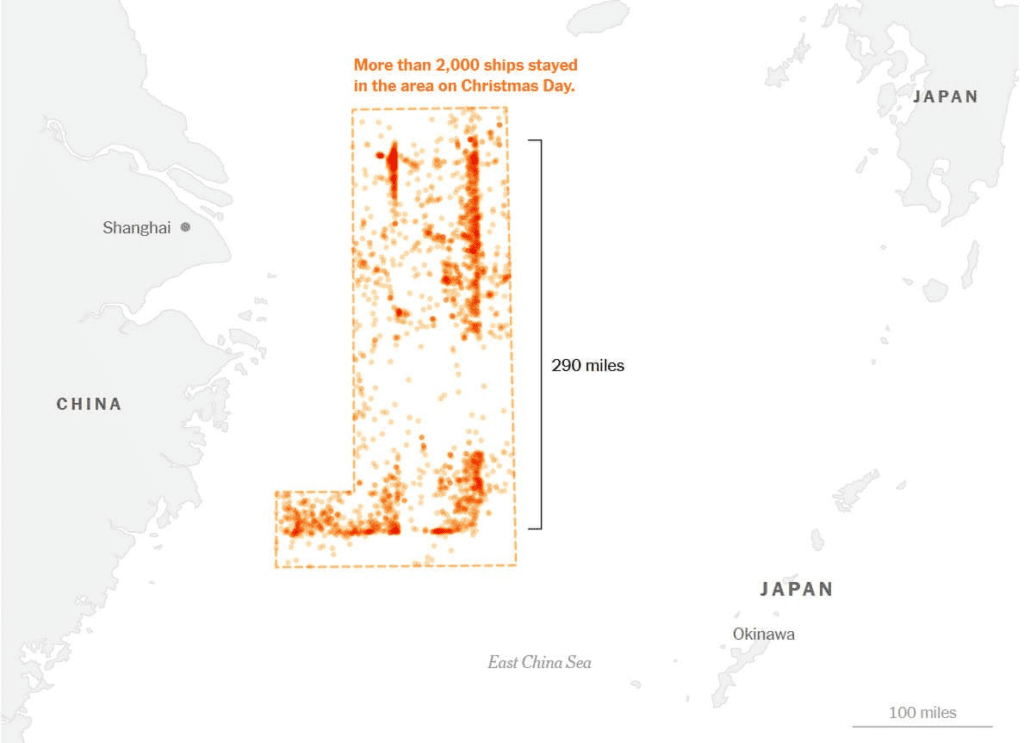
AIS tracking confirmed the vast majority of vessels originated from Zhejiang Province — a major PAFMM homeport region. Expert analysis was unequivocal: the vessels were not fishing (no fishing-detection algorithm classified their movements as apparent fishing activity), and the geometric precision of the formations had no precedent in publicly available maritime data for civilian commercial operations. Gregory Poling of CSIS stated he had never seen such a massing outside of port.
Christmas Day 2025: ~2,000 Chinese fishing vessels form two parallel lines spanning 400 km across the East China Sea. Ray Powell (SeaLight / Stanford): “Chinese fishing fleets routinely operate in large groups, but over a thousand vessels holding parallel lines for hundreds of miles over thirty hours has no clear precedent in publicly available data.” Japan deployed aircraft and repositioned patrol vessels in response.
Expert consensus points to one plausible explanation: China was conducting a large-scale mobilisation readiness exercise — testing its capability to rapidly marshal thousands of civilian vessels that could serve as decoys, logistical support, or amphibious lift assets in a contingency operation targeting Taiwan or involving Japan. Thomas Shugart, a former U.S. Navy officer now at CNAS, summarised the strategic logic: “In the absence of that dual-purpose, civil-military maritime mass, I don’t think they can invade Taiwan. With that, it turns into a ‘maybe they can.'”
Tactical Toolset: From Swarming to Electronic Deception
The PAFMM employs a layered tactical toolkit that escalates from passive presence to active electronic warfare:
| Tactic | Mechanism | Legal / Strategic Effect |
|---|---|---|
| Mass presence / area denial | Hundreds of vessels anchor in contested waters; fish or not | Imposes de facto exclusion zone; overwhelms foreign coast guard capacity |
| Hull lashing / phalanx formation | Up to 12 vessels tied together creating floating barricade | Prevents boarding, towing, or ramming; paralyses law enforcement |
| AIS manipulation / dark shipping | Transponders disabled, vessel IDs rotated, flags of convenience used | Creates AIS clutter; conceals true position and mission; frustrates target discrimination |
| Corner reflector deployment | Faceted polyhedra (up to 60 trihedral elements) hoisted on masts | Inflates RCS; 200-ton trawler mimics 7,000-ton surface combatant on radar |
| False heat signatures / EW decoys | Artificial thermal sources combined with radar reflectors | Forces adversary to expend limited-inventory anti-ship missiles on decoys |
| Cable severing / towed array destruction | Specialised cable-slashing gear; dangerous manoeuvres against survey ships | Sabotages hydrographic surveys and naval towed sonar arrays |
| High-powered laser use | Directed against aircraft cockpits (incl. RAAF helicopter incident) | Denies airspace; psychological harassment without kinetic engagement |
| Acoustic data relay | Receivers connected to seabed sensor networks; transmit data to mainland | Fills PLAN “blind spots”; feeds the Transparent Ocean surveillance architecture |
The C4ISR Network: Fishing Fleet as Global Intelligence Grid
Information Boats and Intelligence Personnel
The PLA explicitly tasks the PAFMM and DWF fleet with filling the “blind spots” (补盲) in its global maritime situational awareness — the coverage gaps that dedicated naval intelligence assets cannot cost-effectively maintain. Naval War College China Maritime Report No. 46 (Martinson, 2025), drawing on PLA primary sources, confirms that militia forces specialising in intelligence are organised into “maritime reconnaissance” (海上侦察) units distributed across China’s coastal provinces.
Specific vessels within these units are designated “information boats” (信息船) outfitted with advanced commercial sensors, high-fidelity satellite navigation, and shortwave and satellite communications enabling beyond-line-of-sight data transmission. Embedded within these vessels are “information personnel” (信息员) — part-time intelligence specialists who maintain continuous secure contact with PAFDs while at sea, relaying visual identification of foreign warships, acoustic anomalies, and signals intelligence directly to PLA operational commands. Because these vessels carry civilian documentation, they can legally loiter near foreign naval bases, monitor exercise zones, and transit critical straits without triggering a legally justifiable response.
PLA experts have also advocated for embedding intelligence personnel on Chinese vessels operating in distant-water regions — and NWC’s Martinson assesses this is likely already occurring across the global DWF fleet. China’s Distant-Water Fishing fleet additionally hosts Party cells and security stewards under a “far-seas policing” model, with the BeiDou satellite navigation and communications system providing the secure data backbone.
The scale of latent ISR capacity is staggering. Even if outfitted only with basic commercial-grade sensors, a fleet of 57,000 vessels theoretically covers over 1.2 million nautical miles per day — a distributed, globally resilient intelligence network with genuine deniability.
The Transparent Ocean Architecture
The fishing fleet’s ISR role is embedded within China’s broader “Transparent Ocean” (透明海洋) strategy — a five-layer architecture designed to eliminate the acoustic and stealth advantages of U.S. and allied submarines in the Western Pacific and beyond. The five layers are: (1) an orbital satellite constellation using interferometric radar altimetry and ocean lidar; (2) the Air-Sea Interface layer, comprising smart buoys, wave gliders, unmanned surface vessels, and critically, the fishing fleet; (3) autonomous underwater vehicles and acoustic gliders below the mixed layer; (4) fixed seabed sonar arrays across strategic straits; and (5) mainland AI-fusion processing hubs creating a real-time kill web.
The fishing fleet is operationally irreplaceable within Layer 2. Acoustic data from seabed sensors travels as slow, low-bandwidth packets that cannot easily penetrate the ocean surface to reach orbital assets. Fishing vessels equipped with specialised receivers loiter at strategic choke points, receive this subsurface data, and translate it into high-bandwidth satellite bursts transmitted securely to mainland processing centres. PLA Navy officers have also published analyses proposing the use of fishing nets and dragged equipment to physically destroy or spoof U.S. hydrophones and towed arrays in a conflict — blending passive acoustic surveillance with kinetic undersea sabotage capability.
The BeiDou Backbone and Dark Shipping
China’s BeiDou Navigation Satellite System, officially recognised by the IMO in November 2014, provides the fishing fleet with a secure, state-controlled communications and positioning backbone that operates independently of Western GPS infrastructure. Vessels equipped with BeiDou VMS (Vessel Monitoring System) terminals transmit position and status to mainland monitoring centres every 10 minutes — enabling real-time operational control of thousands of vessels simultaneously. Crucially, this system operates on Chinese-controlled infrastructure, meaning Beijing can selectively share or withhold vessel position data from international tracking platforms.
Chinese fishing vessels account for 44 percent of global GPS manipulation events detected by commercial maritime intelligence firms. The fleet routinely disables AIS transponders, rotates vessel names and MMSI identifiers mid-voyage, and operates under flags of convenience. A CSIS Futures Lab case study tracking a single suspected militia vessel through 2024 documented the vessel appearing under at least 11 different MMSI identifiers, briefly entering Taiwan’s ADIZ and then disappearing from AIS detection repeatedly — strongly indicative of intentional identity obfuscation coordinated with PLA exercise timelines.
Wartime Integration: Amphibious Lift
Bridging the PLAN’s Amphibious Lift Deficit
A widely cited analytical assumption has been that the PLAN lacks sufficient dedicated amphibious lift to execute a viable cross-strait assault on Taiwan. The PLAN’s grey-hulled amphibious fleet can transport approximately 20,000 troops in a single lift; a realistic force requirement for an initial Taiwan assault and pacification campaign has been estimated at 300,000+ personnel. This apparent gap has led some analysts to dismiss near-term invasion scenarios as implausible. The civil-military fusion doctrine fundamentally invalidates this reasoning.
PLA operational planning explicitly bridges the lift-capacity deficit through comprehensive national defence mobilisation of the civilian maritime sector. As of 2015, the civilian logistics force formally earmarked for military mobilisation consisted of over 5,000 large-capacity ships organised into 89 transportation units, 53 waterway engineering units, and 143 specialised support units. The PLA’s “model of selecting militiamen according to their ship” (依船定兵模式) pre-trains regular civilian crews on complex military operational tasks and integrates them into command-and-control structures long before any hostilities commence.
Civil-Military Maritime Logistics Matrix
| Logistical Function | Peacetime Commercial Use | Wartime / Crisis Application |
|---|---|---|
| Reefer transshipment | Offloads DWF catch; resupplies fuel, food, gear at sea for 12+ month voyages | At-sea replenishment (RAS) for PLAN warships; sustains militia blockades indefinitely |
| RO-RO / heavy lift | Transports commercial vehicles, heavy machinery, bulk goods | Delivers second-echelon troops; launches amphibious assault craft directly from ramps |
| Engineering / tugs | Commercial port construction; standard vessel towing | Rapidly restores captured ports; obstacle clearing; emergency towing of damaged warships |
| General cargo / container | Standard freight | Containerised field hospitals, mobile surgical units, mass casualty triage |
| Fishing fleet / reefer navigation | Mapping fishing grounds; fish migration tracking | Clandestine minelaying; secure routing of PLAN submarines through shallow water |
| PAFMM presence missions | Ostensibly fishing contested waters (subsidised) | Decoy saturation; radar clutter screen; missile expenditure forcing function |
The World’s Most Cost-Efficient Military Force Multiplier
China’s fishing fleet represents a strategic innovation of the first order: a force of over 57,000 vessels that simultaneously generates commercial revenue, secures food supply, establishes political presence, collects distributed intelligence, masks naval combatants, enables amphibious logistics, and enforces territorial claims — all while carrying civilian legal status that constrains adversary response. No conventional military instrument achieves this range of effects across this scale at this cost.
The economic logic is irresistible from Beijing’s perspective. The entire PAFMM presence in the South China Sea — 241 vessels daily at the 2025 average — costs the Chinese state approximately USD 890,000 per day in maximum SBFV subsidy payments. This maintains persistent sovereignty enforcement over an area of the world’s most strategically important waterways. The United States, by contrast, must deploy billion-dollar surface combatants to enforce freedom of navigation through those same waters — at daily operating costs exceeding a single vessel’s SBFV subsidy programme for the entire year.
The unprecedented geometric formations of December 2025 and January 2026 — 2,000 fishing vessels in disciplined parallel lines spanning 400 kilometres — have moved the analytical debate from theory to observable fact. China is actively rehearsing the civil-military maritime mobilisation required for a Taiwan contingency, and it is doing so openly in the East China Sea, testing whether the international community will respond. The silence, so far, has been instructive for Beijing.
The ocean is no longer a neutral domain contested by grey-hulled warships. It is a layered grey zone, and China has deployed its most potent asset to control it: a fleet of fishing boats that are simultaneously economic instruments, intelligence nodes, coercive tools, and the logistical foundation of the largest potential amphibious operation in the 21st century. Recognising this strategic reality is the indispensable first step toward developing the doctrine, law, and capabilities necessary to secure the global maritime commons.


No comment yet, add your voice below!