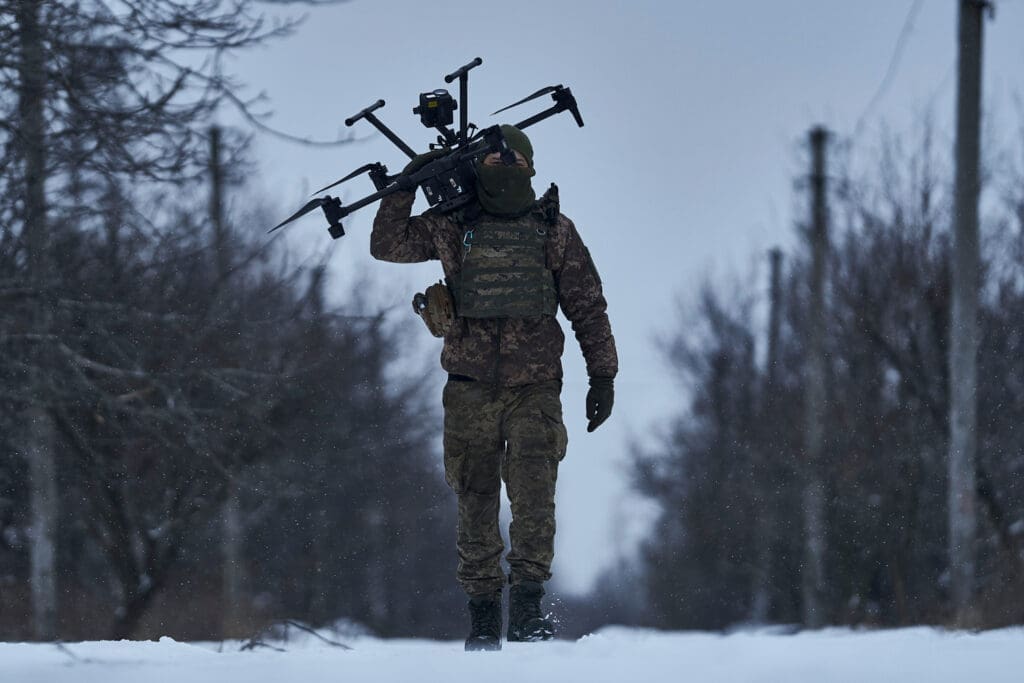
A Ukrainian soldier carries a drone close to the front line near Avdiivka, Donetsk region, Ukraine, on February 17, 2023. Libkos / AP
Ukraine’s expanding use of unmanned systems is reshaping the battlefield, turning low-cost drones into one of the most important weapons of the war and forcing both Kyiv and Moscow to rapidly adapt their tactics.
The war in Ukraine has become one of the clearest demonstrations yet of how quickly modern combat can change. What began as a conventional battlefield dominated by artillery, armor and entrenched front lines has evolved into a conflict where small, unmanned aircraft can decide whether a vehicle moves, a trench survives, or a supply route remains open.
For Ukraine, drones are no longer a secondary tool used only for reconnaissance. They have become central to how the military finds targets, strikes Russian positions, guides artillery and protects its own forces. From small first-person-view drones carrying explosives to longer-range systems capable of reaching targets deep behind Russian lines, unmanned technology has become one of Kyiv’s most important answers to Russia’s advantage in manpower and traditional firepower.
The shift has been especially visible along the front, where FPV drones have changed the daily rhythm of combat. These aircraft, often built from commercial or low-cost components, allow operators to fly directly into enemy vehicles, bunkers, troop positions and supply movements. Their relatively low price has made them attractive to units that need precision strike capability without relying on scarce missiles or expensive Western-supplied systems.
That affordability has also changed the economics of war. A drone costing hundreds or a few thousand dollars can threaten equipment worth millions. Tanks, armored vehicles, artillery systems and air defense assets are all vulnerable when operators can guide explosive drones into weak points from miles away. The result is a battlefield where movement is more dangerous, concealment is harder, and even rear areas are no longer guaranteed to be safe.
Ukraine’s drone ecosystem has grown rapidly under wartime pressure. Government programs, private companies, volunteer groups and military units have all contributed to the expansion of domestic drone production. The country has moved from relying heavily on imported commercial drones to building a broad defense-tech network focused on rapid production, battlefield testing and constant adaptation. That wartime innovation has helped Ukraine develop new unmanned systems faster than traditional procurement systems usually allow.
Russia has adapted as well. Moscow has expanded its own drone use, including reconnaissance drones, FPV strike drones and long-range one-way attack systems. Iranian-designed Shahed drones, now produced and modified by Russia, have become a persistent threat to Ukrainian cities, energy infrastructure and air defenses. Ukraine has responded with layered defenses that include electronic warfare, mobile fire teams, aircraft, air defense systems and interceptor drones.
The drone war has also created a constant technological race. Each side develops new systems, the other side develops countermeasures, and the cycle repeats. Electronic jamming can disrupt drone control signals. Fiber-optic drones can resist jamming. Artificial intelligence can help drones navigate or identify targets. Counter-drone systems can detect, jam or destroy incoming aircraft. In Ukraine, battlefield innovation is not happening over years; it is happening over weeks.
This has changed the way soldiers operate. Troops near the front must assume they are being watched from above. Vehicles move quickly, often at night or under cover. Camouflage, decoys and electronic protection have become daily necessities. A road that appears quiet can become lethal within minutes if a drone spots movement and relays coordinates to artillery or another strike drone.
The human cost is significant. Drone warfare can make the battlefield feel inescapable. Soldiers can be tracked from the air, pursued into tree lines, or struck inside positions that once offered protection. Evacuations and supply missions have become more complicated because drones can monitor routes and wait for movement. The front line is no longer just a line of contact; it is a wide surveillance zone where exposure can be deadly.
At the same time, Ukraine’s use of drones has allowed smaller units to punch above their weight. A well-trained drone team can locate Russian forces, destroy equipment, disrupt assaults and provide real-time intelligence to commanders. In some cases, drones have filled gaps left by shortages in artillery ammunition or air power. They do not replace every traditional weapon, but they have become essential to how Ukraine fights.
The lessons are already being studied far beyond Ukraine. Militaries around the world are watching how inexpensive unmanned systems can overwhelm older assumptions about air superiority, armor protection and battlefield mobility. The conflict has shown that future wars may not be won only by the side with the largest tanks or most advanced aircraft, but by the side that can produce, adapt and deploy technology faster.
Ukraine’s drone war is not just a story about new weapons. It is a story about how war itself is changing. The battlefield is becoming more transparent, more automated and more dangerous for anything that moves without protection. In that environment, drones have become more than machines in the sky. They have become scouts, weapons, shields and symbols of a new era of combat.
A senior CIA official tells Faytuks Network the US can confirm Mojtaba Khamenei survived the initial airstrike on February 28 that killed his father, then-Supreme Leader Ali Khamenei, but his whereabouts since have been a mystery.
U.S. forces are still on track to leave Iraq by Sept. 30, Reuters reports, even as regional tensions rise. Saudi Arabia is warning that Iran-backed groups in Iraq and Yemen could be preparing coordinated attacks on the Kingdom.
Faytuks Network is built by volunteers and powered by its community. Contributions help cover the hosting, security and infrastructure costs that keep the site running. Plus, exclusive Discord and X benefits!
We use cookies to ensure that we give you the best experience on our website. If you continue to use this site we will assume that you are happy with it.AcceptPrivacy Policy











No comment yet, add your voice below!