



Norway's King Harald Dies at 89

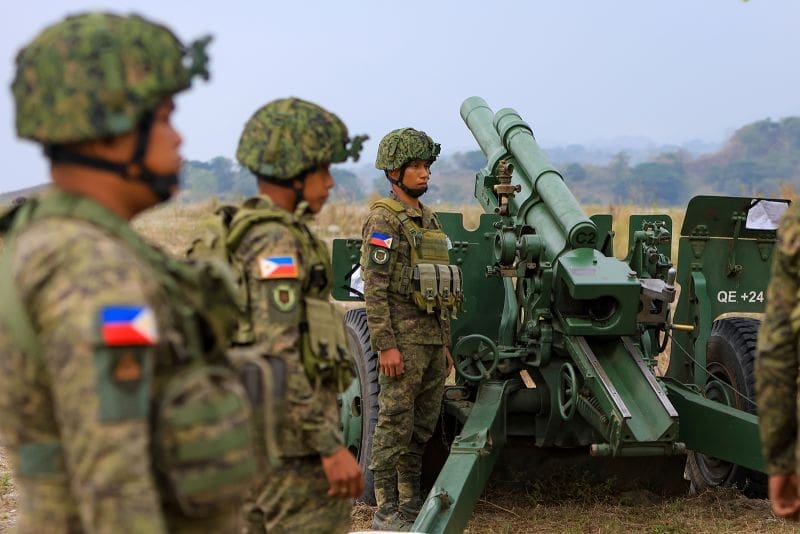
From archipelagic vulnerability to strategic anchor, Manila’s military modernization, economic corridors, minilateral partnerships, and 2026 ASEAN Chairmanship are forging a rules-based order in the most contested waterway on earth.
Strategic Hinge: The Philippine Archipelago as the Maritime Fulcrum
In the turbulent opening of 2026, as the world calibrates to a sustained era of multi-polarity, one nation in Southeast Asia stands out with remarkable clarity: the Republic of the Philippines. Bounded by the South China Sea to the west, the Philippine Sea to the east, and the Celebes Sea to the south, the Philippine archipelago is not merely a geographic curiosity; it is the strategic hinge upon which the balance of the Indo-Pacific pivots.
Under President Ferdinand Marcos Jr., Manila has executed one of the most consequential foreign and defence policy transformations in modern Southeast Asian history. The Philippines has shed the appeasement posture of the Duterte era and embraced an assertive, multi-vector “connector-state” strategy, positioning itself simultaneously as a military ally, economic partner, and diplomatic leader for a coalition of like-minded democracies.
In a recent address to Japanese media preceding his state visit, President Ferdinand Marcos Jr. acknowledged the inevitable strategic entanglement of the Republic in any potential Taiwan contingency. This sobering assessment is underscored by the archipelago’s immediate geographic proximity to the flashpoint and the imperative to protect the nearly 200,000 Filipino nationals currently residing within the island’s jurisdiction.
While emphasizing Manila’s desire for regional stability, the President articulated a pragmatic realism, noting that the immutable constraints of geography would likely compel its involvement should active hostilities erupt across the strait.
“Except that if there is actual confrontation, if there is conflict, just looking at the map, you can tell that the northern Philippines, at the very least, is going to be part of that or will feel the effects,” he said.
Constructing the Missile Bastion: Transitioning from Domestic Defense to Regional Deterrence
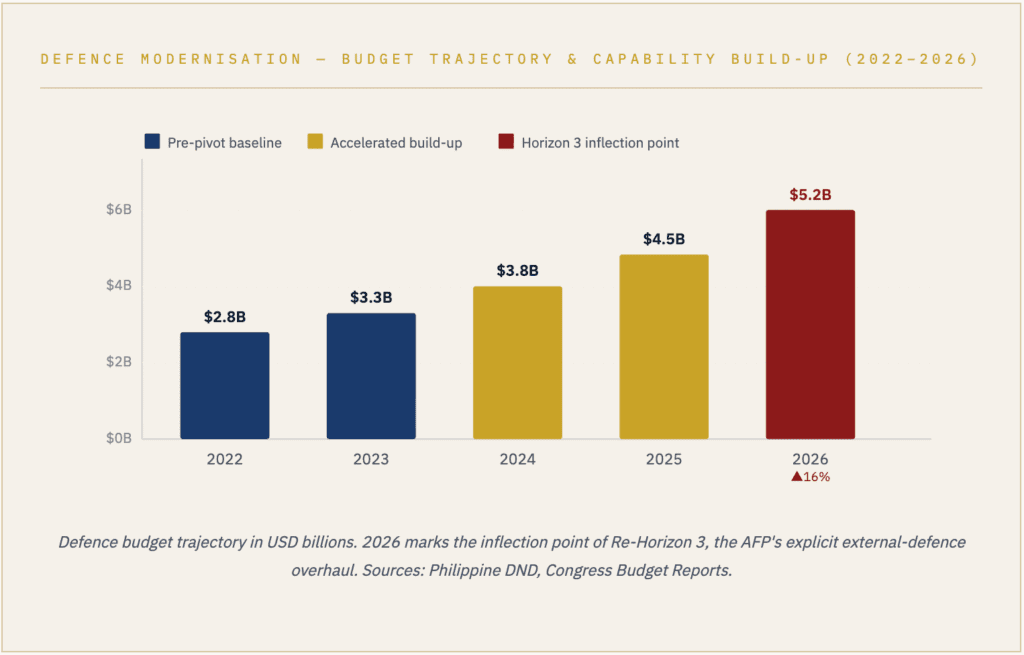
The most striking manifestation of this strategic pivot is the radical restructuring of the Armed Forces of the Philippines (AFP) via the “Re-Horizon 3” initiative, a $35 billion modernization program meticulously engineered for anti-access/area denial (A2/AD) capabilities against the People’s Liberation Army Navy. After decades of preoccupation with internal counter-insurgency, the AFP has, by 2026, officially realigned its core mission toward the preservation of the Exclusive Economic Zone (EEZ) and the defense of the First Island Chain.
“Defense leadership, notably Secretary Gilberto Teodoro Jr., has characterized Beijing’s sweeping maritime assertions across the South China Sea as an ‘existential’ threat to the sovereignty of the Republic.”
In a resolute fiscal commitment, the 2026 national budget has earmarked ₱40 billion (~$673 million) for immediate AFP capital upgrades, bolstered by a further ₱50 billion (~$842 million) in authorized unprogrammed funds. This unprecedented investment, reflected in a total defense outlay of $5.2 billion (₱299.3 billion), a 16% surge from the prior year, cements Manila’s status as one of the most rapidly ascending military spenders within Southeast Asia.
The Triad of Deterrence
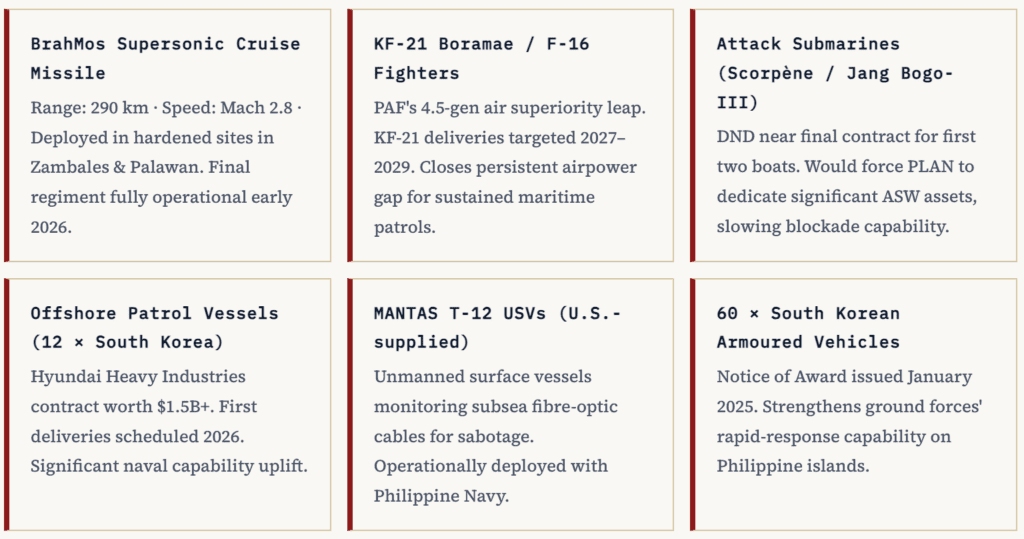
The operationalization of Manila’s deterrent posture is anchored upon a triad of strategic capability advancements, precisely calibrated to remediate historical deficits in the Republic’s maritime power projection:
Synthesizing Sensor-to-Shooter Efficacy: Collaborative Integration with U.S. Marine Littoral Regiments
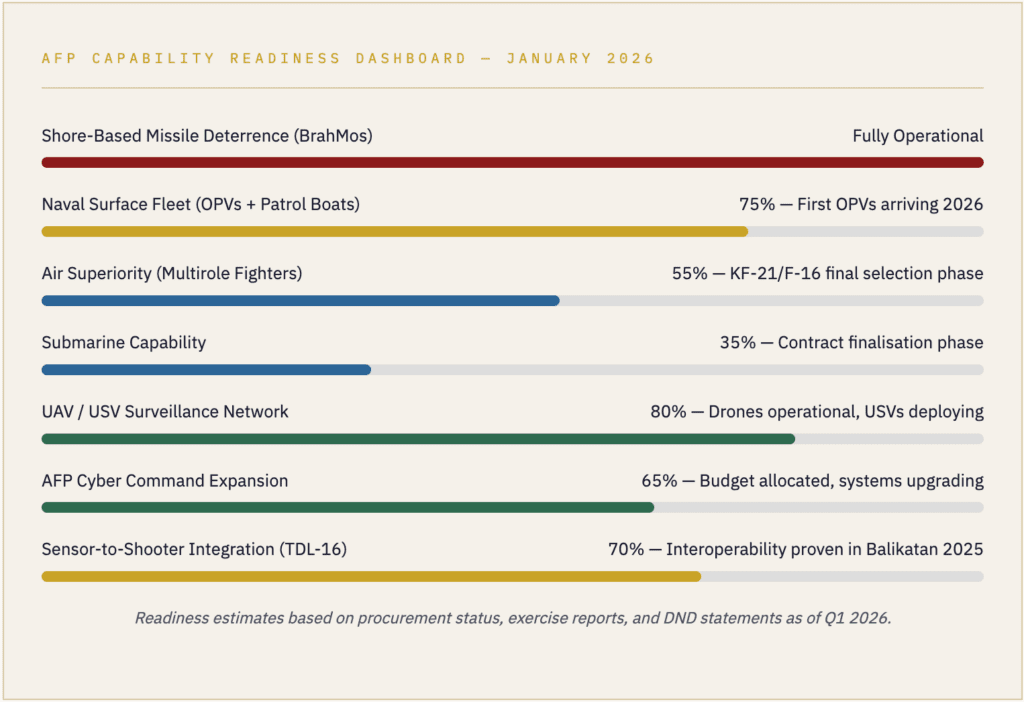
This comprehensive modernization extends far beyond the acquisition of physical hardware. The Philippine Marine Corps (PMC) is currently undergoing a profound doctrinal metamorphosis, catalyzed by high-intensity interoperability with U.S. Marine Littoral Regiments (MLR). Landmark engagements, such as Exercise Balikatan 2025, have validated the efficacy of cross-domain targeting, where American surveillance assets, including advanced UAVs and orbital sensors, seamlessly relay precision coordinates to Philippine BrahMos units, establishing a formidable combined-arms deterrent.
Furthermore, Exercise Kamandag 9 (late 2025) focused on institutionalizing “shoot-and-scoot” maneuvers, ensuring the survivability of PMC elements against sophisticated electronic and satellite reconnaissance. These efforts culminated in the Basco Coastal Campaign, which stress-tested the defense of the Bashi Channel, a vital maritime corridor on Taiwan’s southern perimeter, through the rapid deployment of BrahMos batteries via naval logistics and aerial insertion.
By the dawn of 2026, the Philippine Coastal Defense Missile Force has achieved full operational status, with assets strategically positioned within reinforced and concealed installations across Palawan and Northern Luzon. This emergent “missile wall” provides overlapping, multi-layered coverage across the most volatile sectors of the West Philippine Sea, effectively reinforcing the Republic’s maritime sovereignty.
“Navigating Our Future, Together”: Manila as the Institutional Bulwark
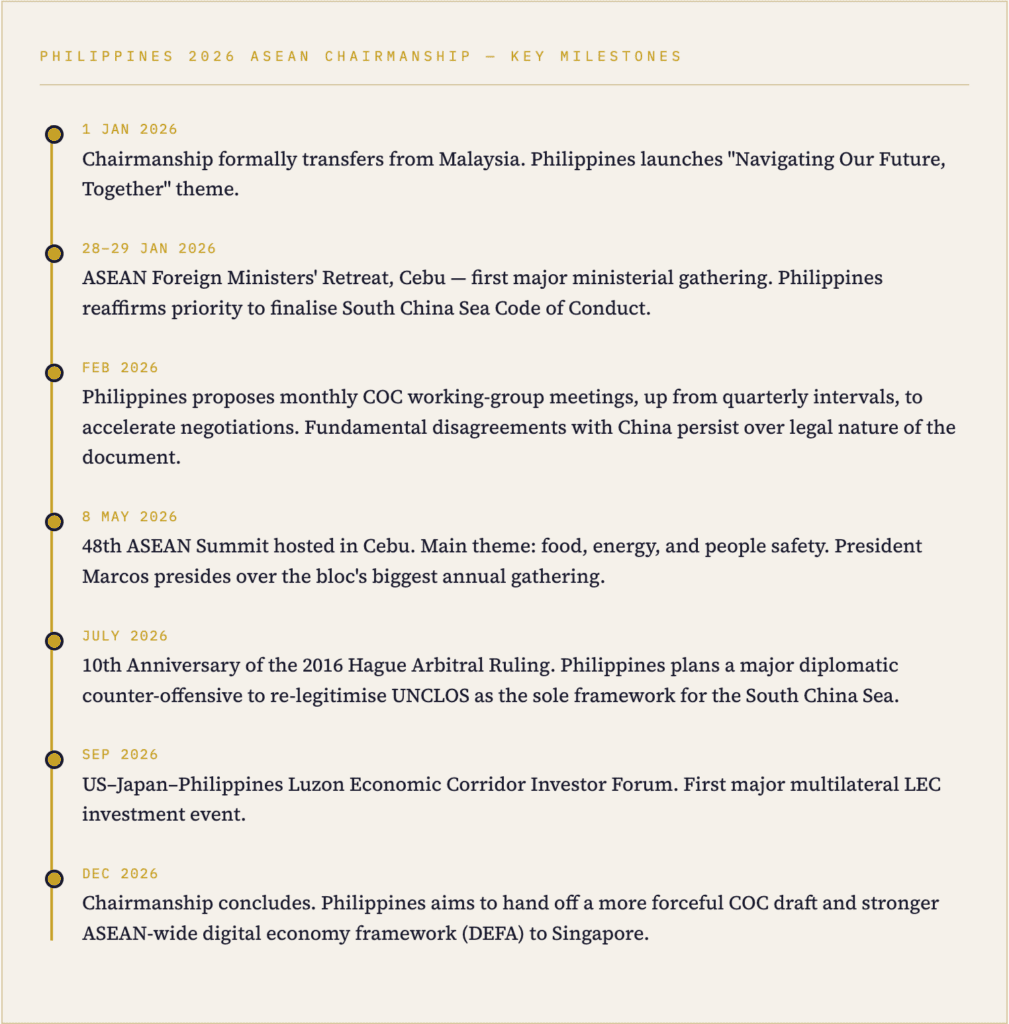
On January 1, 2026, the Republic assumed the pivotal role of ASEAN Chair, championing the institutional theme “Navigating Our Future, Together.” This strategic chairmanship is meticulously architected upon a tripartite framework: peace and security anchors, prosperity corridors, and people empowerment. Manila is set to orchestrate an unprecedented diplomatic surge, facilitating over 650 high-level engagements, including two principal summits and 24 ministerial dialogues, representing the most intensive operational tempo in the bloc’s contemporary history.
“The temporal alignment of this leadership mandate is profoundly symbolic, coinciding with the decennial anniversary of the 2016 Arbitral Award, which decisively dismantled the legal basis of Beijing’s expansive maritime claims.“
Manila is strategically leveraging this historic milestone to re-entrench UNCLOS as the primary, non-negotiable benchmark for South China Sea governance. This assertive diplomatic maneuver effectively presents ASEAN with a fundamental choice: the preservation of a rules-based system or the quiet acceptance of a “might-is-right” regional paradigm.
The Non-Indifference Doctrine: Reimagining ASEAN Collective Resilience
Perhaps the most conceptually ambitious pillar of Manila’s chairmanship is the direct challenge to the often-paralyzing tradition of “non-interference” within the bloc. The Philippines is actively advancing the doctrine of “Non-Indifference”,a strategic proposition that ASEAN cannot remain a passive bystander when coercive PLA exercises or persistent grey-zone operations jeopardize regional trade arteries and human life. This sophisticated reframing seeks to fundamentally calibrate the bloc’s collective response capacity, ensuring that great-power coercion is met with institutional resolve rather than diplomatic silence.
Undersea Governance: Securing the Digital and Physical Seabed
In a parallel priority, Manila is elevating “Undersea Governance,” the protection of critical fiber-optic networks, seabed mineral resources, and submerged infrastructure, to the forefront of the ASEAN security agenda. By pivoting the South China Sea discourse from a localized friction over “fishing rights” toward a broader imperative of critical infrastructure protection, the Republic is positioning any interference with maritime cables as a systemic regional violation. To operationalize this mission, the Philippine Navy has already integrated advanced MANTAS T-12 unmanned surface vessels to provide persistent, high-fidelity monitoring of these vital undersea corridors.
Conclusion
Manila is no longer managing disparate initiatives; it has architected a unified strategic ecosystem. In this framework, advanced missile batteries are sustained by the Energy Secure Philippines initiative, providing a security umbrella for Pax Silica industrial hubs and New Clark City acceleration zones. These assets are monitored via high-fidelity unmanned surface vessels and codified by the 2016 Arbitral Award, all while being diplomatically championed through the Republic’s pivotal ASEAN Chairmanship. Each pillar of sovereignty serves to reinforce the durability of the next.
Should the Republic falter, whether through the unravelling of domestic political continuity, the deceleration of growth velocities, or the erosion of alliance reliability, the First Island Chain would lose its critical southern anchor. Such a strategic failure would deprive regional partners like Vietnam and Malaysia of a potent moral precedent and silence the most resolute legal voice defending maritime norms. Without this foundation, the Luzon Economic Corridor would lose its geoeconomic raison d’être, leaving the South China Sea vulnerable to systemic coercion.
Ultimately, the Philippines is not merely a stakeholder in the regional security architecture; it has become, through its geographic positioning, institutional resolve, and emergent capability, the indispensable bulwark for a Free and Open Indo-Pacific (FOIP).
Sources:
- Asian Development Bank (ADB). Asian Development Outlook September 2025 & April 2026.
- CSIS. “Rhetoric vs. Reality: The Philippines, ASEAN, and the South China Sea.” November 2025.
- Chatham House. “With the Philippines as ASEAN Chair, a South China Sea Agreement is unlikely.” December 2025.
- Foreign Policy. “The Philippines Wants to Seal South China Sea Code of Conduct.” February 2026.
- Foreign Policy. “The Philippines Are in for a Turbulent 2026 as ASEAN Chair.” January 2026.
- OECD. Economic Surveys: Philippines 2026. February 2026.
- The Diplomat. “Southeast Asia’s Military Modernisation Set to Accelerate in 2026.” January 2026.
- U.S. Embassy Manila. “Fact Sheet: Luzon Economic Corridor.” May 2026.
- U.S. Department of State. “U.S. and Philippines Plan the Launch of Historic 4,000-Acre Economic Security Zone.” April 2026.
- Xinhua. “Philippine Congress Boosts Army Modernisation Budget to $673M in 2026.” January 2026.
- Philippine Congress / DND. FY 2026 National Budget Documentation.
- ASEM InfoBoard. “Philippines 2026 ASEAN Chairmanship.” February 2026.
- Second Line of Defense. “The Luzon Economic Corridor and Pax Silica.” April 2026.
- Rappler. “Philippines Takes ASEAN Helm Amid Stormy Seas.” February 2026.

A senior CIA official tells Faytuks Network the US can confirm Mojtaba Khamenei survived the initial airstrike on February 28 that killed his father, then-Supreme Leader Ali Khamenei, but his whereabouts since have been a mystery.
U.S. forces are still on track to leave Iraq by Sept. 30, Reuters reports, even as regional tensions rise. Saudi Arabia is warning that Iran-backed groups in Iraq and Yemen could be preparing coordinated attacks on the Kingdom.



No comment yet, add your voice below!