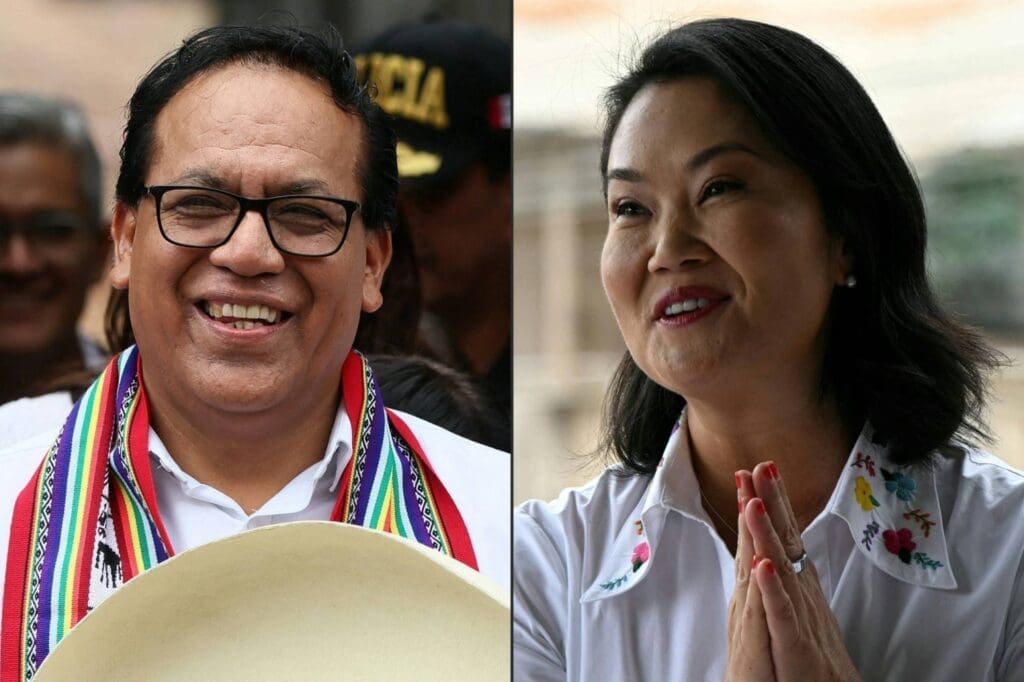
Peruvians headed to the polls Sunday in a closely contested presidential runoff election between right-wing candidate Keiko Fujimori and left-wing candidate Roberto Sánchez, capping a deeply polarized campaign that has highlighted sharp divisions over the country’s economic model, security policies and foreign relations.
Recent opinion polls have suggested a tight race, with both candidates competing for undecided voters in a country that has experienced years of political instability and frequent changes in government.
Keiko Fujimori
Fujimori, the daughter of former President Alberto Fujimori, is seeking the presidency for a fourth time after unsuccessful bids in 2011, 2016 and 2021.
Her platform focuses heavily on public security and economic liberalization. Fujimori has pledged to increase investment in police equipment and deploy the military to strengthen border security. Economically, she supports deregulation, foreign investment and a reduction in government spending, while promoting the use of artificial intelligence to streamline public administration.
In healthcare, Fujimori has proposed creating an online platform aimed at reducing hospital overcrowding and increasing investment in medical infrastructure. Her education proposals include curriculum reforms emphasizing civic values and expanding access to digital classrooms in rural areas.
She has also called for greater investment in renewable energy to reduce dependence on imported diesel, while advocating anti-corruption measures centered on digital transparency tools. In foreign affairs, she has pledged to pursue what she describes as a pragmatic foreign policy.
Roberto Sánchez
Sánchez, a congressman and former minister of foreign trade and tourism under former President Pedro Castillo, is running on a left-wing platform centered on expanding the role of the state in the economy.
On security, Sánchez has proposed police reforms and the repeal of laws he argues contribute to impunity. Economically, he has called for moving away from Peru’s current market-oriented model in favor of greater state involvement in strategic sectors, along with policies aimed at industrialization and agrarian reform.
His healthcare plan includes increasing public health spending to 8% of the national budget and expanding access to essential services to cover 95% of the population. In education, Sánchez has pledged to raise spending to 6% of the budget, with goals including universal access to water, sanitation and electricity in rural schools, as well as increasing secondary school completion rates.
Sánchez has also proposed placing the energy sector under greater state control while increasing the share of electricity generated from clean sources to 40%. His platform includes judicial and constitutional reforms intended to strengthen anti-corruption efforts.
In foreign policy, he has advocated closer ties with BRICS countries and deeper Latin American integration.