



Norway’s King Harald Hospitalized in Oslo

NASA’s Swift Telescope Faces Fiery Reentry After Rescue Mission Fails
- NASA has abandoned plans to capture and raise the orbit of the Swift Observatory after the spacecraft sent to save it suffered major attitude-control problems.
- By Ken K
- • August 19 2026
- •
- 5 minutes
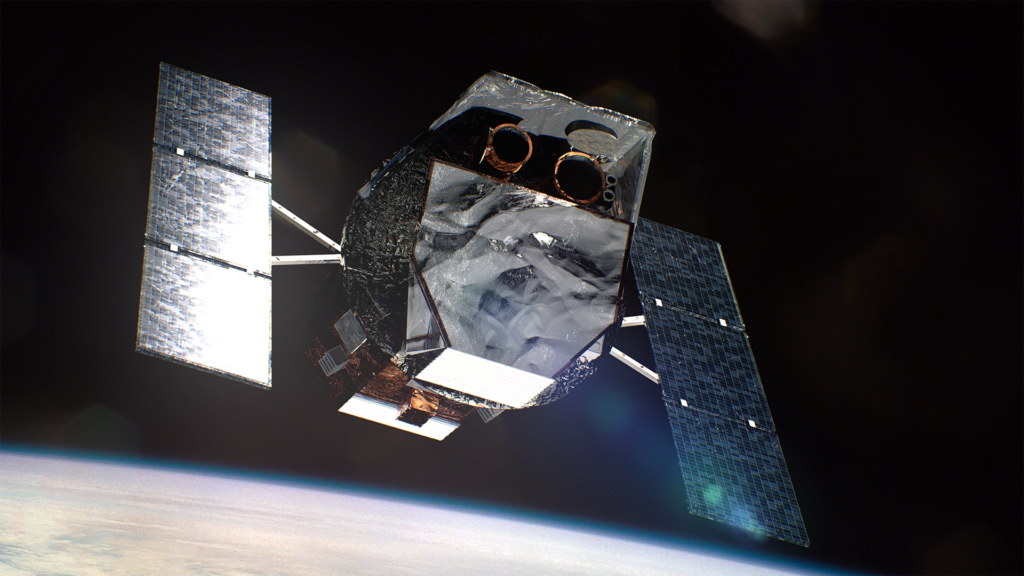
- An artist’s concept shows NASA’s Neil Gehrels Swift Observatory orbiting above Earth. Image from NASA Goddard Space Center.
NASA’s Neil Gehrels Swift Observatory is likely headed for a destructive reentry later this year after a first-of-its-kind mission to save the aging space telescope failed, NASA said Wednesday.
NASA and Katalyst Space Technologies have dropped plans for the company’s LINK spacecraft to capture Swift and push it into a higher orbit. LINK suffered persistent attitude-control problems after reaching space, leaving it unable to safely carry out the boost.
The decision leaves Swift, which has spent more than two decades studying some of the most violent events in the universe, without an announced way to stop its continuing orbital decay. NASA said the observatory is likely to reenter Earth’s atmosphere later in 2026. The reentry is not expected before October, according to The Associated Press.
Swift itself did not suffer the failure that ended the rescue attempt. The problem struck LINK, the robotic servicing spacecraft built by Arizona-based Katalyst to reach the observatory, grab it and gradually raise its orbit.
LINK launched July 3 aboard a Northrop Grumman Pegasus XL rocket released from an aircraft near Kwajalein Atoll in the Marshall Islands. The spacecraft initially completed a series of checkouts, but trouble emerged later in July.
NASA said July 28 that two of LINK’s three reaction wheels were not operating and that its cold-gas thruster system had also lost some functionality. The failures caused LINK to enter a multi-axis spin and led to sporadic communications with controllers.
Engineers spent weeks trying to recover the spacecraft. LINK was initially spinning at about 9 degrees per second. Katalyst used an electric propulsion thruster to slow that rotation to about 1.47 degrees per second by Aug. 6. Engineers then uploaded new flight software designed to control the spacecraft using its remaining working systems.
Those efforts were not enough to make a capture attempt safe. NASA and Katalyst announced Aug. 19 that LINK would no longer attempt to grapple Swift or raise its orbit. The spacecraft may still approach Swift and carry out rendezvous and proximity operations, allowing engineers to collect data that could help future satellite-servicing missions.
“This is not the outcome we were working toward,” NASA Administrator Jared Isaacman said. He said NASA would use lessons from LINK’s remaining operations to support future missions.
The loss of the boost leaves Swift in an increasingly unforgiving orbit. NASA reported Aug. 11 that the observatory was about 216 miles, or 347 kilometers, above Earth. Engineers considered an average altitude of about 185 miles, or 300 kilometers, a critical threshold below which attempting the rescue would become substantially harder.
Increased solar activity has accelerated Swift’s fall. Energy from an active Sun heats and expands Earth’s upper atmosphere, increasing the small amount of atmospheric drag experienced by satellites in low Earth orbit. NASA said unexpectedly strong activity around the 2024 solar maximum sharply changed projections for Swift, with models that once extended into the 2030s shifting toward a 2026 reentry.
With the orbit-raising attempt now abandoned, that slow descent is expected to continue until Swift encounters enough atmosphere to reenter.
What Swift was built to do
Swift launched from Cape Canaveral on Nov. 20, 2004, as a new kind of rapid-response space observatory built primarily to study gamma-ray bursts, or GRBs. NASA renamed it the Neil Gehrels Swift Observatory in 2018 in honor of the mission’s first principal investigator.
Gamma-ray bursts are brief, extraordinarily powerful flashes of high-energy radiation linked to events such as the collapse of massive stars and mergers involving neutron stars. Because many fade rapidly, astronomers need to locate them and begin follow-up observations within seconds or minutes.
Swift was designed specifically for that job. Its wide-field Burst Alert Telescope, or BAT, watches the sky for new gamma-ray bursts and can calculate their locations. Swift can then automatically turn toward the event, bringing its X-Ray Telescope and Ultraviolet/Optical Telescope to bear on the same area. Under normal operations, the spacecraft can begin that repositioning within roughly 20 to 100 seconds.
Together, the three instruments allow astronomers to study a single event in gamma rays, X-rays, ultraviolet light and visible light. Swift also rapidly sends burst locations to researchers on Earth, allowing other observatories to join the observation.
That rapid response helped turn Swift into what NASA has called an “astrophysics multitool.” Its work expanded beyond gamma-ray bursts to include supernovae, neutron stars, black holes, stellar explosions, tidal disruption events and other objects that suddenly brighten or change.
The race to save Swift
The threat to Swift did not begin with a failure of its science instruments. Instead, the spacecraft gradually lost altitude because of atmospheric drag, a normal problem for objects in low Earth orbit that cannot regularly raise their own orbits. Stronger-than-expected solar activity accelerated that process.
By early 2025, NASA said nearly all of its orbital models showed Swift reentering by 2026. The agency began looking for an unconventional way to keep the observatory alive.
NASA awarded Katalyst Space a contract in September 2025 to build and fly a spacecraft capable of reaching Swift, capturing it and raising its orbit. The contract was worth about $30 million, and Katalyst had less than a year to design, build, test and launch LINK.
While Katalyst raced to build the rescue craft, Swift’s own operators tried to buy time. NASA suspended most Swift science operations on Feb. 11 so controllers could keep the spacecraft pointed in an orientation that presented less surface area to the thin upper atmosphere. The change reduced drag and slowed the observatory’s descent. Swift’s Burst Alert Telescope remained able to detect gamma-ray bursts, but the spacecraft stopped its normal rapid slews for follow-up observations with its other telescopes.
The strategy worked well enough to extend the rescue window. NASA said in May that the new operating method was likely to keep Swift above the critical 185-mile altitude into early fall.
LINK’s July launch appeared to put a rescue within reach. The plan called for the robotic spacecraft to rendezvous with Swift, secure it with its capture system and then slowly raise the observatory toward a much safer orbit. Success could have extended Swift’s scientific life by years while also demonstrating technology for servicing other satellites.
Instead, LINK’s attitude-control problems stopped the mission before the two spacecraft could be joined. LINK’s remaining rendezvous work could still provide NASA and Katalyst with useful experience in autonomous navigation and operations around another satellite. But it will not change Swift’s orbit.
For Swift, a mission that spent more than 20 years racing to catch some of the universe’s shortest-lived explosions is now in its own race against time. NASA expects the observatory’s orbit to keep shrinking until it falls into the atmosphere later this year, bringing one of the agency’s longest-running high-energy astronomy missions to an end.
More Stories
from the Faytuks Newsroom.
Share this Story
From Faytuks Network

A senior CIA official tells Faytuks Network the US can confirm Mojtaba Khamenei survived the initial airstrike on February 28 that killed his father, then-Supreme Leader Ali Khamenei, but his whereabouts since have been a mystery.
U.S. forces are still on track to leave Iraq by Sept. 30, Reuters reports, even as regional tensions rise. Saudi Arabia is warning that Iran-backed groups in Iraq and Yemen could be preparing coordinated attacks on the Kingdom.
Support Faytuks Network
Faytuks Network is built by volunteers and powered by its community. Contributions help cover the hosting, security and infrastructure costs that keep the site running. Plus, exclusive Discord and X benefits!
Contribute





No comment yet, add your voice below!