
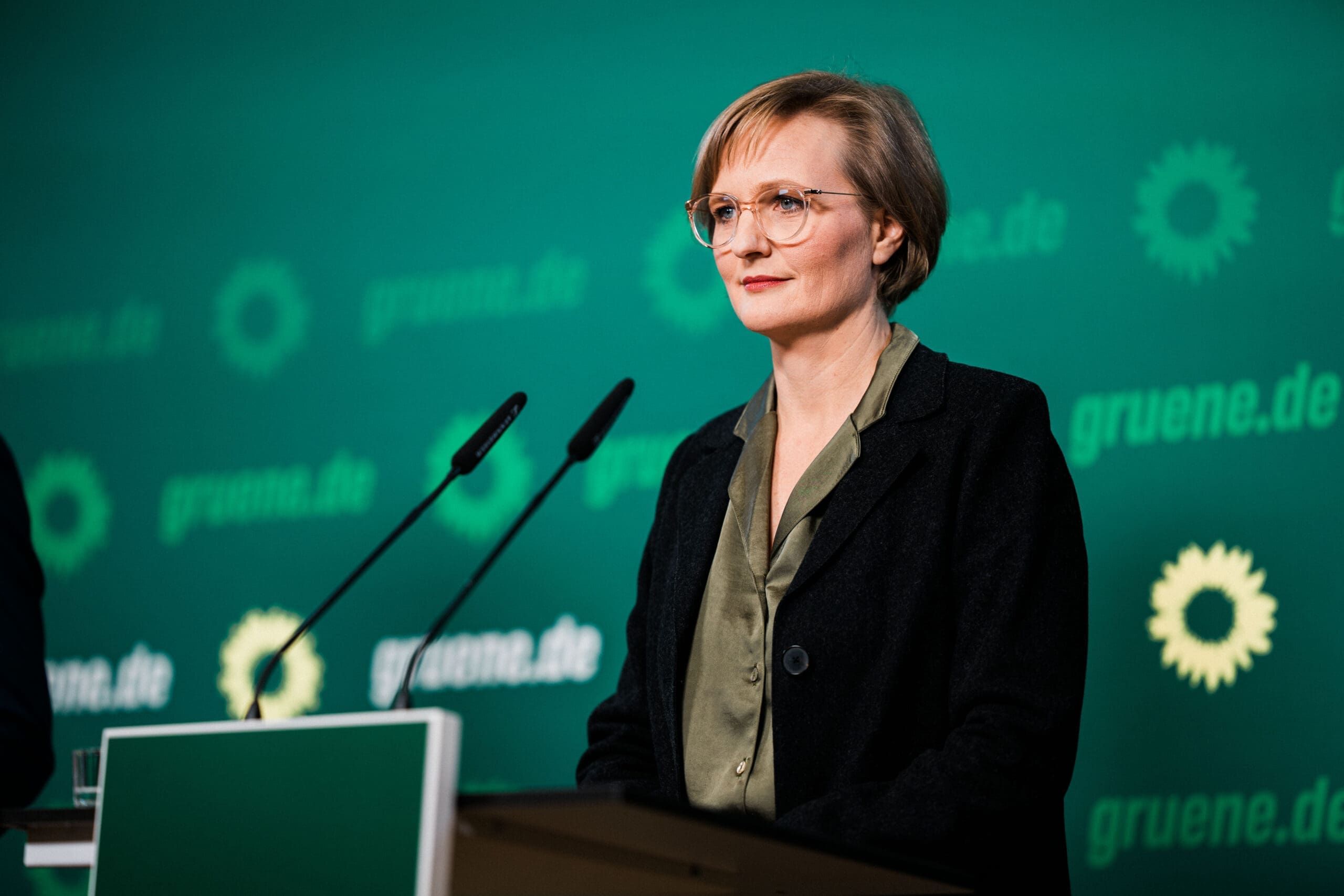
With its junior coalition partner SPD hitting historic lows in recent polling and new cross-party synergies emerging on digital regulation and structural reform, Germany’s conservatives and the Greens are cautiously exploring shared avenues for potential future federal governance.
The Backroom Revival: Pizza, Pasta and Political Realignment
On a mild spring evening in Berlin’s Moabit district, a stream of black Audi limousines with tinted windows pulls up outside a local Italian restaurant. While regular patrons dine outside on pasta and wine under the marquises, high-profile occupants of the Bundestag transport fleet step past the front entrance. Their destination is a private backroom with petrol-green walls, shielded by a heavy red curtain for maximum discretion.
As documented in a revealing domestic report by Der Spiegel, an elite, confidential cross-party contingent of federal lawmakers from the conservative Union (CDU/CSU) and the environmentalist Green Party are quietly gathering here during parliamentary session weeks. This regular, discreet format marks a modern revival of the so-called “Pizza Connection” of the 1990s, when a younger generation of then-Bonn politicians first overcame their ideological differences to exchange ideas. Coordinated on the Green side by Claudia Müller – the party’s top candidate in Mecklenburg-Vorpommern – and on the CDU side by Silvia Breher, these confidential rounds allow roughly two dozen lawmakers to step away from public posturing and gauge potential policy overlaps.
The strategic alignment extends all the way to the leadership level. In an even more striking pairing, Katharina Dröge, the co-leader of the Greens’ parliamentary group, has cultivated a resilient personal rapport with CSU hardliner Alexander Dobrindt. Despite sitting on opposite ends of the ideological spectrum, the two have apparently established an informal relationship where they address each other with the familiar “Du” – a detail that accidentally slipped into the open during a broadcast on German public television. Dröge emphasizes that this dialogue is about building a reliable personal foundation rather than immediate policy concessions, noting that “those who are furthest apart contextually must speak to one another.”
Strategic Subtext in Leipzig: Softening Rhetoric and Internal Tensions
The changing political climate was put on prominent display during the Greens’ recent parliamentary group retreat in Leipzig. In a highly symbolic move that turned heads across Berlin, Green faction leaders Britta Haßelmann and Katharina Dröge invited Annegret Kramp-Karrenbauer, the former CDU leader and current head of the Konrad-Adenauer-Foundation, to address their 85 lawmakers on the polarization of society and the cooperation of democratic forces.
The invitation carried an unmistakable dual purpose. On one hand, it served as a calculated political jab aimed at German Chancellor Friedrich Merz, who had openly opposed Kramp-Karrenbauer’s appointment to the flagship conservative think tank during a fierce internal party battle. On the other hand, it broadcasted a clear, reconciliatory signal to the broader Union, signalling an explicit willingness by the Greens to establish a productive dialogue with the conservative establishment.
This outreach is finding an inconspicuous echo within the Union. The once-relentless anti-green rhetoric from Chancellor Merz and Bavarian Minister-President Markus Söder has noticeably quieted – which could, admittedly, also be explained simply by an increased focus on their own coalition partner. Behind closed doors, however, influential figures within the CDU are beginning to acknowledge that governing alongside a cohesive, disciplined Green Party might actually prove less exhausting and far more stable than enduring the endless friction and policy stagnation associated with their current junior coalition partner, the SPD.
These strategic calculations are further compounded by internal whispers of a potential chancellor swap, with factions increasingly looking toward Hendrik Wüst – the North Rhine-Westphalian Minister-President who is currently steering a successful Black-Green coalition.
The Catalyst: Electoral Shifts and State Blueprints
This cautious dance is being actively accelerated by a dramatic reconfiguration of Germany’s polling landscape. A recent GMS poll has sent shockwaves through Berlin, capturing the junior coalition partner SPD in a free fall, plummeting to a historic low of just 11 percent.
For the Greens, these shifting numbers offer profound relief. Climbing to between 14 and 16 percent nationwide, they are now running neck-and-neck with the Social Democrats, and in some cases overtaking them entirely – a devastating blow for the SPD, which has historically stood alongside the conservative Union as Germany’s other major ‘people’s party’ (Volkspartei).
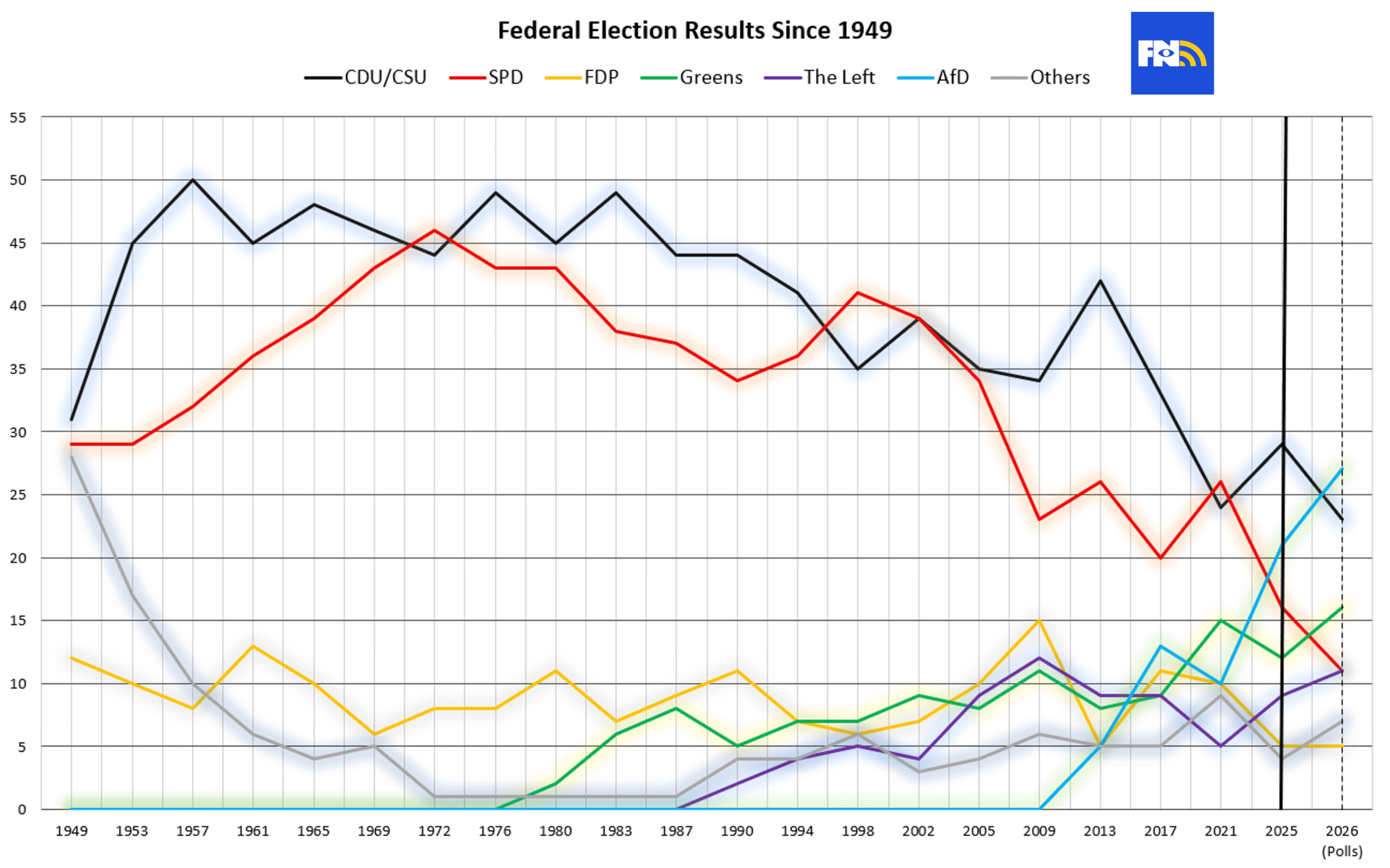
A table showing the results of all Federal German Elections since 1949 and a current poll by GMS.
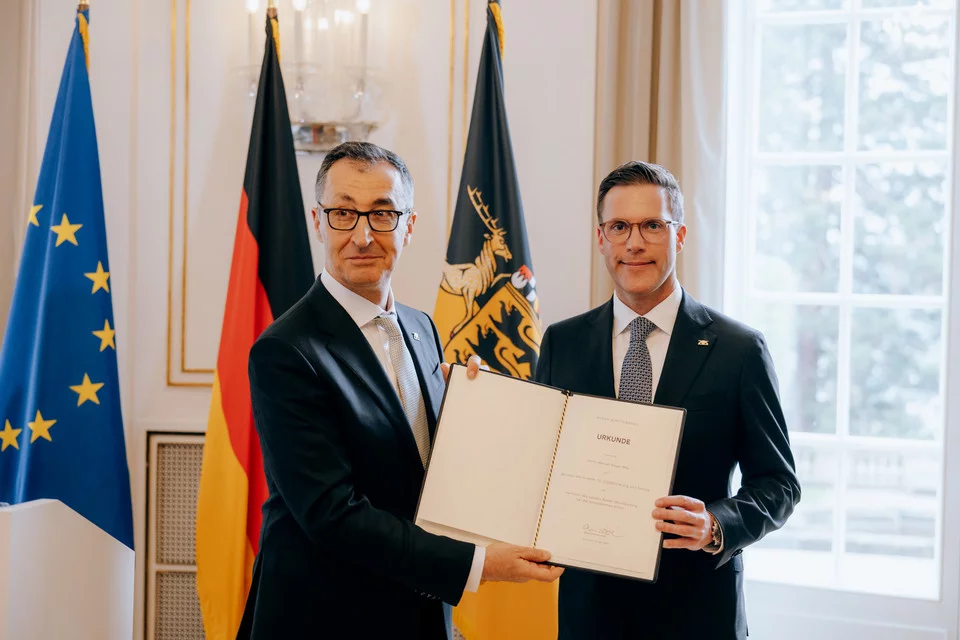
Furthermore, a functional “proof of concept” for Black-Green governance already flourishes at the regional level. Green co-leader Felix Banaszak successfully helped architect the highly cooperative, stable coalition in North Rhine-Westphalia under CDU Minister-President Hendrik Wüst. Similar arrangements are operating smoothly in Schleswig-Holstein, and in Baden-Württemberg, where Green heavyweight Cem Özdemir was recently sworn in as Minister-President following successful coalition negotiations with the regional CDU.
Bridging the Gap: Policy Convergence and Upcoming Litmus Test
The rapprochement is in some cases also translating into legislative synergy. In an unexpected display of policy convergence, the Greens recently provided a tailwind to conservative proposals aimed at implementing a social media ban for children, demonstrating that the two historical antagonists can potentially collaborate on complex digital and societal regulations. They also share what are arguably the two most robust pro-Ukrainian and pro-NATO stances in Germany’s political landscape. Their mutual embrace of military rearmament is a defining trait that sharply distinguishes the German Greens from their traditionally pacifist counterparts across Europe and the globe.
Prominent Green strategists are actively framing a potential federal alliance as a unique vehicle capable of unlocking profound structural and economic reforms that previous coalitions could not deliver. By bridging conservative fiscal principles with the Greens’ modernization goals, figures like Baden-Württemberg Finance Minister Danyal Bayaz argue that the party can position itself as a credible reform entity addressing pressing issues like pension security and labour market flexibility.
Serious programmatic hurdles, however, remain entrenched. Negotiators on both sides freely admit that migration continues to be the most volatile chasm dividing the camps, closely followed by persistent friction points surrounding national energy policy. While leaders like Schleswig-Holstein’s Deputy Minister-President Aminata Touré note that a drop in asylum application numbers has allowed the Union to discuss migration more factually – potentially easing federal cooperation – the Green left wing remains highly vigilant against compromising core ecological and social ideals.
The first true litmus test for this evolving relationship will arrive next year during the Federal Assembly’s vote to select a successor to President Frank-Walter Steinmeier. Whether the Union and the Greens can turn their quiet backroom dinners into a broader constitutional consensus will determine if this cautious testing of the waters is merely a temporary tactical flirtation or the blueprint for Germany’s next governing era.


No comment yet, add your voice below!