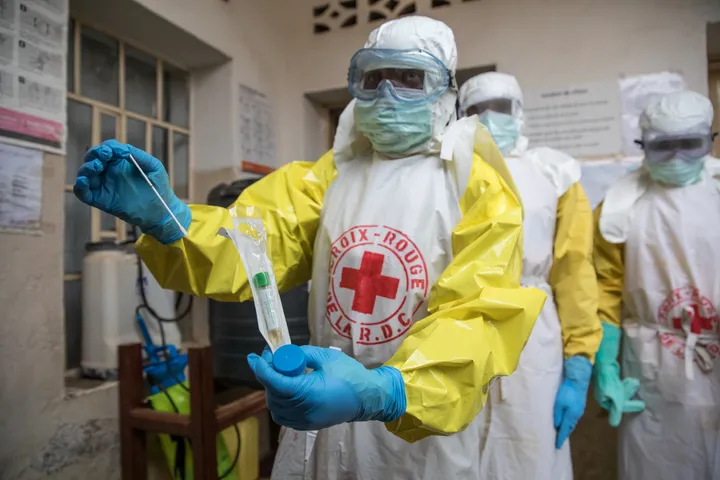
New research suggests the Ebola outbreak in eastern Democratic Republic of Congo and Uganda may be spreading far more widely than confirmed case counts show, raising pressure on health agencies as they try to contain a rare Ebola strain with no approved vaccine or specific treatment.
Researchers at Imperial College London estimated that the outbreak may have already caused roughly 400 to 800 infections. The estimate is far above the early confirmed case count and points to a large gap between detected cases and the likely true scale of transmission.
The outbreak is caused by Bundibugyo ebolavirus, a rare Ebola-causing virus that has been documented in only two previous outbreaks, in Uganda in 2007 and Congo in 2012. Experts at the London School of Hygiene & Tropical Medicine said the current event is already believed to be the largest known outbreak of Bundibugyo virus disease.
The World Health Organization declared the outbreak a public health emergency of international concern on May 17, citing confirmed cases in Congo and Uganda, suspected deaths across multiple health zones and the risk of further cross-border spread. WHO said the event does not yet meet the criteria for a pandemic emergency.
The emergency declaration came after Congo reported eight confirmed cases, 246 suspected cases and 80 suspected deaths in Ituri province as of May 16. Uganda also reported two confirmed cases in Kampala, including one death, among people who had traveled from Congo.
Scientists said the numbers may reflect weeks of undetected transmission before the outbreak was formally recognized. In expert comments published by the Science Media Centre, researchers warned that insecurity, displacement and high population mobility in eastern Congo could make surveillance, contact tracing and patient isolation much harder.
Bundibugyo virus also creates a harder medical response than the more common Zaire Ebola virus. Licensed Ebola vaccines and treatments were developed mainly for Zaire ebolavirus and are not expected to protect against Bundibugyo virus disease, according to experts cited by the Science Media Centre.
That leaves responders relying on core outbreak controls: fast testing, isolation, contact tracing, safe burials, infection control in clinics and clear community messaging. LSHTM experts said those steps are especially difficult in Ituri, where armed insecurity, displacement, weak infrastructure and mobile mining communities can slow the response.
Africa CDC also declared the outbreak a public health emergency of continental security on May 18. The agency said it was concerned by cross-border movement, community deaths outside formal health systems, weak infection control and the proximity of affected areas to Rwanda and South Sudan.
The warning from researchers changes the picture of the outbreak. The official totals show what has been found. The modeling suggests what may already be happening beyond the reach of testing and surveillance.
For health officials, that gap is now the central danger. The faster teams can find hidden chains of transmission, the better chance they have of stopping the outbreak before it spreads deeper into cities, border communities and health facilities.