



Norway’s King Harald Hospitalized in Oslo

North Korea Rewrites Its Constitution, Erasing the Dream of a Unified Korea
- By Boyka B.
- • May 9 2026
- •
- 8 minutes
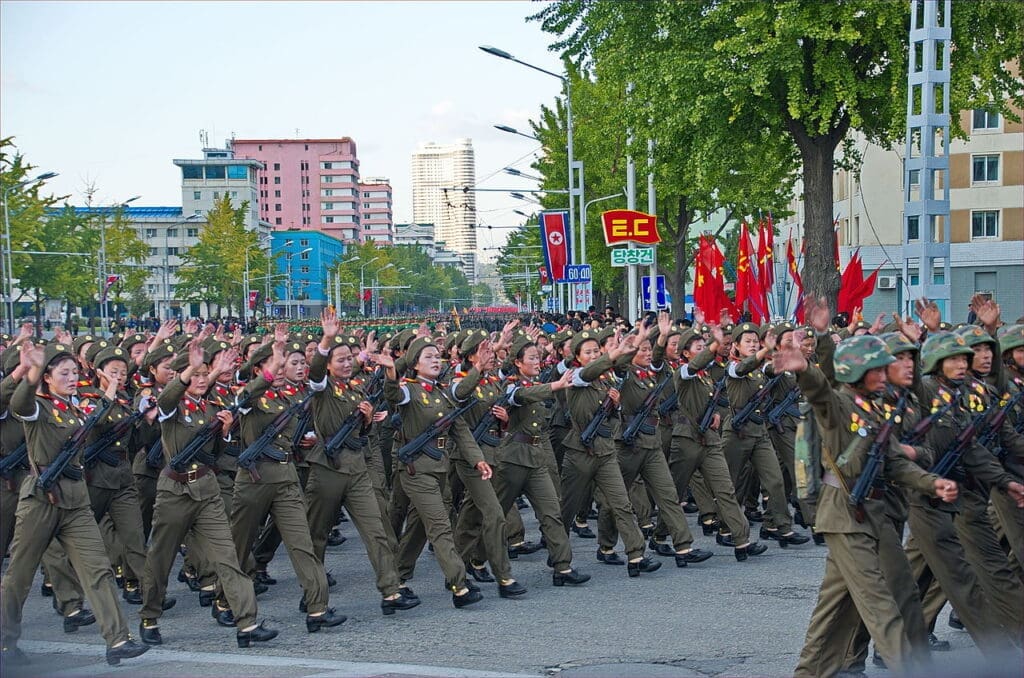
- Image: Uwe Brodrecht/Wikimedia
North Korea has quietly but decisively revised its constitution, stripping out decades-old language calling for reunification and formally recognizing two separate Korean states.
Per reports, the revision was likely adopted at a March meeting of North Korea’s Supreme People’s Assembly and disclosed on May 6 at a news conference by South Korea’s Unification Ministry. It removes language calling for the “peaceful reunification” of the Korean Peninsula, language that had been enshrined in the North’s constitution since a 1992 revision.
The significance of what now replaces that language cannot be overstated.
A new Article 2 defines North Korean territory as the land “bordering the People’s Republic of China and the Russian Federation to the north and the Republic of Korea to the south”, the first time North Korea has ever added a territorial clause to its constitution.
By naming the “Republic of Korea” as a neighboring country rather than a wayward southern province, Pyongyang has rendered the concept of one Korea constitutionally extinct.
The revision also elevates Kim Jong Un’s position as “head of state,” further consolidating his authority over state affairs and the country’s nuclear forces.
According to Lee Jung-chul, a North Korea expert and political science professor at Seoul National University, terms deeply rooted in Korean national identity, including “northern half,” “reunification of the fatherland,” “peaceful reunification” and “great national unity”, have been removed from both the preamble and the main body of the constitution.
These were not mere political phrases. For generations, they represented the shared aspiration of a people divided by war.
North Korea’s constitutional revision is not an impulsive act of belligerence. It is a carefully sequenced strategic move that has been telegraphed since Kim’s declaration of the “two hostile states” doctrine in late 2023, advanced through the Workers’ Party rule changes in 2024, and now codified in the country’s supreme law in 2026.
Each step has been deliberate.
These developments beg several questions: Why now, and what is the road ahead?
The following sections address those questions and examine possible scenarios that could be expected.
Strategic Motivations: Why Now, and Why This Way?
The Regime-Survival Imperative
Kim Jong Un has already concluded that discarding reunification is the most strategically advantageous approach for securing the regime’s survival.
The most fundamental driver is the preservation of the Kim family dynasty.
Reunification, in any realistic scenario, would mean the end of the North Korean state as it currently exists. South Korea’s economy is roughly 50 times larger than the North’s, its population is twice the size, and its international standing belongs to the world’s top tier of middle powers, while North Korea sits near the bottom of nearly every global development index.
For Kim, the prospect of “absorptive” reunification, in which the North is absorbed into the South as happened with East and West Germany, represents an existential threat.
By constitutionally burying reunification, Kim removes the ideological scaffolding upon which regime collapse could be hung. There can be no “failure to achieve reunification” if reunification was never the goal.
The revision reframes the DPRK not as a state in waiting, but as a complete and permanent sovereign entity.
The Nuclear Legitimation Strategy
Since the collapse of the Hanoi summit with the United States in 2019, North Korea has pursued a deliberate strategy of building itself a new identity as a self-reliant nuclear state.
The constitutional changes are the capstone of that effort.
By enshrining nuclear command in the constitution and declaring North Korea a “responsible nuclear weapons state,” Kim is not asking for acceptance. He is asserting it as a legal fact.
The logic is sophisticated.
As long as reunification remained the stated goal, denuclearization remained a plausible demand from Washington and Seoul, because a unified Korea would not need a separate nuclear arsenal.
By eliminating reunification from the national framework, Kim severs that link entirely. He can now approach any future talks with the United States purely on the terms of arms control between two recognized nuclear powers, without the precondition of denuclearization that has stalled diplomacy for decades.
Securing the Russia-China Axis
Kim’s pivot has been calibrated to his dramatically altered geopolitical position.
Since 2022, Russia’s war in Ukraine has transformed North Korea from an isolated pariah into a valued strategic partner for Moscow. North Korea has supplied an estimated 15,000 troops and substantial ammunition stocks to Russia’s war effort.
In return, Pyongyang has gained advanced military technology, hard currency and, most crucially, a powerful partner with a United Nations Security Council veto who will shield it from international pressure.
The symbolic high point came in September 2025, when Kim appeared alongside Presidents Vladimir Putin and Xi Jinping at a military parade in Beijing, the first meeting of all three leaders since the Cold War.
Witness reports suggest Kim used the occasion to explain his “hostile two-state” doctrine to both leaders and seek their endorsement.
This trilateral alignment gives Pyongyang cover to harden its position against Seoul and Washington, knowing that no punitive U.N. resolution can pass while Russia and China stand firm.
Should Donald Trump and Kim meet again, Trump would find Kim in a far stronger negotiating position, with a larger nuclear arsenal and stronger backing from Russia and China.
South Korea’s Internal Vulnerabilities
Kim’s timing has also been shaped by South Korean domestic politics.
The political crisis triggered by former President Yoon Suk Yeol’s brief declaration of martial law in December 2024, and his subsequent removal, created an extended period of uncertainty in Seoul.
Although liberal President Lee Jae Myung, who took office in June 2025, has extended numerous conciliatory gestures, including halting propaganda broadcasts across the border, Kim has chosen to ignore them all.
This is a deliberate calculation.
Engaging with a liberal South Korean government would risk legitimizing dialogue and potentially softening North Korea’s population toward the South.
Publicly rebuffing Lee’s overtures, while pointing to South Korea’s internal chaos, allows Kim to portray Seoul as an unreliable, internally divided adversary, strengthening the “hostile state” narrative at home.
Domestic Propaganda and Internal Control
Reunification, paradoxically, posed a domestic risk for Pyongyang.
The dream of a unified Korea kept open the idea that North Koreans and South Koreans shared a common identity and common future.
As South Korean cultural products have increasingly permeated the North despite severe penalties, this shared identity becomes a crack in the wall of ideological isolation.
By constitutionally defining South Korea as a foreign hostile state, Kim can now treat any exposure to or sympathy with South Korean culture as contact with a foreign enemy and not mere cultural contamination.
The revision thus strengthens the legal and ideological framework for internal repression, reclassifying what might have been a family matter as a national security threat.
Analysts also note the darker corollary: When South Koreans are no longer considered compatriots but foreign enemies, it becomes ideologically easier for the regime to justify, internally, the potential use of nuclear weapons against the South’s population.
Breaking With His Grandfather’s Legacy
Reunification was the stated goal of Kim Il Sung from 1948 and remained a cornerstone of both Kim Jong Il’s parting messages and the regime’s ideological identity for 75 years.
The “peaceful reunification of the Korean nation” was the central slogan of North Korea’s united-front strategy, a political tool to cultivate pro-Pyongyang sympathizers in the South and internationally.
Kim Jong Un’s decision to discard this framework is therefore not without domestic risk.
It explicitly repudiates a legacy that serves as the foundation of his family’s political legitimacy.
Analysts at the International Crisis Group note that while no one can act on such questions, given the regime’s authoritarian controls, it nonetheless marks a remarkable departure, suggesting Kim calculates the strategic benefits outweigh the legitimacy costs of breaking with his grandfather’s vision.
Abandoning reunification marks a notable shift, suggesting Kim has concluded that discarding it is the most strategically advantageous approach for securing the regime’s survival.
A Calculated Asymmetry Toward Washington
There is careful diplomatic geometry at work.
Even as Kim slams the door on South Korea, he keeps a window open to Washington.
Multiple analysts have noted that the “two hostile states” doctrine is partly designed to bring the United States back to the negotiating table, but without the precondition of denuclearization that doomed previous rounds of diplomacy.
Kim’s message to Washington is implicit but clear: North Korea is a permanent nuclear state. The question now is not whether to accept this, but how to manage it.
This positioning means Kim can simultaneously present himself as a hard-liner toward Seoul, satisfying domestic audiences and his Russian and Chinese partners, and as a pragmatic interlocutor toward Washington, one prepared to discuss arms control as a sovereign nuclear power, not as a supplicant seeking to trade his weapons for sanctions relief.
The Road Ahead
For Regional Security
Regional experts warn that the removal of the “compatriot” framing from North Korean ideology is not merely symbolic.
It removes a psychological and moral restraint on escalation.
Nuclear deterrence has historically relied partly on the assumption that both sides wish to avoid destroying a shared nation. That assumption no longer applies on the North Korean side.
The revised constitution’s language about nuclear weapons, framed as tools for national defense and potential “subjugation” of the South in wartime, reflects a doctrine that is more permissive about their use than at any previous point in North Korean history.
For Diplomacy With the United States
Kim appears to be positioning North Korea for a potential re-engagement with Washington on terms far more favorable than in previous rounds.
A meeting between Kim and the Trump administration, which has shown openness to direct engagement, would find Kim with a larger nuclear arsenal, a constitutionally embedded nuclear identity, and stronger strategic backing from Moscow and Beijing than at any point since the Cold War.
The price of talks has gone up considerably, and the deliverable Washington can realistically expect “meaningful denuclearization” has effectively left the table.
Kim is not simply abandoning reunification.
He is constructing a new national identity for North Korea, one built around sovereign permanence, nuclear legitimacy, and strategic alignment with Russia and China rather than dialogue with Seoul or Washington.
The dream of a unified Korea that sustained two peoples across seven decades of division has not merely been postponed. It has, in Pyongyang’s legal order, been erased.
Whether this closes all doors permanently remains to be seen. History has a way of confounding even the most confident constitutional declarations.
But for now, Kim Jong Un has made his bet: that North Korea’s survival depends not on eventual unity, but on the world accepting its permanent division on his terms.
More Stories
from the Faytuks Newsroom.
Share this Story
From Faytuks Network

A senior CIA official tells Faytuks Network the US can confirm Mojtaba Khamenei survived the initial airstrike on February 28 that killed his father, then-Supreme Leader Ali Khamenei, but his whereabouts since have been a mystery.
U.S. forces are still on track to leave Iraq by Sept. 30, Reuters reports, even as regional tensions rise. Saudi Arabia is warning that Iran-backed groups in Iraq and Yemen could be preparing coordinated attacks on the Kingdom.
Support Faytuks Network
Faytuks Network is built by volunteers and powered by its community. Contributions help cover the hosting, security and infrastructure costs that keep the site running. Plus, exclusive Discord and X benefits!
Contribute






No comment yet, add your voice below!