




Ireland: Unprepared and Unwilling – The Irish Security Environment in 2026
- 2026 has exposed glaring and long-standing gaps in Irish security. Is the island ready to meet them?
- By Martin
- • September 23 2026
- •
- 10 minutes
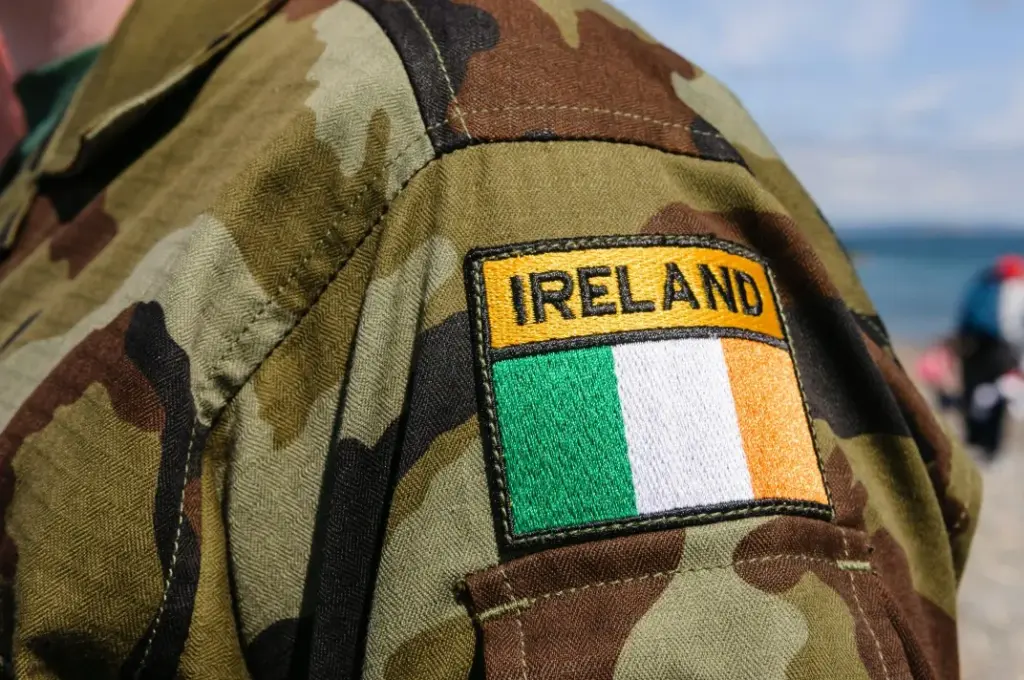
- Photo by The Sun.
On July 1, 2026, Ireland took over the Presidency of the Council of the European Union. A rotating leadership position among all 27 EU member states, it is Ireland’s 8th time holding the EU Presidency. While Ireland is well-versed in carrying out the duties required of a country holding the position, never before has Ireland assumed leadership of the Council at such a critical juncture for both European and Irish security.
Not merely a ceremonial title, chairing the Presidency of the Council of the European Union is a substantial administrative and diplomatic undertaking, requiring a multi-body support structure in order to effectively administer and host a tidal wave of political, security, logistical, lobbying, judicial and special-interest groups descending on the Irish capital of Dublin for the six-month tenure of the Presidency.
Since July 1, Ireland has already received high-profile visits from major world leaders, including Ukrainian President Volodymyr Zelenskyy, EU President Ursula von der Leyen, German Chancellor Friedrich Merz and US President Donald Trump, among many others. This amounts to more major state visits to the country in three months than it would normally experience in an entire calendar year. Outside of high-profile world leader visits, Dublin has had a densely packed run of meetings focused on international security and defence, ranging from a Gymnich meeting of EU foreign affairs ministers to a meeting of EU defence ministers and the Political and Security Committee (PSC) summit.
Yet the scale of Ireland’s diplomatic exposure rests squarely at odds with the State’s longstanding approach to defence and security. Placing Ireland firmly in the crosshairs of state-backed threats, the EU Presidency and the myriad world leaders, sensitive meetings and senior political figures it brings with it present a host of security challenges Ireland’s leaders are unable, and at times unwilling, to meet.
For decades, successive Irish governments have operated on the assumption that Ireland’s geographic position, military neutrality and relatively benign domestic security environment insulated the country from many of the threats confronting its European neighbours and allies. That assumption has become increasingly difficult to sustain. While the EU Presidency has begun to shine a light on just how unprepared Ireland is, the country has persistent security gaps due to hosting critical transatlantic infrastructure and major multinational technology companies, and administering critical western Atlantic airspace while operating with defence, intelligence and cyber-security capabilities that are extremely limited when compared with its British and EU contemporaries.
The contradiction has become particularly stark during the EU Presidency. Ireland is being asked to perform the role of a country at the centre of European security decision-making while still relying on a national security system developed for a considerably less threatening strategic environment. The result is an uncomfortable mismatch between the importance of what Ireland is hosting and the resources available to secure it.
The scale of these disparities become even harder to reconcile when measured against the Irish Government’s stated security and military objectives. The Department of Defence defines its strategic goals as being “to defend Irish sovereignty, protect Irish Citizens and secure Irish interests” while safeguarding the State’s territorial integrity. The relevant measure of Irish defence policy, by the government’s own metric, is ultimately whether Ireland possesses the practical capability to perform the functions its own defence policy says it exists to provide.
Throughout 2026, and increasingly since July 1, Ireland has experienced multiple security events in which it has either lacked the capability to respond appropriately or relied on its neighbours to fill material and intelligence-related gaps:
- July 1–December 2026: Ireland has formally requested a British and French warship presence in Irish waters for the duration of Ireland’s Presidency of the EU.
- March/April: Intense Russian shadow-fleet activity, including the presence of Russian submarines in Ireland’s Exclusive Economic Zone (EEZ), which hosts major transatlantic subsea communications. This required assistance from US and UK air and sea assets to track activity through territorial waters due to a lack of Irish reconnaissance capabilities.
- July 1: The arrival of Zelenskyy and the EU Commission in Ireland required the stationing of the French frigate Aquitaine to provide radar and air-defence coverage in Irish waters, as there is no Irish vessel with similar capabilities.
- August 31: The EU Defence Ministers meeting required the UK Royal Navy to provide air defence and maritime surveillance, as there are no Irish Air Corps or Naval Service assets with similar capabilities.
- Of special note: While occurring in December 2025, up to five drones were spotted in close proximity to Volodymyr Zelenskyy’s aircraft as it came in to land in Dublin for a state visit. According to unnamed sources, the drones intercepted the flight path of the Ukrainian president’s aircraft, which had landed slightly earlier.
Compounding the glaring gap in Irish security and defence, allied military assistance provided to Ireland by its British and EU neighbours must adhere to a 12-nautical-mile (22 km) restriction outside Ireland’s waters due to Irish legislation relating to foreign militaries operating within Irish territory. This places allied military support in a position where it must police Irish maritime and air domains while also operating at a material and logistical disadvantage when responding to any potential emergency situation.
While military cooperation between EU nations is routine, especially regarding maritime issues, Ireland requires this assistance due to a total and complete inability to provide these functions for itself. An ally supplementing an existing national capability is materially different from an ally supplying a capability that does not exist domestically in any form.
Many in Ireland will point to neutrality for the failings in the Irish military and security apparatus’. Military neutrality cannot adequately explain the absence of radar, interceptor aircraft, air-defence systems, anti-submarine capability or a navy capable of monitoring and protecting its own air and sea domains. Moreover, if Ireland intends to remain militarily neutral, the ability to independently protect its own sovereign territory is a far more consequential and imperative task.
All of this is to say that the giant-sized hole in Irish security and defence—in material planning, spending and procurement, along with legislative failures by successive Irish governments to address deficiencies in the Irish Defence Forces and defence planning as a whole—has made clear that these issues are no longer theoretical or difficult to identify. These are not obscure capability gaps buried in defence white papers. They are unidentified drones and the manifestations of shadow fleets during presidential visits.
The remaining obvious question, then, is how the Irish Government has responded to such an increasingly visible mismatch between the State’s security responsibilities and its ability to meet them. One might naturally expect, through an evidence-based approach repeatedly demonstrated throughout 2026, that the Irish Government would have the political leverage and runway with an Irish electorate that has historically been averse to heavy military spending to loosen the Irish purse strings and finally invest in much-needed multi-domain military equipment required to secure Irish territory and avoid potential future disasters. Specifically, this would come in the form of long-range radars with accompanying command-and-control apparatus, subsea monitoring via towed-array sonar equipment and maritime patrol aircraft, modern multirole frigates with modern radar and air-defence capability, and jet interceptor aircraft to police Irish airspace.
While the Irish Government has claimed it is increasing defence spending and procuring overdue capabilities, including military radar, counter-drone systems, sonar, helicopters and new armoured vehicles, the large majority of this investment improves Ireland’s ability to detect and monitor threats rather than independently respond to them. It still lacks interceptor aircraft, medium- or long-range air defence, a credible anti-submarine warfare capability and sufficiently equipped naval vessels, and does not have concrete plans to procure any of these systems in the long term.
Even the claim that the Irish Government is increasing spending on defence is dubious at best. Defence spending through 2026 has risen 11% to €1.49 billion, and €1.7 billion in capital investment is planned through 2030. Yet even as the Irish Government promotes “record” investment, the Department of Defence has been ordered to find €12 million in savings, contributing to delays or pauses in naval air-search radar, radar-guided naval guns and new Air Corps helicopters, along with cuts that will have a significant real-world impact on capability and personnel support within the Irish Defence Forces, which are already suffering from manpower shortages and retention problems, specifically among experienced and specialist personnel. Current projections indicate the established goal of 9,700 personnel may not be reached until at least 2031.
Another important distinction here is between announcing investment and materially delivering equipment and capability. An aerospace defence contract does not simply manifest air-policing capability, a sonar array does not create the ability to directly address a hostile subsea threat. Procurement of a modern frigate does not magically create and reinforce operational capacity or readiness in the face of sweeping budget cuts.
The contradiction is increasingly difficult to reconcile and is emblematic of Ireland’s approach to defence. Ireland is attempting to rebuild military capability while simultaneously cutting equipment programmes and personnel support at the most critical moment, when it needs to persuade more people to join and experienced personnel to stay.
Ireland’s brief tenure of the 2026 EU Presidency has exposed that the failures of the security apparatus in the country have long since stopped being about inadequate resources and have become an issue of inadequate political leadership and planning. Ireland has not arrived at this position unexpectedly. The deterioration of the Defence Forces, the personnel shortfall, the absence of credible air defence and the limitations of the Naval Service have been documented for years by senior Defence Forces staff, military analysts and international observers.
The threats are known. The deficiencies are known. The solutions are largely known and have been repeatedly offered to the Irish Government. The security environment Ireland exists in, while complex, is not uncharted territory for any modern Western military or government. What remains absent is a level of political urgency proportionate to the security environment Ireland now finds itself operating within. Delayed decisions, contradictory priorities and institutional complacency have now resulted in theoretical deficiencies becoming real, in the form of allied warships and aircraft policing Irish territory due to Ireland’s lack of ability to do so itself. One only needs to sit on the Wicklow coast with a good pair of binoculars on a clear day to see the manifestation of decades of failure in Irish security policy sitting roughly 20 km offshore.
For years, the capability gaps were documented and the deterioration of the Defence Forces was measurable. The Government had ample opportunity to act before those shortcomings translated into operational dependence on other countries. Instead, Ireland has arrived at a point where allies are not merely supplementing Irish capabilities; in several critical areas, they are providing capabilities Ireland never developed in the first place.
This is ultimately an indictment of Irish defence policy and the Irish lawmakers and politicians responsible for it. The individuals at fault here are not the rank and file of the Irish Defence Forces or its senior leadership. The Irish Defence Forces have warned for years that the security environment facing the nation was changing faster than their ability to respond to it. In 2024, former Chief of Staff Lieutenant General Seán Clancy acknowledged that Ireland had no subsurface capability with which to monitor an EEZ ten times the size of the country’s landmass, repeatedly stressing that any new equipment would be meaningless without the personnel required to operate it. His successor, Lieutenant General Rossa Mulcahy, has been even more explicit, identifying Russian maritime activity, cyberattacks and conventional military threats as increasingly pressing concerns and arguing that Ireland must possess the capability to address a security crisis before seeking assistance from partners. The Irish military has repeatedly identified the vulnerabilities, warned that they were worsening, outlined the capabilities required to address them and ultimately been met with disinterest by multiple Irish governments.
Ireland cannot credibly claim surprise at vulnerabilities it spent years choosing not to address. It cannot celebrate record investment while simultaneously delaying equipment, cutting support and accepting timelines that leave fundamental capability gaps unresolved for years. Moreover, reliance on Britain, France and other partners cannot indefinitely substitute for the basic responsibilities of national defence by a first-world nation. The excuses long paraded no longer apply. Ireland has the financial capacity to act, and the security environment it finds itself in poses a direct challenge to Irish sovereignty.
Generosity provided to Ireland by its allies cannot, and should not be considered a defence policy by any competent government. The uncomfortable conclusion is that Ireland’s present situation was not imposed upon it. It was created by political incompetence and sustained by continued inaction, leaving Ireland to sleepwalk into a security crisis it is neither equipped nor willing to confront.
More Stories
from the Faytuks Newsroom.
Share this Story
From Faytuks Network

Saudi air defenses intercept and destroy a Houthi drone attempting to enter restricted airspace over Mecca, coalition says.
The aircraft was downed south of the holy city at 18:50 local time Tuesday. Spokesman describes it as the second such attempt after a 2017 ballistic
Several explosions were heard on Iran's Qeshm Island, with local sources saying the sounds came from the sea, according to IRNA
Support Faytuks Network
Faytuks Network is built by volunteers and powered by its community. Contributions help cover the hosting, security and infrastructure costs that keep the site running. Plus, exclusive Discord and X benefits!
Contribute



No comment yet, add your voice below!