Gov. Bill Lee signed a new congressional map into law Thursday, breaking up Memphis’ majority-Black 9th District and giving Republicans a strong chance to control all nine of Tennessee’s U.S. House seats.
Rep. Sheila Cherfilus-McCormick (D-FL) resigned from Congress on Tuesday, according to NOTUS, stepping down just hours before the House Ethics Committee was set to announce sanctions against her.
WASHINGTON, D.C., Apr. 20 – Secretary of Labor Lori Chavez-DeRemer resigned on Monday, according to a post on X from the White House Communications Director. Keith Sonderling will take her role as Acting Secretary of Labor.
Labor Secretary Lori Chavez-DeRemer will be leaving the Administration to take a position in the private sector. She has done a phenomenal job in her role by protecting American workers, enacting fair labor practices, and helping Americans gain additional skills to improve their…
In recent days, Secretary Chavez-DeRemer has faced Labor Department investigations into allegations that she used official resources for personal errands and leveraged DOL grants to advance her political career. The probes have already led to several senior department staffers being placed on administrative leave or resigning.
Bulgaria held its eighth consecutive parliamentary election since 2021 on Sunday, with former President Rumen Radev’s Progressive Bulgaria coalition securing a parliamentary majority.
Texas Rep. Tony Gonzales submitted his resignation to the U.S. House on Tuesday amidst the unveiling of a sexual
misconduct scandal that led to his former aide dying by suicide in September 2025, stepping down from the position for the remainder of his term.
OTTAWA, Ontario, April 13 — Prime Minister Mark Carney’s Liberal Party now holds a majority government in Canada’s House of Commons, a shift that gives the party enough seats to govern without relying on opposition support. The breakthrough came Monday after Liberal candidates won two key federal by-elections in Toronto-area ridings, pushing the party to 173 seats in the 343-seat chamber, the threshold for a majority.
The result marks a major political turning point for Carney, whose government had been operating in minority territory since the 2025 federal election. In recent months, the Liberals had already been closing in on majority status through a string of opposition defections, including several lawmakers who crossed the floor from the Conservatives and one from the New Democratic Party. Monday’s wins gave the party the final numbers it needed.
A majority gives Carney far more room to move on budgets, legislation and confidence votes, reducing the leverage of rival parties and likely strengthening his hand as Ottawa navigates economic pressure tied to trade tensions with the United States. Reuters and The Associated Press both reported that Carney’s standing has risen as he positions himself as a steady manager of economic uncertainty and foreign pressure.
The immediate political fallout is likely to be felt most sharply by Conservative leader Pierre Poilievre, whose party has been weakened by recent defections and now faces a Liberal government with a clearer path to govern through the next scheduled federal election cycle. One Quebec by-election result remained closely watched Monday night, but the Liberals had already done enough to secure control.
For Canada, the change is more than symbolic. It turns a government that had to negotiate for survival into one that can now govern from a position of parliamentary strength.
This is a breaking news story. Information may be updated, amended, or removed as details emerge.
Representative Eric Swalwell (D-CA) announced plans on Monday to resign from congress amid sexual assault allegations following calls from lawmakers on both sides to step down.
HAVANA — Cuba is facing one of its most serious internal crises in decades as a worsening energy shortage, economic decline, and rising public frustration combine to test the resilience of the island’s communist government.
Headlines
Rolling blackouts, some lasting more than a dozen hours per day in parts of the country, have become routine as Cuba struggles with fuel shortages and aging power infrastructure. The outages have disrupted transportation, food distribution, and access to essential services, amplifying an already severe economic crisis.
Rolling blackouts regularly affect the island for dozens of hours. (Ramon Espanosa/AP)
In recent days, the situation has spilled into public unrest. Residents in the central Cuban city of Morón protested prolonged power outages and shortages, with demonstrators vandalizing a local Communist Party office, an unusually direct confrontation with government authority in a country where dissent is tightly controlled. Cuban authorities later confirmed arrests following the incident.
Separately, students at the University of Havana staged a rare protest over power and internet disruptions earlier this month, highlighting how frustrations are spreading beyond working-class neighborhoods to include younger and more politically active segments of society.
Fuel shortages driving the crisis
At the center of the crisis is Cuba’s worsening fuel shortage. The island relies heavily on imported oil to run its power plants and transportation systems, and those supplies have become increasingly constrained.
Officials in Havana say the shortage stems from tightening U.S. sanctions and disruptions to oil deliveries from Venezuela, which has historically supplied Cuba with heavily subsidized fuel. The lack of fuel has forced authorities to ration electricity and suspend some industrial activity.
President Miguel Díaz-Canel acknowledged the severity of the situation in recent remarks, saying the government is exploring diplomatic avenues to ease pressure and stabilize fuel imports. Reuters reported that Cuba has held talks with the United States as the economic situation worsens.
Growing geopolitical tension
The crisis also carries broader geopolitical implications.
Cuba has sought diplomatic and economic support from Russia and China as it attempts to navigate sanctions pressure and energy shortages. Chinese officials recently expressed support for Cuba amid what Beijing described as “external interference,” while Russia has similarly criticized U.S. pressure on the island.
Analysts say neither country appears likely to fully rescue Cuba’s struggling economy, but both have incentives to maintain political ties with Havana and limit U.S. influence in the Caribbean.
The island’s location, roughly 90 miles from Florida, gives it outsized strategic importance in regional geopolitics. During the Cold War, Cuba served as a major Soviet ally and intelligence outpost in the Western Hemisphere, most notably during the 1962 Cuban Missile Crisis.
Today, the strategic concerns are different but still significant, including migration pressures, regional instability, and the potential expansion of foreign intelligence or economic influence in the region.
Unrest remains limited at this time
Despite the rising tensions, large-scale nationwide protests have not yet materialized. Cuba’s security apparatus remains highly capable of suppressing dissent, and past demonstrations have often been followed by arrests and surveillance.
Still, the frequency of recent protests and the increasingly confrontational tone of some demonstrations suggest growing strain inside the country.
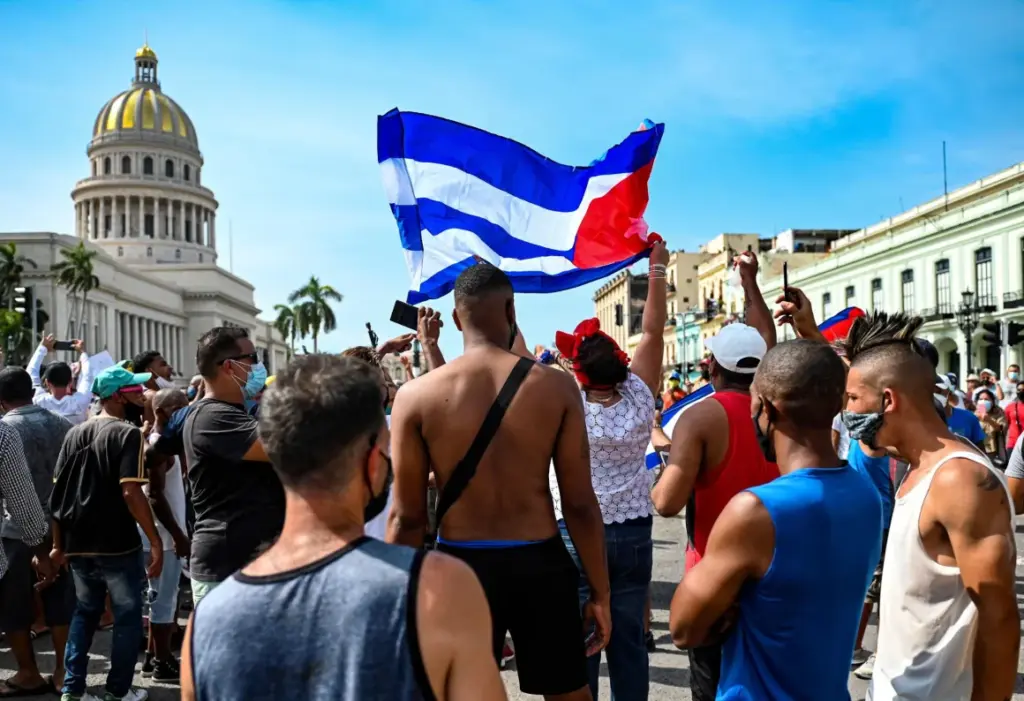
Many observers note parallels with the July 2021 protests, the largest anti-government demonstrations on the island in decades, which were sparked by similar frustrations over shortages and blackouts.
Cubans demonstrate in rare protests in Havana on July 11, 2021. Yamil Lage/AFP/Getty Images
For now, the Cuban government appears focused on managing the crisis through a combination of rationing, diplomatic outreach, and internal security measures. Whether that strategy can stabilize the country in the months ahead remains uncertain.
What happens next may depend largely on one critical factor: energy.
If fuel deliveries resume and electricity outages ease, tensions could stabilize. But if shortages worsen, or if the power grid suffers another major failure, then analysts warn the island could see broader unrest.
For a government already facing its most severe economic stress in decades, the margin for error is narrowing.
President Donald Trump will deliver the 2026 State of the Union tonight, February 24, starting at 9:00 p.m. Eastern. Faytuks Network is kicking off live coverage ahead of the speech with updates, key lines in context, and what it signals for the months ahead.
Expect a heavy focus on the economy and the White House pitch to “working families,” along with a familiar emphasis on law and order, the military, and immigration enforcement. Trade will also likely be in the spotlight after recent legal turbulence around tariffs, and the administration is expected to frame the address as a broader argument that the United States is being “respected again” abroad. Virginia Gov. Abigail Spanberger will deliver the Democratic Response.
We use cookies to ensure that we give you the best experience on our website. If you continue to use this site we will assume that you are happy with it.AcceptPrivacy Policy