Echoes of Repression: The Regime’s War on Its Own People

In the wake of a deep economic crisis, Iran has been caught up in a spiral of ruthless crackdowns spearheaded by the nation’s security apparatus. The move comes amidst accusations of foreign involvement, labelling the anti-government protests as an orchestrated effort to spark unrest within the borders of the country. Consequently, the streets of Iran have shaken with unprecedented state violence designed to silence opposing voices, claiming the lives of thousands in the process.

Although there have been several instances of economic crises in Iran following the Iranian Revolution in 1979, the latest crisis marks a tipping point, resulting from many factors including reimposed sanctions by the U.S., high volatility in the market, and the Islamic Revolutionary Guard Corps (IRGC) rooting itself deeply within the institutions fueling the economy — prompting a major severance from Iran’s mercantile sphere, the Bazaaris.

On December 28, 2025, the Grand Bazaar of Tehran faded into silence, with shopkeepers going on strike in an act of protest against deteriorating economic indicators and the factors that led to them. Albeit limited initially to the vicinity of the Grand Bazaar, the strike gained momentum rapidly, evolving into nationwide strikes that eventually led to protests defying the authority of the Iranian government—a crisis in which the collapse of Iran’s rial played a significant role.

“If If I die and my death leads to positive change, I’m okay with that.”

Sourena Golgoun’s last message, ITV.


With protests erupting nationwide, the Iranian government has answered demands with lethal force. Relying on its domestic security apparatus, the Basij, to suppress dissent, the state also enforced a total internet blackout, effectively severing the country’s lifeline from the outside world.

As protests intensified in both scope and magnitude, they became the focus of several human rights groups, raising concerns about rights violations as the government’s response to the protestors grew harsher. Among monitoring organizations, the Human Rights Activists News Agency (HRANA) has confirmed 7,015 deaths since the protests began, with an additional 11,744 cases yet to be verified. Meanwhile, The Times reported that more than 16,500 people have lost their lives, in addition to 330,000 wounded. Although the true death toll remains unverified, Iran’s Foreign Minister Abbas Araghchi stated in an interview that only 3,117 people have died during the protests, directly disputing the claims of on-the-ground sources and human rights groups.

The treatment of protestors held in custody is also a point of concern, with a strict lid imposed on the nation’s detention centers and prisons, leaving the conditions in which detainees are being held mostly unknown. However, according to Iran International, reports allege that protestors in custody have been injected with ‘unspecified’ substances, a practice linked to several suspicious deaths. While some detainees have been released or, like Erfan Soltani, released on bail, many others remain imprisoned, awaiting a fair trial.

In spite of recent human rights violations and systematic oppression at home, the protests continue to resonate abroad, with many Iranians and supporters taking to the streets in a show of solidarity. Iran’s Crown Prince Reza Pahlavi’s call for a Global Day of Action on February 14th was honored by millions, as major cities around the world witnessed massive crowds answering the call.

LIVEIranian protests

Follow along for the latest updates on the protests in Iran.

Over the past year, Iranian regime forces have allegedly killed several thousand protesters and civilians. We’ll continue posting the latest developments from inside Iran as they emerge.

Iran-US talks to be held in Geneva, Switzerland on Tuesday

Steve Witkoff meeting Israeli hostage families

Steve Witkoff meeting with hostage families in Tel Aviv, early 2025.

United States diplomats will meet with Iranian officials in Geneva on Tuesday to discuss relationships in hope to avoid a greater conflict. Reuters reports Steve Witkoff and Jared Kushner will be present, with members from Oman taking part for mediation efforts.

This new schedule comes after a week since the first talks were held in Oman, where no formal one-on-one discussion took place. So far, issues such as the Iranian nuclear program, ballistic arsenal and the support for proxies have not been cleared up, with Tehran stating their clear intentions of keeping their missile capabilities, although mixed signals in regards to the enrichment program.

In earlier negotiations, diluting the 60% enriched uranium in return for full sanction relief was brought up, although this solution did not lead to any further concrete deal. The thought of Iran’s supply being brought out of the country was also declined by officials, said by Iran’s atomic energy minister, Mohammad Eslami.

As this second round of talks begin, the USS Gerald R. Ford will continue en route to the Middle East from the Caribbean, continuing the large military buildup in the theatre. All this is alongside significant airlift operations, deploying air defence and jets around the region.

Ukraine and Russia diplomatic talks will also continue in Geneva at the same time, as the United States ramps up pressure for both sides to negotiate to end the 4-year-war.

US deploys second carrier strike group

USS Gerald R Ford (CVN-78)

As military intervention with Iran looms, Washington has indicated that the deployment of the USS Gerald R. Ford will take place, leaving the Caribbean and heading to an area situated around the Middle East. This comes a month after Ford’s role in Operation Absolute Resolve, which led to the capture of then-sitting Venezuelan president, Nicolás Maduro.

The USS Gerald R. Ford, the largest and most advanced currently afloat, will also supposedly be followed by its escort ships, allowing for a greater strike package if Washington ever decided to act against Iran.

This further deployment comes after continued air assets have been recorded entering military bases around the Middle East for the last couple weeks. So far, a Chinese satellite has confirmed air defence being positioned at a base in Jordan, likely to protect against missile volleys from Iran. This is a continued threat seen by both the United States and Israel.


Alongside this brand-new deployment, USS Abraham Lincoln which is believed to be in the Arabian Sea, has also been deployed in the region. Last week the Lincoln shot down an Iranian Shaded 139 which was actively surveilling the ship.

Us deploys second carrier strike group

Diego Garcia, as seen above, has had limited but noticeable movements of airframes

The Ford’s deployment away from the Caribbean theatre also extends its current operational time frame to at least April in accordance with reports from the New York Times, making it an unusual extension for an American carrier. This adds up to its current operational period being extended close to a year if the current projected time frame materialises.

This large military presence has added pressure onto Tehran to follow through with the negotiations laid out by the United States, which follows red lines such as limited ballistic weaponry, end of the nuclear program and removal of funding and assistance with their terrorist proxies across the region.

With already one set of talks having been carried through, there’s been limited hope of a  successful path to diplomacy, with certain agreements on the issues above not being resolved as of now.

On Wednesday, Israeli Prime Minister Benjamin Netanyahu met with President Trump and discussed issues surrounding Gaza and Iran, with Reuters also confirming that Israel announced their position in the “Board of Peace” group during this meeting. This is one of the five meetings held with Trump since his inauguration in late January 2025.

Israeli media also claimed this meeting was in effort to lay out conditions they wanted, including a harsher approach to negotiations with Tehran. 

Bella 1 Still On the Run

A profile image of tanker Bella-1

UPDATE (1431 EST 12/31/25): Bella 1 is still on the run. CNN reports this morning that the White House believes Bella 1 no longer intends to make port in Venezuela, and might choose to give up the chase for the sanctioned vessel with ties to Iran after almost two weeks, despite being unclear about the cargo, or why the crew chose to flee. USN/USCG assets remain on standby, should the order come to seize the vessel by force.


Original Article: According to The NewYork Times, the U.S.-sanctioned oil tanker Bella 1 remains on the run in the Atlantic after refusing to comply with a U.S. Coast Guard interception attempt on Dec. 21 in the Caribbean Sea. U.S. officials told the newspaper the vessel was moving toward Venezuela to take on oil when the Coast Guard moved to stop it, but the ship continued underway and has been pursued since.

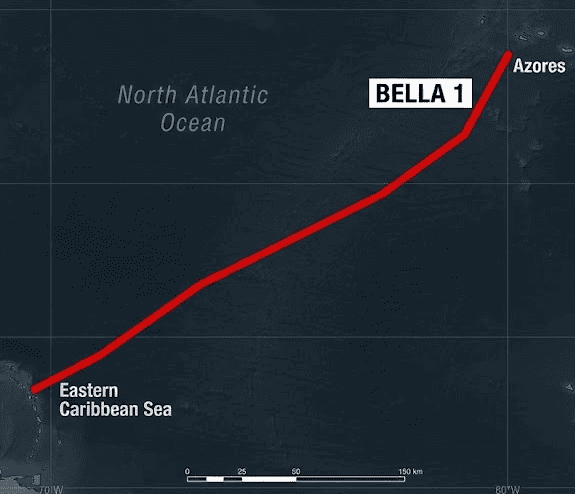
The tanker’s track has since shifted. U.S. officials briefed on the operation said Bella 1 recently altered course northwest, steering away from the Mediterranean, potentially towards waters near Greenland or Iceland. The officials don’t believe the ship to be carrying cargo. During the escape, the crew reportedly painted a Russian flag on the side of the vessel and is now claiming Russian status—an apparent attempt to complicate any boarding or seizure effort.

Given a rough heading NNE and a constant speed of 10kts, members of Faytuks Network’s all-volunteer OSINT team put Bella 1’s position potentially somewhere near the Azores, heading north for the Norwegian Sea and perhaps a final destination of Murmansk, Russia. Another posited destination is Iran, in which case she could potentially head for the Strait of Gibraltar.

Bella 1 still on the run

Federal officials have obtained a seizure warrant tied to Bella 1’s prior involvement in transporting Iranian oil, saying the ship is associated with a broader “ghost fleet” used to move oil for sanctioned regimes. Officials indicate that additional tanker seizures tied to Venezuela’s oil trade are planned as the U.S. expands efforts to curtail illicit oil revenue streams supporting the Maduro regime in Caracas.

Centcom says U.S. and partner raids in Syria removed nearly 25 ISIS operatives after the major Dec. 19 strike

U.S. Central Command says U.S. and partner forces killed or captured nearly 25 ISIS operatives in Syria in the days after a large-scale Dec. 19 strike, describing the activity as part of a sustained effort to disrupt the group’s networks and prevent it from rebuilding.

In a statement released from Tampa, Florida, Centcom said follow-on operations ran from Dec. 20 to Dec. 29 and included 11 missions across Syria. The command said at least seven ISIS members were killed and the remaining operatives were captured. Centcom also reported that the missions led to the elimination of four ISIS weapons caches.

The announcement follows what Centcom described as Operation Hawkeye Strike, launched on Dec. 19. Centcom said U.S. and Jordanian forces struck more than 70 targets using more than 100 precision munitions, with aircraft, attack helicopters and artillery involved. The command said the strikes destroyed ISIS infrastructure and weapons sites across central Syria.

“We will not relent,” Centcom commander Adm. Brad Cooper said in the statement. He added that the United States remains “steadfast in commitment” to working with regional partners to “root out the ISIS threat posed to U.S. and regional security.”

Centcom framed the activity as part of a broader counter-ISIS campaign over the past year. The command said U.S. and partner operations in Syria over the last 12 months resulted in more than 300 terrorists being detained and over 20 killed. It also said ISIS “inspired” at least 11 plots or attacks against targets in the United States in 2025, without providing additional details in the statement.

“Continuing to hunt down terrorist operatives, eliminate ISIS networks, and work with partners to prevent an ISIS resurgence makes America, the region, and the world safer,” Cooper said.

ISIS no longer controls territory in Syria and Iraq the way it did at its peak, but U.S. officials have repeatedly warned that cells and facilitators can still generate attacks, exploit instability, and regenerate if pressure eases. Centcom did not identify the individuals killed or captured, nor did it specify precise locations for the raids and weapons caches beyond saying the missions were conducted across Syria.

The figures and operational claims come directly from Centcom and were not independently verified in the statement. Still, the update signals the command intends to pair large strike packages with rapid follow-on raids designed to seize personnel and dismantle weapons stockpiles, aiming to keep ISIS remnants fragmented and on the defensive.