Yemen blames Houthis after Indian vessel sinks in Red Sea

The MSV Faize Noore Oliya capsized off Yemen after being struck by a projectile. Thirteen Indian nationals and one other crew member were taken safely to the port of Mokha.
Continue reading




The MSV Faize Noore Oliya capsized off Yemen after being struck by a projectile. Thirteen Indian nationals and one other crew member were taken safely to the port of Mokha.
Continue reading
A suspected drone strike has targeted liquefied natural gas (LNG) storage tankers at Egypt’s Mediterranean port of Damietta, according to an initial assessment by British maritime security firm Ambrey.
Continue reading
The U.K. Ministry of Defence has launched an investigation into a reported confrontation involving the Russian frigate Admiral Grigorovich, which allegedly fired warning shots at a British yacht navigating the English Channel.
Continue reading
Throughout the history of modern crises, the standoff revolving around Iran differs significantly from the rest, which brings the crucial question of what exactly the U.S. endgame is.
Continue reading
Recent UKMTO and JMIC warnings point to renewed pirate activity off Somalia, including vessel seizures and attempted boardings.
Continue reading
Iran’s oil exports have effectively collapsed under the CENTCOM naval cordon, turning a ceasefire into a slow economic strangulation campaign that may threaten the regime more than open war ever did. Cut off from its main source of revenue and stripped of its usual wartime rally narrative, Tehran is now confronting one of the most dangerous moments in its modern history.
Continue reading
The Strait of Hormuz is a narrow channel of water between Iran and Oman, just 21 nautical miles across at its tightest point, through which roughly one-fifth of the world’s oil and LNG passes every day. For most of its modern history, the strait has functioned quietly. Tankers transit, insurance rates sit near zero, and Western drivers never hear the name. That changed on 28 February 2026, when Operation Epic Fury triggered the most serious disruption of Gulf shipping since the 1980s Tanker War.
The Strait of Hormuz connects the Persian Gulf to the Gulf of Oman and onward to the Arabian Sea. On its northern shore sits Iran; on its southern shore, the Musandam Peninsula belonging to Oman. At its narrowest, between Iran’s Larak Island and Oman’s Quoin Island, it measures roughly 21 nautical miles (EIA, 2025). Traffic moves through a formal two-lane scheme: inbound and outbound lanes roughly two miles wide, separated by a two-mile buffer. In a normal year, about 100 commercial ships pass through every day.
The strait is one of a handful of global chokepoints, narrow channels whose closure would strand entire economies. The EIA ranks Hormuz as the world’s most important oil transit chokepoint. In peacetime, it draws no attention because transit simply works.
In 2024, oil flow through Hormuz averaged 20 million barrels per day, about 20 percent of global petroleum liquids consumption and roughly 25 percent of all seaborne oil trade (EIA, June 2025). About 20 percent of global LNG trade also transits the strait, almost all from Qatar. The IEA estimates that 93 percent of Qatari and 96 percent of Emirati LNG exports depend on this single corridor.
Five countries account for over 93 percent of crude flows: Saudi Arabia (37 percent), Iraq (23 percent), the UAE (13 percent), Iran (11 percent), and Kuwait (10 percent). Pipeline bypass capacity is roughly 3.5 to 5.5 million barrels per day, against a normal flow of 20 million. The buyers are overwhelmingly Asian. In 2024, 84 percent of crude transiting Hormuz went to Asia. China alone took 38 percent, followed by India, South Korea, and Japan. According to Columbia University’s Center on Global Energy Policy, 45 to 50 percent of China’s crude imports normally transit Hormuz.
Al Jazeera estimates more than 500 billion US dollars of oil and gas flow through the strait annually, roughly 1.4 billion dollars every day.
On 28 February 2026, the United States and Israel launched coordinated strikes on Iranian nuclear, missile, and naval targets. According to a CSIS analysis, Iran’s Supreme Leader Ali Khamenei was killed in the opening strike. He was succeeded by his son, Mojtaba Khamenei.
Iran’s response at sea was immediate. On 2 March, the IRGC declared the strait closed to “unfriendly nations.” Between 28 February and 12 April, Kpler and UK Maritime Trade Operations counted 22 confirmed attacks on commercial vessels. Transits collapsed from roughly 100 a day to just 279 in the first six weeks, a drop of about 92 percent. Qatar declared force majeure on LNG after Iranian drone strikes on Ras Laffan.
Brent crude, which had averaged 71 dollars per barrel in February, peaked around 128 dollars on 2 April. European TTF gas jumped 35 percent in a single session on 3 March. A two-week ceasefire announced on 8 April produced a brief price slide, but as of mid-April, IRGC gunboats have fired on tankers again and Brent has settled around 99 dollars.
Iran’s conventional navy is no match for the US Fifth Fleet. Yet it retains credible disruption power through asymmetric warfare and geography. The Iranian coastline runs about 950 miles along the strait, and seven islands (Abu Musa, Greater and Lesser Tunb, Qeshm, Hengam, Larak, and Hormuz) form what analysts call an “arch defence” across the shipping lanes.
The tools include an estimated 2,000 to 6,000 naval mines (CBS News, citing DIA), with unit costs as low as 1,500 dollars. The IRGC operates roughly 1,500 fast attack craft practising swarming tactics. Anti-ship cruise missiles (Noor, Qader) and ballistic anti-ship missiles (Khalij Fars family) cover the strait from shore. Shahed-136 drones and unmanned surface vessels have joined the arsenal. GPS jamming and spoofing have surged; Windward reported over 1,100 vessels affected in a single day in March 2026.
Iran also has a track record of tanker seizures: the Stena Impero (2019), the Advantage Sweet (2023), and the MSC Aries (2024).
The consensus from CSIS, RAND, and Chatham House: Iran probably cannot permanently close the strait against a sustained US response, but it can disrupt traffic for weeks or months, and even a handful of mines is enough to trigger the insurance panic that does the real economic damage.
Between 1984 and 1988, Iran and Iraq attacked more than 450 vessels during the Iran-Iraq War. The Reagan administration reflagged 11 Kuwaiti tankers under the US flag, launching Operation Earnest Will, the largest naval convoy operation since the Second World War. On 14 April 1988, USS Samuel B. Roberts struck an Iranian mine; four days later, the US Navy launched Operation Praying Mantis, sinking the frigate Sahand in the largest US surface engagement since 1945.
The lasting lesson was economic. Despite hundreds of attacks, fewer than 2 percent of Gulf shipping was disrupted. Iran concluded it could not win a naval war but could impose enormous cost through mines, small boats, and insurance panic. The post-1988 IRGC force structure flows directly from that conclusion.
Under Part III of the 1982 UN Convention on the Law of the Sea, all ships enjoy a right of transit passage through straits used for international navigation (Article 38). Coastal states shall not hamper such passage, and there shall be no suspension of it (Article 44).
Iran signed UNCLOS in 1982 but never ratified it. Its 1993 Marine Areas Act claims only a right of innocent passage, requiring prior authorisation for warships. The dominant legal view, articulated by scholars such as James Kraska, is that UNCLOS transit-passage provisions reflect customary international law and bind Iran regardless of ratification.
Additional frameworks reinforce the point. The 1907 Hague Convention VIII forbids mines whose sole object is to intercept commercial shipping. The San Remo Manual treats indiscriminate mining of international straits as a violation of humanitarian law. UN Security Council Resolution 552 (1984) condemned attacks on neutral Gulf shipping. On 7 April 2026, a Bahrain-sponsored resolution to secure the strait was vetoed by Russia and China.
Marine insurance is the hidden mechanism that translates military risk into economic paralysis. Four policies keep a ship sailing: Hull and Machinery (covers the ship), Protection and Indemnity (covers liabilities like pollution and crew injury), Cargo insurance (covers the goods), and War Risk insurance (covers mines, missiles, seizure, and hostile acts). The first three explicitly exclude war; the fourth must be purchased separately.
The gatekeeper is the Lloyd’s of London Joint War Committee, which publishes a list of high-risk waters. When an area is listed, any ship entering it must pay an Additional War Risk Premium, typically as a seven-day cover for a single voyage. On 3 March 2026, the JWC expanded its listed areas to include the entire Arabian Gulf.
In peacetime, war risk premiums for Hormuz ran about 0.025 to 0.05 percent of hull value. After 28 February, Lloyd’s List reported premiums surging to 1.5 to 3 percent, and up to 5 percent for US, UK, or Israeli-connected ships. For a 138 million dollar supertanker, that means 10 to 14 million dollars per transit, adding roughly 5 to 7 dollars to the cost of every barrel carried.
The deeper point: insurance panic can close a strait without a single mine being laid. Banks, charterers, and flag-state regulators will not authorise sailings without cover. When premiums spike or cover is withdrawn, tankers simply stop. Lloyd’s data show Hormuz traffic falling more than 80 percent in early March 2026, days before most mines were deployed.
Roughly one-fifth of global oil and LNG, valued at half a trillion dollars a year, flows through a 21-mile channel bordered by one of the world’s most sanctioned regimes. For four decades, the system worked because closing the strait would hurt Iran’s own customers, above all China. Operation Epic Fury has stress-tested that equilibrium. What the crisis has revealed is that Iran does not need to close the strait to shake the global economy. A handful of drones, a few mines, and a Lloyd’s market listing are enough to move the price of oil by 30 dollars and stall 90 percent of traffic. The strait’s long quiet made the world forget how narrow the margin really is.
Last updated: April 2026. Sources include the US Energy Information Administration, International Energy Agency, CSIS, Lloyd’s List, Al Jazeera, Columbia University CGEP, Lawfare, CBS News, Lloyd’s Joint War Committee, and Windward Maritime AI.

Following over a month of escalating hostilities, Washington and Tehran agreed to a Pakistan-brokered, two-week ceasefire on April 8. This pause in the conflict presents a major opportunity to re-establish diplomatic channels between the two governments, enabling the possibility of ever reaching a bilateral agreement beneficial to both sides. However, the final outcome rests entirely on the actions of the involved actors.
Continue reading
Last Saturday, Yemeni Houthi forces carried out a ballistic missile strike against Israel, triggering sirens over Beersheba and surrounding towns, entering the equation after declaring their firm support for the Islamic Republic.
Continue reading
The Strait of Hormuz, a narrow chokepoint linking the Persian Gulf to the Gulf of Oman and carrying approximately one-fifth of global seaborne oil and significant LNG volumes has been effectively closed since early March 2026 amid the ongoing US-Israel military campaign against Iran (initiated 28 February 2026). Iran declared the waterway closed to vessels linked to the US, Israel and allies, with 21+ confirmed attacks on merchant ships and counting (causing at least 11 seafarer deaths/missing and multiple abandonments), threats of further strikes, and retaliatory hits on regional energy infrastructure.
This has driven tanker traffic to near-zero, down from ~153 daily transits pre-crisis, prompting Gulf producers to cut output as storage limits are met. This has spiked global oil prices beyond 2022 highs (briefly exceeding $100/bbl) and forced rerouting or suspension by major shippers. US responses include strikes on Iranian naval assets, destroying a large portion of its regional naval power, but reopening remains contingent on the current scenario. Iran although has stated that countries who complete transaction in Chinese Yuan can be given an allowance to pass
The Strait has faced repeated disruptions tied to Iran-Gulf tensions, establishing a pattern of asymmetric pressure via shipping harassment and infrastructure targeting without full closure until 2026:
These precedents demonstrate Iran’s proven capability for disruption but also historical restraint until the existential threat posed by the 2026 leadership decapitation strikes.
Trigger (28 February 2026): Coordinated US-Israel airstrikes (“Operation Epic Fury”/Roaring Lion) targeted Iranian military/nuclear sites and leadership compounds in Tehran. Supreme Leader Ali Khamenei and multiple senior officials were killed (confirmed by Iranian state media and US/Israeli statements). Iran retaliated immediately with missiles/drones on US bases in UAE/Qatar/Bahrain, Israeli territory, and Gulf targets.
Iranian-made Strait Disruption (from 1 March):
IRGC declared the strait “closed” to adversary-linked shipping (2–4 March formal announcements), warning of attacks on any transiting vessel. Tactics: drones, sea drones/USVs, projectiles, fast boats, and mines. The US Navy struck Iranian minelayers and Kharg Island oil terminal.
Verified Ship Attacks (UKMTO/IRGC-corroborated; 21+ by 12 March, additional through 19 March; total ~24 documented incidents):
Casualties: 11+ seafarers killed/missing; 1+ port worker.
This comes amid the dangerous and costly escalation of strikes on the oil facilities
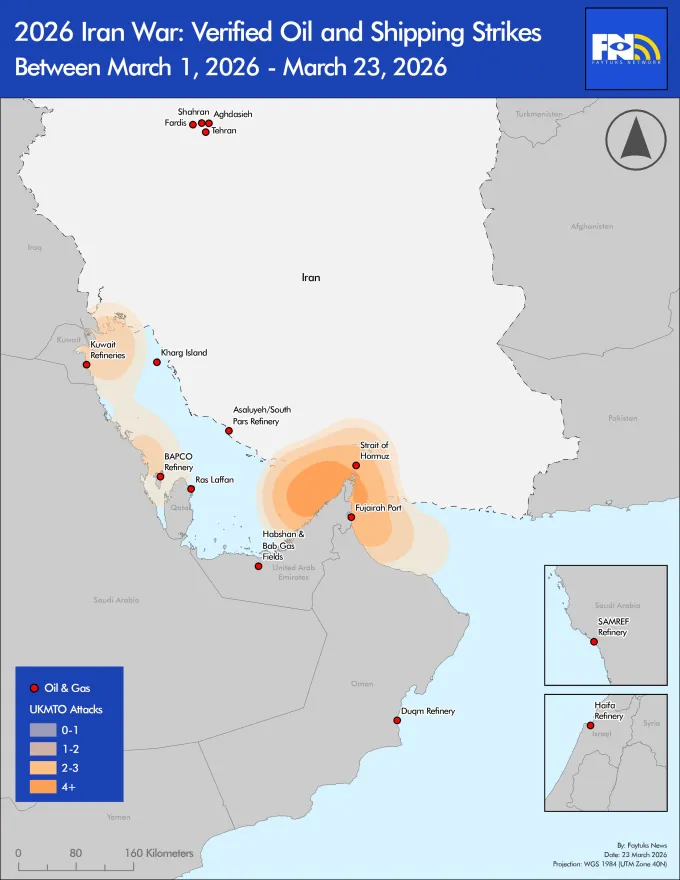
Verified Hits on Oil/Gas Facilities
Israel:
Gulf Nations:
Iranian Facilities (targeted by Israel/US):
US/Gulf Responses: Trump offered Navy escorts, political-risk insurance, and continued strikes on Iranian naval/minelaying assets. G7 discussed escorts; China pressed Iran privately while routing select vessels. Iraq declared force majeure; shipping firms (Maersk) suspended.
Conclusion:
Iran’s asymmetric playbook selective enforcement allowing approved passages while punishing Western-linked vessels, paired with retaliatory strikes against critical infrastructure exploits existential stakes to impose global leverage without inviting total naval defeat. US/Israeli Strikes on its naval fleet has degraded but not eliminated Tehran’s drone/USVs/shore-missile capacity, sustaining functional denial.
Strategically, this proves selective disruption outperforms absolute blockade: it has spiked oil prices, forced Gulf curtailments, triggered force majeures, and exposed bypass-route fragility delivering outsized economic coercion at sustainable risk. As of 21 March 2026, the chokepoint remains contested, underscoring hybrid warfare’s potency at energy arteries: Iran trades short-term pain for diplomatic leverage, while the US retains reopening tools but faces escalation. Absent swift ceasefire, the crisis cements the strait as a durable hybrid battlefield where verified pressure, not conquest, reshapes global energy security.