War in the Middle East: United States and Israeli forces continue aerial campaign against Iran







The second round of indirect high-stakes nuclear negotiations between the United States and Iran wrapped up in Geneva on Thursday with the Omani mediator hailing “significant progress,” but no breakthrough deal emerged. Technical discussions are now scheduled for next week in Vienna, even as the Trump administration maintains a firm stance on Iran’s uranium enrichment program and sanctions relief. The diplomatic momentum is tempered by aggressive US military posturing across the Middle East, a notable lack of public commentary from American negotiators, an urgent trip by Oman’s foreign minister to Washington, and a wave of international travel advisories for both Iran and Israel.
Omani Foreign Minister Sayyid Badr Al Busaidi, who has been shuttling between the two sides as intermediary, issued a measured update immediately after the day’s sessions. “We have finished the day after significant progress in the negotiation between the United States and Iran,” he posted. “We will resume soon after consultation in the respective capitals. Discussions on a technical level will take place next week in Vienna.” Iranian Foreign Minister Abbas Araghchi echoed the positive tone, calling the round one of the most intense yet and noting that Tehran had submitted written proposals. He added two sides agreed that technical teams will begin discussions and reviews in Vienna starting Monday and new round of negotiations will be held in less than a week.In stark contrast, the US delegation led by Special Envoy to Middle East Steve Witkoff and Jared Kushner has remained largely silent, with the White House declining to issue any detailed readout or optimistic statements of its own.
Hours after the Geneva sessions concluded, Al Busaidi was already en route to the United States for high-level meetings in Washington today. The Omani minister is scheduled to brief Vice President JD Vance and other senior officials in an explicit push to keep the diplomatic path open and avert any military confrontation. The trip is highlighted as a last ditch effort to bridge remaining gaps before the Trump administration’s self-imposed deadline loom closer.
While talks continue, the Pentagon has assembled what analysts describe as the largest US military presence in the Middle East in more than two decades. Two aircraft carrier strike groups including the USS Gerald R. Ford are converging on the region, accompanied by over 150 additional combat aircraft, including F-22 Raptors and F-35s forward-deployed to bases in Jordan, Qatar, Saudi Arabia, and even Israel. E-3 Sentry AWACS aircrafts and additional tankers support have been rushed into theater.
CENTCOM Commander General Brad Cooper personally briefed President Trump and Joint Chiefs Chairman General Dan Caine on potential strike options against Iranian targets. Reports also indicate non-essential personnel are being quietly moved out of vulnerable forward bases such as Al Udeid in Qatar and facilities in Bahrain a precautionary “evac” posture widely interpreted as “EVC” (enhanced vigilance and contingency evacuation measures) on US airbases in the Gulf. Iran has publicly highlighted these same bases as potential targets in any conflict.
Following the first round of negotiations and the subsequent escalation in rhetoric, embassies across the globe have issued urgent travel warnings. China became the latest major power to urge its citizens in Iran to evacuate immediately, citing the rapidly deteriorating security situation. Multiple other nations including Germany, France,Australia, India, and South Korea have advised their nationals to reconsider or defer travel to Israel as well as Australia, Brazil, China, Cyprus, Finland, Germany, India, Poland, Serbia, Singapore, Japan,South Korea, Sweden, and the United States have issued travel advisory for Iran.Note that some nations, such as the UK, have issued strong “do not travel” warnings or withdrawn diplomatic staff without explicitly calling for all citizens already in Iran to depart, so they are not included in this explicit evacuation list.The US State Department has gone further, authorizing non-essential embassy personnel and families in Israel to depart and warning American citizens to “reconsider travel” due to the risk of sudden escalation.
On the Israeli front, the IDF has placed the entire country on heightened alert. Recent airstrikes have targeted Hezbollah missile production and storage sites in Lebanon’s Bekaa Valley, aimed at degrading the group’s ability to join any wider conflict. Israeli officials have delivered blunt warning to Hezbollah and Lebanese authorities: any involvement in a US-Iran war even limited will trigger massive retaliation, including strikes on civilian infrastructure such as Beirut’s airport. Hezbollah has signaled it will not intervene in a “limited” US strike on Iran but maintains red lines if Iranian leadership or territory faces existential threat. Israeli defense officials are simultaneously assessing the risk of Iran activating its full “axis of resistance,” including coordinated attacks from Yemen’s Houthis and Iraqi militias.
The coming week will be decisive. Technical experts head to Vienna on Monday for detailed discussions on uranium stockpiles and verification mechanisms, while political-level talks could resume shortly thereafter. Oman’s intervention in Washington today is viewed by diplomats as the final push to find common ground before President Trump’s threats of military action become reality.

U.S. President Donald Trump has established a new 10-15 day deadline for Iran to agree to a “meaningful” concession on Washington’s demands or face serious consequences. On Thursday, speaking with reporters aboard Airforce one, he said “I would think that would be enough time, 10, 15 days, pretty much maximum.” After the ending of indirect negotiations in Geneva over Tehran’s nuclear enrichment, ballistic program and proxy affiliation, Trump warned that the United States will decide within given deadline whether to pursue further military action.
Speaking at the inaugural meeting of the newly formed “Board of Peace” in Washington, Trump reiterated that the U.S. wants a diplomatic solution but signalled impatience with the pace of talks. “We have to make a meaningful deal otherwise bad things will happen,” he said, with this firm time frame being “pretty much maximum” for a diplomatic solution.
The deadline comes amid a significant U.S. military buildup in the Middle East and ongoing diplomatic efforts, underscored by a U.S. military buildup that includes two aircraft carrier strike groups, the USS Abraham Lincoln & USS Gerald R. Ford, supported by guided-missile destroyers and other assets positioned across the Persian Gulf and Arabian Sea. The buildup also includes advanced fighter aircrafts, surveillance platforms, aerial refuelling tankers, and reinforced Patriot and THAAD missile defence systems at multiple regional bases.
On Friday, Iranian FM Araghchi appeared on MS Now saying Tehran has not offered to suspend its nuclear or ballistic missile programs, and that the United States has not demanded this under current negotiation guidelines. He added that Iran expects to submit a formal proposal to Washington by end of the week , pending the approval of senior Iranian leadership. Tehran reiterated that talks will remain confined to the subject of Iran’s nuclear program, rejecting discussions on missile limitations or regional proxies—underscoring the enduring gaps between U.S. and Iranian positions.
As the deadline approaches, Tehran has warned that all U.S. bases and assets in the region will be considered legitimate targets in the event of military action. For Washington, the coming days represent a narrowing diplomatic window in which to secure a framework that meets their policy objectives: the dismantling of the Iranian nuclear program, and reduction of their missile program and proxy support. Failure on the diplomatic front could mean both sides must prepare for a high-stakes conflict that could threaten regional stability.

Significant movement of tankers, jets and further cargo has taken place, entering the Middle East region as the United States prepares for a campaign against the Iranian regime.
In the last 72 hours, the influx of tankers and jets has significantly increased, with F35s, F22s, F15s, F16s, AWACS (Airborne Early Warning System) and other critical platforms being recorded entering the area. In addition to these, air-to-air refuelers such as the KC-135 and KC-46, are flying into bases throughout the area, suggesting the fact a more drawn-out conflict could be a part of possible options for Washington against Tehran.
Trump earlier today onboard Air Force One stated that a decision will be made within a 10-15 day window, although analysts have mention the potential for military action to commence in the next few days.
Sources telling Axios state that action could begin within days, with it more than likely being a continued campaign lasting for weeks. Although further reports have also brought the fact that Donald Trump may prefer a more initial approach to military force, enough to bring them to the negotiation table.
As we continue to view large scale aerial movements from Washington, not seen since 2003, Iranian military assets have also taken part in live fire training within and around the Hormuz Strait. The threat of Iran halting global shipping through this critical waterway is still present, with it being a viable action in which Iran could potentially conduct in the event of offensive actions by Israel or the United States.
Tuesday last week, the second round of negotiations took place in Geneva, Switzerland. These talks were aimed at Tehran’s nuclear, ballistic programs alongside their support for proxy groups around the region. As of now, no concrete concessions have been given by either side, with both talks ending without any further progress.
Iran’s Foreign Minister, Abbas Araghci stated that “good progress” has been made, with Iran setting the framework for future talks. Despite the positivity from the Iranian diplomatic team, Washington says only “modest” compromises had been given surrounding the nuclear program, the main point of contention in the current talks. JD Vance also mentioned that talks went well “in some ways”. It is unclear what direction which may be taken in the future if diplomatic talks were to continue.
Currently, the United States has positioned over 126 land-based fighter aircraft alongside two carrier strike groups. Alongside this, Israel will likely participate in an attack with United State forces, with the IDF ready for a “large and multi-front” conflict, one which may involve Iran and its proxy forces.

The United States has carried out an operation to seize a Venezuela-linked tanker formerly known as Bella-1
Continue reading
President Donald Trump said on Monday that the United States struck a Venezuelan “dock area” he described as linked to drug-running boats, claiming a “major explosion” at a site where traffickers “load the boats up with drugs,” according to the BBC.
While Trump declined to identify who carried out the attack, telling reporters, “I don’t want to say that” when asked about the CIA, the BBC reported there has been no official confirmation from Caracas and no strike footage has been released the way the Pentagon has publicized prior maritime interdiction strikes.
U.S. officials familiar with the operation, however, told CNN the CIA conducted a drone strike earlier this month on a remote port/dock facility on Venezuela’s coast, which U.S. intelligence assessed was being used by the Venezuelan gang Tren de Aragua to store narcotics and move them onto boats for onward shipment. The network reported no one was present at the time of the strike and no casualties resulted.
The New York Times separately reported that the strike occurred last week and described it as the first known U.S. operation inside Venezuela during the Trump administration’s pressure campaign, targeting a dock believed to be involved in staging narcotics for loading onto boats. The Times said Trump had mentioned the incident twice in recent days, first in a radio interview and again on Monday. His first mention can be listened to below.
Key operational details remain contested. CNN reported that sources described U.S. Special Operations Forces as providing intelligence support, but a U.S. Special Operations Command spokesperson denied any support “to include intel support.” The CIA declined to comment to CNN, while the Pentagon referred questions to the White House, which has not provided a detailed public account at the time of publication.
The reported land strike comes as Washington intensifies a wider campaign that has combined counter-narcotics justification with escalating pressure on Venezuelan President Nicolás Maduro. U.S. strikes on suspected drug-smuggling boats in the Caribbean and eastern Pacific have been occurring since September. It appears the operation has now expanded from maritime strikes, to tanker seizures, to clandestine land strikes.
A new boat strike occurred yesterday, bringing the total number to 30 (31 if you count the dock), with the U.S. reporting 106 total individuals killed in those strikes.

UPDATE (1431 EST 12/31/25): Bella 1 is still on the run. CNN reports this morning that the White House believes Bella 1 no longer intends to make port in Venezuela, and might choose to give up the chase for the sanctioned vessel with ties to Iran after almost two weeks, despite being unclear about the cargo, or why the crew chose to flee. USN/USCG assets remain on standby, should the order come to seize the vessel by force.
Original Article: According to The NewYork Times, the U.S.-sanctioned oil tanker Bella 1 remains on the run in the Atlantic after refusing to comply with a U.S. Coast Guard interception attempt on Dec. 21 in the Caribbean Sea. U.S. officials told the newspaper the vessel was moving toward Venezuela to take on oil when the Coast Guard moved to stop it, but the ship continued underway and has been pursued since.
The tanker’s track has since shifted. U.S. officials briefed on the operation said Bella 1 recently altered course northwest, steering away from the Mediterranean, potentially towards waters near Greenland or Iceland. The officials don’t believe the ship to be carrying cargo. During the escape, the crew reportedly painted a Russian flag on the side of the vessel and is now claiming Russian status—an apparent attempt to complicate any boarding or seizure effort.
Given a rough heading NNE and a constant speed of 10kts, members of Faytuks Network’s all-volunteer OSINT team put Bella 1’s position potentially somewhere near the Azores, heading north for the Norwegian Sea and perhaps a final destination of Murmansk, Russia. Another posited destination is Iran, in which case she could potentially head for the Strait of Gibraltar.
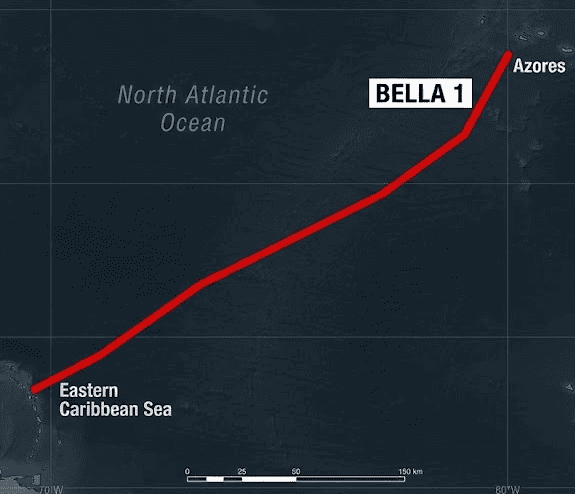
Federal officials have obtained a seizure warrant tied to Bella 1’s prior involvement in transporting Iranian oil, saying the ship is associated with a broader “ghost fleet” used to move oil for sanctioned regimes. Officials indicate that additional tanker seizures tied to Venezuela’s oil trade are planned as the U.S. expands efforts to curtail illicit oil revenue streams supporting the Maduro regime in Caracas.