Yemen blames Houthis after Indian vessel sinks in Red Sea

The MSV Faize Noore Oliya capsized off Yemen after being struck by a projectile. Thirteen Indian nationals and one other crew member were taken safely to the port of Mokha.
Continue reading




The MSV Faize Noore Oliya capsized off Yemen after being struck by a projectile. Thirteen Indian nationals and one other crew member were taken safely to the port of Mokha.
Continue reading
The Iran War is once again underway. What initially began as a series of limited exchanges between the United States and Iran has escalated into a renewed military conflict. U.S. strikes targeting strategic military and dual-use infrastructure across southern and western Iran have been met with Iranian missile and drone attacks centered on American military bases and allied facilities across the Gulf. A visual investigation by the Faytuks Network Intelligence Team has identified damage to several U.S. military facilities in the Middle East.
The saga began last Wednesday when U.S. President Donald Trump ordered retaliatory airstrikes on Iran following its attack on three vessels in the Strait of Hormuz. U.S. Central Command (CENTCOM) carried out the strikes in a multi-day operation intended to pressure Iran into conceding to U.S. demands over shipping through the Strait, a key issue in the negotiations at the time.
What followed was a brief lull in the fighting as the United States informed Iran that it had until Saturday to publicly declare the Strait of Hormuz open. Iran, however, rejected the demand during negotiations with Oman on Saturday. In response to the U.S. ultimatum, Iran struck a cargo vessel in the Strait as the deadline expired and formally declared the Strait of Hormuz closed. Days of intense fighting followed, with the United States launching airstrikes across Iran while Iran carried out missile and drone strikes against U.S. military bases and Gulf nations across the region.
Here’s a map of the countries that Iran has attacked in the past week:
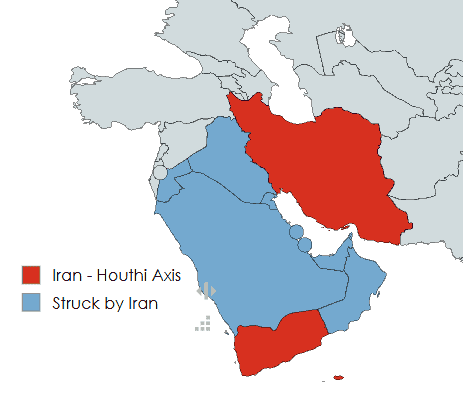
Iran has launched drone and missile attacks on targets in Iraq, Kuwait, Bahrain, Qatar, UAE, Oman, Saudi Arabia, and Jordan in the past few days. The attacks in this latest round of fighting have primarily targeted American military installations and economic infrastructure across the Gulf. Iran has achieved mixed success in these attacks, landing some hits while most others are intercepted. Among those hits though, are several U.S. military bases.
Several U.S. military bases have sustained light damage by Iranian strikes in recent days. The Faytuks Network Intel Team has performed an in-depth satellite imagery analysis of some of these facilities and created easy-to-understand visuals.
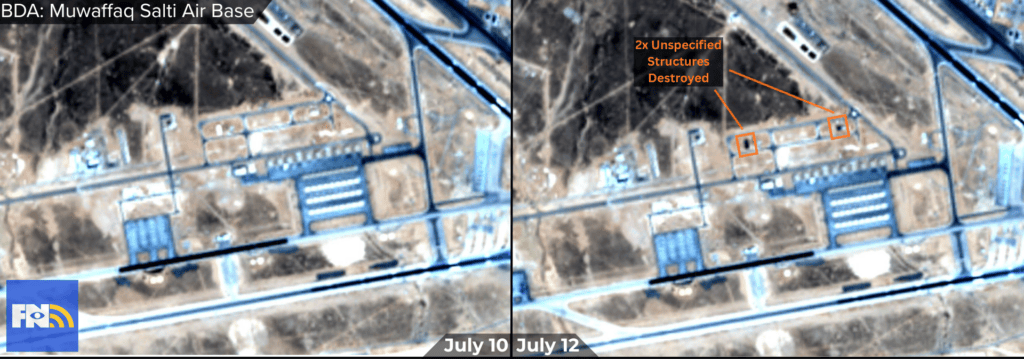
Muwaffaq Salti Airbase – Muwaffaq Salti Airbase is a critical piece to the current U.S. force projection in the Middle East. It houses several U.S. fighter squadrons including the workhorse F-15s and the vaunted F-35s. Its importance to combat operations in the region has made it a focal point for Iranian attacks, experiencing repeated missile attacks almost every night. Satellite imagery from July 12th reveals that the base received two new hits to facilities north of some aircraft shelters. The structures appear to have been destroyed and it remains unclear what purpose they served.
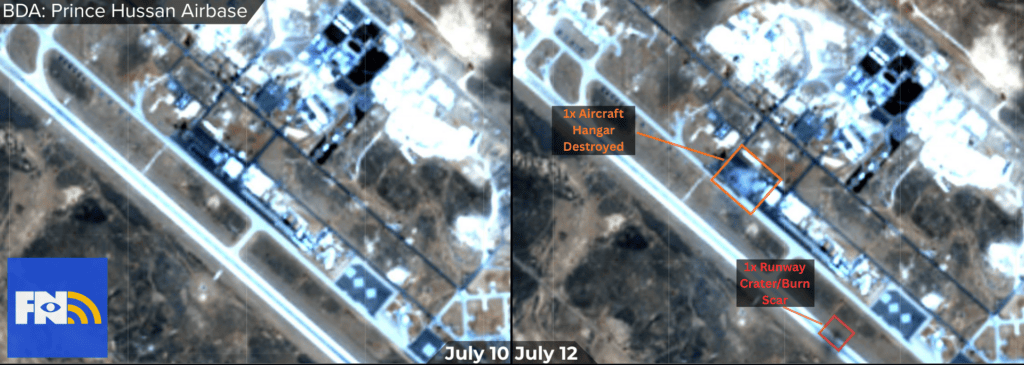
Prince Hussan Airbase (H5) Prince Hussan Airbase, also known as H5 airbase is another Jordanian airbase that houses U.S. forces and aircraft. It has been another focal point of Iran’s attacks on Jordan. Satellite imagery from July 12th reveal that the base has suffered at least 2 missile impacts in recent days. The strikes, while limited in number will have an impact on operations at the base. One structure, believed to be an aircraft hangar was destroyed by missile fire. It is unclear what aircraft, if any was in the hangar at the time of the strike. Another Iranian missile also caused damage to the runway area at the airbase. Though the impact crater is not directly on the runway and rather to it’s immediate edge, it has still caused damage to the adjacent central part of the runway as seen by a burn scar in imagery. The location of the damage has likely rendered the runway unsuitable for larger aircraft like the C-17 Globemaster, the C-5 Galaxy, or any other large aircraft, all of which would require long strips of runway to land and takeoff from. However, flight operations from smaller aircraft like fighter jets or light aircraft, which need smaller portions of runway to operate, are likely still able to operate out of the base.
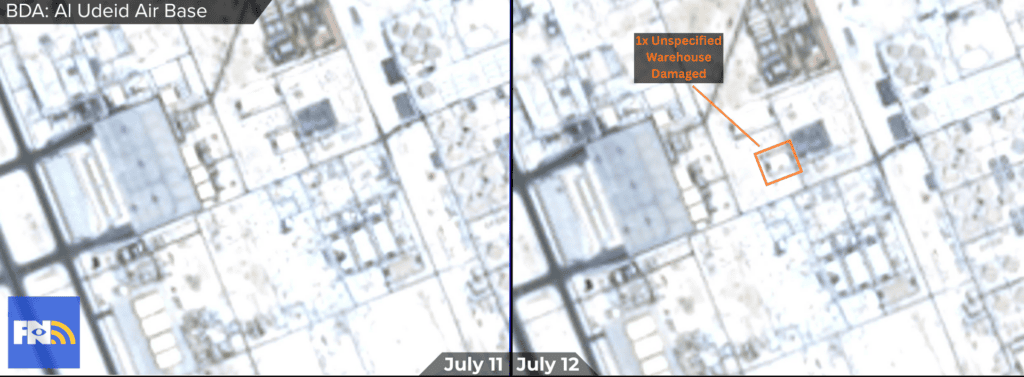
Al Udeid Airbase – Al Udeid Airbase had previously been the largest U.S. airbase in the Middle East. It was home to dozens of tanker aircraft and was a critical logistics hub for the region. However, its proximity to Iran has made it a frequent target for Iranian attack, and it was thus evacuated of most of its aircraft and personnel prior to the start of hostilities. The base was once again brought back to its returned to its pre-war operating posture in the weeks between the signing of the Memorandum of Understanding between the U.S. and Iran, only to go back to its evacuated posture last week as hostilities once again ramped up. Since then, the base has been attacked multiple times by Iranian missiles and drones. Satellite imagery from July 12th reveals that a suspected logistics warehouse at the base was hit in overnight Iranian strikes on July 11th. The facility appears to have been damaged rather than destroyed, suggesting that the strike’s impact will be minimal.
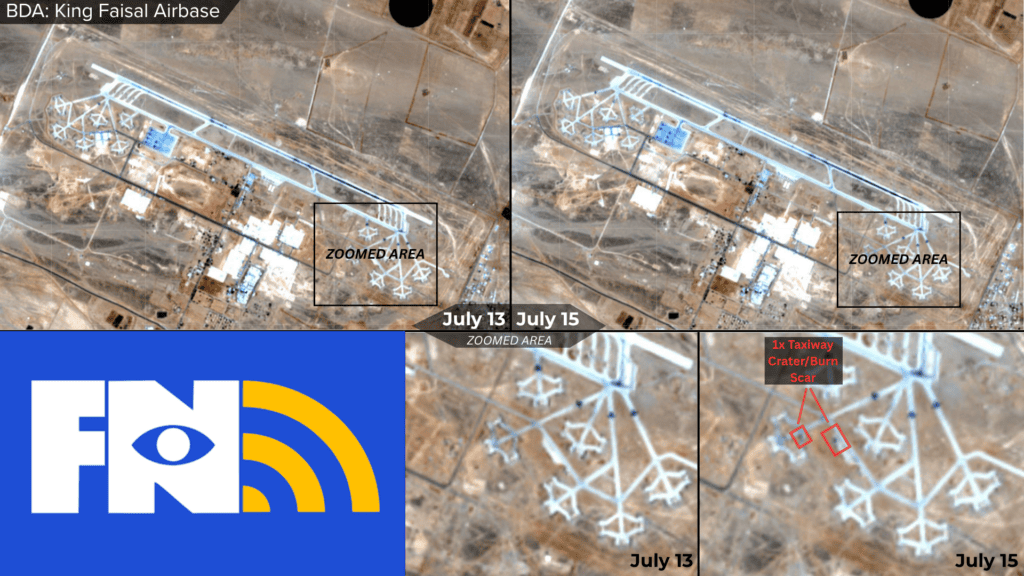
King Faisal Airbase – King Faisal airbase, a major military airbase in Southern Jordan that has hosted U.S. and British special forces prior to the outbreak of the war. It is currently home to several combat search and rescue teams (CSAR) and some ground forces. On the night of July 14th, the base was subject to a heavy missile attack by Iran. Satellite imagery from July 15th reveals that at least 2 projectiles hit the base, creating craters and burn scars on the airfield’s ramp where aircraft are typically parked. The impacts from the attack are minimal, with no facilities or aircraft being damaged. Operations are unlikely to be significantly affected at the base and the damage to the ramp can be easily repaired.
Unverified footage, claimed to have been filmed near the base overnight, appears to show several missiles or missile debris penetrating local air defenses and impacting areas in and around the installation. Faytuks Network geolocators were unable to independently verify the video’s claimed location, though they assessed there to be a moderate probability that it was filmed near the base.
Iran’s strikes on U.S. bases in the past one week have intensified and so has the damage from their strikes. While most projectiles have been intercepted and damage has remained minimal at most gulf bases, the same cannot be said in Jordan. Despite attempting to intercept, Iranian missiles have repeatedly struck their targets in Jordan nearly every night in the past few days since hostilities ramped up. The pattern is concerning and may suggest that local air defense batteries in Jordan are becoming saturated and experiencing shortages of interceptor missiles, an issue that would result in air defense crews firing fewer interceptors interceptors per missile and therefore achieving a lower intercept rate.
The attacks on Muwaffaq Salti and Prince Hussan airbase appear to be more significant than the rest, with multiple structures damaged and a crater adjacent to the runway. Meanwhile, most of Iran’s other attacks on U.S. military facilities have been largely unsuccessful, limiting their impact to operations in the region.

Yemen’s Houthi movement has warned it could shut the Bab el-Mandeb Strait if fighting escalates, threatening a major oil and trade route as shipping through the Strait of Hormuz remains disrupted.
Continue reading
Last Saturday, Yemeni Houthi forces carried out a ballistic missile strike against Israel, triggering sirens over Beersheba and surrounding towns, entering the equation after declaring their firm support for the Islamic Republic.
Continue reading
As conflict continues to loom between Iran and the United States, Tehran is facing an increasingly acute military situation. Iran posses a large and comprehensive missile and drone force capable of reaching all United States military bases in the region in addition to Israel. As seen in the 12-day war, Tehran has the largest arsenal of ballistic missiles in the region. This ability was demonstrated with multiple strikes through the period of conflict in June 2025 leaving 32 Israeli civilians dead according to the Times of Israel.
Iran features thousands of SRBM (short range ballistic missiles) and MRBM (Medium range ballistic missiles), some capable of 2,000km in range, easily having the capacity to deliver large payloads across Israel and the surrounding region. The Khorramshahr and Emad missiles both feature this range, with the Emad having a potential 500 meter accuracy according to CSIS. Although not extremely accurate, the amount available to their disposal makes any volley a highly dangerous event.
In the event of war, Tehran would want to maintain a sizable missile force to prop up their own escalation ladder. This allows them to include multiple threats in the later parts of a conflict which could pose as a deterrence for Washington to continue. In doing so, Iran would want to keep their road-mobile launch vehicles in a safe area away from incoming Israeli/US offensive actions. In the 12-day-war, Tehran’s ability to perform large scale strikes on Israeli was greatly damaged by the fact they lost multiple launch vehicles, causing their missile volleys to dwindle
Despite the extensive missile forces Iran has present, this isn’t the only option to their advantage. Iran has affiliation with multiple terrorist-proxy forces dispersed throughout the region. Although most have been battered in the recent conflicts since October 7th, 2023, most still maintain a visible threat. One such example is the Houthis in Yemen, which have continued to demonstrate their capabilities, potentially harming Washington’s interests in the region.

This is a dominant strategy for Iran, although it depends on the willingness and capabilities Yemen still features since the continuous strikes which have since occurred after their continued campaign on global shipping from multiple other countries.
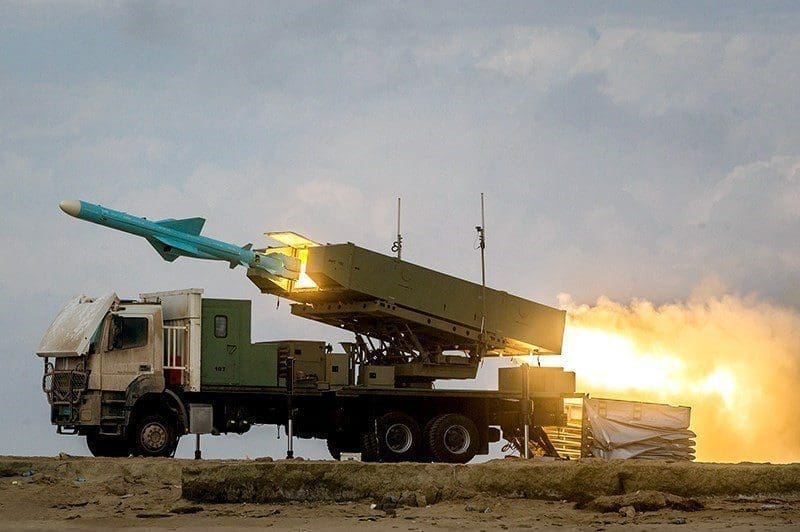
Alongside this, another choke point Iran has against their adversaries is the Strait of Hormuz. Iran has a well-developed anti-shipping missile capability. The Noor is an example of this, with a range of 120km and potential speed near 0.9 Mach (1100 KM/h or 690 MP/h). This would be a more risky option for Iran, with potential greater consequences if such operation was to materialize. Risking further damage to the regime may be something they seek to avoid, especially if initial strikes are successful in regards to decapitation of IRGC (Islamic Revolutionary Guard Corp) forces or other senior members of government.
Another option for Tehran is a campaign against oil facilities across the region. This would inflict the greatest damage to the region, although likely leading forces from the Gulf States being brought into the conflict, widening the strike package against Iran. This situation is undesirable for Tehran as it would bring a wider threat to the IRGC. Despite this, targeting these specific facilities would offer a more substantial effect to the region.
In any large scale conflict, Tehran would seek an option which provides the greatest deterrence whilst also offering a potential chance for an off-ramp. The extensive missile forces present alongside the political situation within the country makes it difficult to view potential operations Iran could conduct.
In regards to the United States and Israel, both have begun preparation including deploying an extensive array of air defense including Patriot and THAAD systems, in order to protect against damage to their forces or civilian population centers.