Iran’s options for retaliation: bluff or not

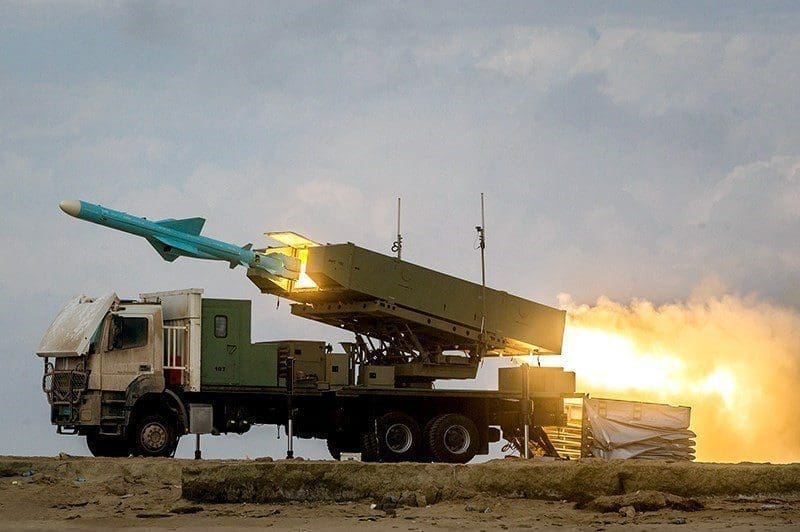
Iranian Fateh-110 missile being fired - Iranian state media

As conflict continues to loom between Iran and the United States, Tehran is facing an increasingly acute military situation. Iran posses a large and comprehensive missile and drone force capable of reaching all United States military bases in the region in addition to Israel. As seen in the 12-day war, Tehran has the largest arsenal of ballistic missiles in the region. This ability was demonstrated with multiple strikes through the period of conflict in June 2025 leaving 32 Israeli civilians dead according to the Times of Israel.

Iran features thousands of SRBM (short range ballistic missiles) and MRBM (Medium range ballistic missiles), some capable of 2,000km in range, easily having the capacity to deliver large payloads across Israel and the surrounding region. The Khorramshahr and Emad missiles both feature this range, with the Emad having a potential 500 meter accuracy according to CSIS. Although not extremely accurate, the amount available to their disposal makes any volley a highly dangerous event.

In the event of war, Tehran would want to maintain a sizable missile force to prop up their own escalation ladder. This allows them to include multiple threats in the later parts of a conflict which could pose as a deterrence for Washington to continue. In doing so, Iran would want to keep their road-mobile launch vehicles in a safe area away from incoming Israeli/US offensive actions. In the 12-day-war, Tehran’s ability to perform large scale strikes on Israeli was greatly damaged by the fact they lost multiple launch vehicles, causing their missile volleys to dwindle

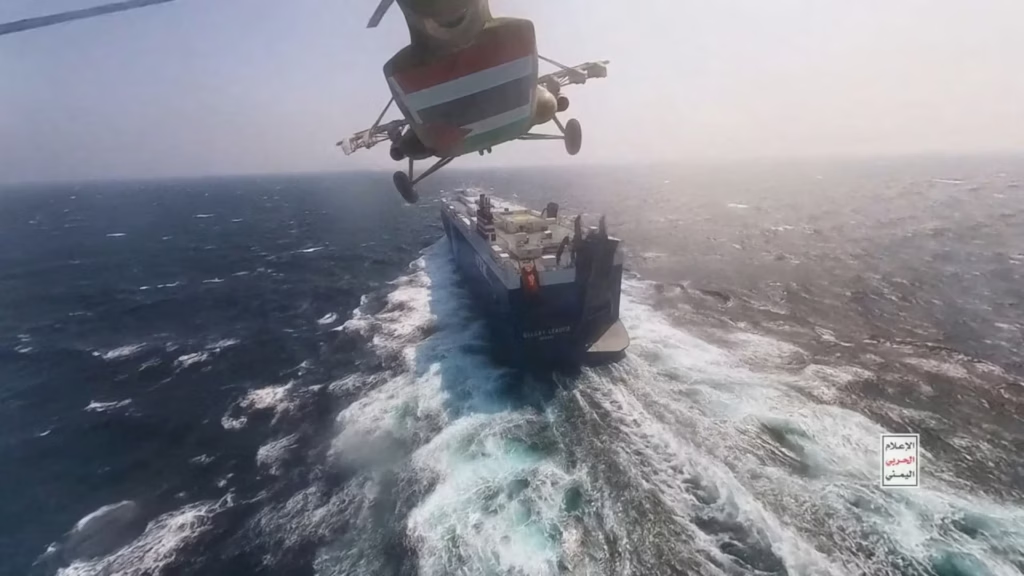
Despite the extensive missile forces Iran has present, this isn’t the only option to their advantage. Iran has affiliation with multiple terrorist-proxy forces dispersed throughout the region. Although most have been battered in the recent conflicts since October 7th, 2023, most still maintain a visible threat. One such example is the Houthis in Yemen, which have continued to demonstrate their capabilities, potentially harming Washington’s interests in the region.

Houthis targeting shipping in the red sea
Houthis targeting commercial shipping in the red sea

This is a dominant strategy for Iran, although it depends on the willingness and capabilities Yemen still features since the continuous strikes which have since occurred after their continued campaign on global shipping from multiple other countries.

Alongside this, another choke point Iran has against their adversaries is the Strait of Hormuz. Iran has a well-developed anti-shipping missile capability. The Noor is an example of this, with a range of 120km and potential speed near 0.9 Mach (1100 KM/h or 690 MP/h). This would be a more risky option for Iran, with potential greater consequences if such operation was to materialize. Risking further damage to the regime may be something they seek to avoid, especially if initial strikes are successful in regards to decapitation of IRGC (Islamic Revolutionary Guard Corp) forces or other senior members of government.

Iran’s options for retaliation: bluff or not
Noor, an anti-shipping missiles developed by Iran which could be used in the event of conflict

Another option for Tehran is a campaign against oil facilities across the region. This would inflict the greatest damage to the region, although likely leading forces from the Gulf States being brought into the conflict, widening the strike package against Iran. This situation is undesirable for Tehran as it would bring a wider threat to the IRGC. Despite this, targeting these specific facilities would offer a more substantial effect to the region.

In any large scale conflict, Tehran would seek an option which provides the greatest deterrence whilst also offering a potential chance for an off-ramp. The extensive missile forces present alongside the political situation within the country makes it difficult to view potential operations Iran could conduct.

In regards to the United States and Israel, both have begun preparation including deploying an extensive array of air defense including Patriot and THAAD systems, in order to protect against damage to their forces or civilian population centers.

India’s desperation to power : New Rafale deal but little too late?

Rafael Fighter

India moves yet closer to another milestone military acquisition as an Acceptance of Necessity has been issued by India’s Ministry of Defence through the Defence Acquisition Council. The procurement of 114 multi-role fighter aircraft (MRFA) has now been approved. This represents one of the largest fighter jet acquisition programs by a foreign customer in recent history.

Although ambiguity has been maintained by the Indian Air Force regarding the final selection of aircrafts by official statements, the press release issued by PIB Delhi on 12 February 2026 specifically mentioned Rafale as the multirole fighter aircraft approved in principle.

Objective of MRFA program

The primary objective of the MRFA program is to enhance India’s ability to conduct dominance operations across the full spectrum of modern conflict and to improve deterrence through long-range offensive strike capability. According to Economictimes,Out of the 114 aircraft, approximately 96 are planned to be manufactured in India, while 18 will be imported from France in flying away condition. Out of which 24 are to be the F5 standard, with the remaining 90 aircrafts are to be produced in F4 standard, both offering upgrade pathways in the near future.

The roots of this tender trace back to 2018, following the original  Medium Multi-role Combat aircraft( MMRCA ) program launched in 2007 for 126 aircraft. The current MRFA process formally restarted in April 2019 with the issuance of an RFI. As a result, nearly eight years have elapsed to reach this stage, during which the IAF’s squadron strength has declined to about 29 against a sanctioned strength of 42.

Latribune reports also suggest that additional aircraft for the Indian Navy may be embedded in this order either five extra jets added to the existing naval requirement or as many as 31 additional aircraft, potentially bringing the total fleet to around 145.

Growing problems

Even the sanctioned strength of 42 squadrons is now considered inadequate. Several legacy fleets including six Jaguar squadrons, three MiG-29 squadrons, and three Mirage 2000 squadrons are expected to retire in the coming years. This highlights a persistent structural weakness in India’s air power planning: long-term dependence on foreign OEMs, coupled with delays in indigenous programs.

During the upcoming visit of French President Emmanuel Macron, an MoU is expected to be signed. However, this will not constitute a final contract. Following AON, several procedural steps remain: issuance of a formal Request for Proposal, submission of commercial and technical bids, negotiations on pricing, delivery schedules, offsets, and localisation, conversion into a contractual framework, and final approval by the Cabinet Committee on Security. Indigenisation remains the central sticking point.

Too late or a real power move?

The answer lies somewhere in between. This is best described as a desperate but necessary catchup move.

The acquisition of additional Rafale aircraft, including the Rafale-M naval variant, represents a meaningful enhancement of near-term combat capability rather than a symbolic gesture. While delayed modernization is evident, the operational impact will be immediate. The move simultaneously addresses declining squadron strength and signals deterrence to regional rivals as China and Pakistan continue to modernize.

Deliveries are expected to begin around 2028 for the naval variant and 2029–2030 for the Air Force timelines that coincide with the Indian Tejas Mk2 program, raising concerns that domestic development may be affected. This overlap has fueled domestic criticism as the government’s theme of self-sufficiency seems more of an imported assembly than actual R&D to fill Make In India Quota. India previously procured 36 Rafales as an emergency measure to plug capability gaps. That purchase was driven by delays in indigenous programs and shrinking squadron numbers. The present acquisition expands both land-based and carrier-borne strike capability amid rapid Chinese military expansion along the LAC, accelerated modernization of Pakistan’s Air Force, and intensifying competition in the Indo-Pacific.

Operationally, Rafales offer high readiness, advanced sensors, long-range precision strike, and proven electronic warfare. Their integration into existing infrastructure improves availability as fleet size grows.

Two and a Half Front Reality

India increasingly faces a potential two and half front scenario involving China, Pakistan, and regional instability to the east. Additional Rafales enhance flexibility by enabling simultaneous force allocation across multiple fronts, faster redeployment, and deeper standoff strikes without heavy forward basing. However, the deeper issue remains structural fighting across two and a half fronts, which stresses fleet size, ISR coverage, logistics, and industrial endurance. Rafale improves short term flexibility, but only expanded production scale, integrated sensor networks, and supply chain sovereignty determine whether India can sustain pressure across all three directions.

Geopolitical Dimension

The expanded Rafale purchase reflects closer strategic alignment with France, valued for its willingness to supply advanced systems with fewer political conditions and greater technology transfer flexibility. This fits India’s multi vector foreign policy, positioning France as a “capability partner” and having no strings attached relationship to avoid constraints on capability and usage.

The move also reduces dependence on the United States, amid engine delays and uncertainty over future deals, and mitigates exposure to geopolitical volatility such as sanctions risks associated with Russian platforms.

“Too Late” Critics’ Perspectives

Defense critics argue the Rafale expansion merely reacts to a 15 year old force structure deficit and fails to meaningfully counter China’s systemic military growth. From ThePrint, Ajay Ahlawat, a retired IAF fighter pilot, points out that while India struggled with procurement delays and lack of indigenous platform production, China inducted fifth-generation fighters, expanded Tibetan airbases, built dense ISR networks, and refined joint kill chains. Pakistan, meanwhile, has improved operational experience and integrated newer platforms.The core limitations are structural: Effects on domestic programs,Sustainability,Fill rate vs depletion rate,quantity and quality differences,capability. China has the upper hand in every one of these areas while India lags behind even with acquired rafale imports.

According to TheWire,This whole MMRCA to MRFA process is a vastly expensive return to the starting block that merited scrutiny rather than hysterical celebration with lost oportunity for domestic industry and technology accquisition with lack of clarity and transparency from ministry of defense side.

Thus, Rafale serves mainly as a bridging solution while India develops indigenous platforms such as Tejas Mk2 and AMCA. The real danger is strategic complacency, relying on imports to solve short term crises while domestic timelines slip.

Conclusion

The Rafale expansion is too late for long term force planning, but not too late for near term deterrence.It significantly strengthens India’s immediate combat posture and raises the cost of limited conflict. However, it does not alter the fundamental asymmetry with China, rooted in scale, sensor integration, and industrial depth.

Ultimately, Rafale buys India time.

What matters now is whether that time is used to build production capacity, integrated ISR networks, and strategic autonomy or merely to prepare for the next emergency procurement.In that sense, this is not a true power move.
It is a catch up move.


Iran-US talks to be held in Geneva, Switzerland on Tuesday

Steve Witkoff meeting Israeli hostage families

Steve Witkoff meeting with hostage families in Tel Aviv, early 2025.

United States diplomats will meet with Iranian officials in Geneva on Tuesday to discuss relationships in hope to avoid a greater conflict. Reuters reports Steve Witkoff and Jared Kushner will be present, with members from Oman taking part for mediation efforts.

This new schedule comes after a week since the first talks were held in Oman, where no formal one-on-one discussion took place. So far, issues such as the Iranian nuclear program, ballistic arsenal and the support for proxies have not been cleared up, with Tehran stating their clear intentions of keeping their missile capabilities, although mixed signals in regards to the enrichment program.

In earlier negotiations, diluting the 60% enriched uranium in return for full sanction relief was brought up, although this solution did not lead to any further concrete deal. The thought of Iran’s supply being brought out of the country was also declined by officials, said by Iran’s atomic energy minister, Mohammad Eslami.

As this second round of talks begin, the USS Gerald R. Ford will continue en route to the Middle East from the Caribbean, continuing the large military buildup in the theatre. All this is alongside significant airlift operations, deploying air defence and jets around the region.

Ukraine and Russia diplomatic talks will also continue in Geneva at the same time, as the United States ramps up pressure for both sides to negotiate to end the 4-year-war.

US deploys second carrier strike group

USS Gerald R Ford (CVN-78)

As military intervention with Iran looms, Washington has indicated that the deployment of the USS Gerald R. Ford will take place, leaving the Caribbean and heading to an area situated around the Middle East. This comes a month after Ford’s role in Operation Absolute Resolve, which led to the capture of then-sitting Venezuelan president, Nicolás Maduro.

The USS Gerald R. Ford, the largest and most advanced currently afloat, will also supposedly be followed by its escort ships, allowing for a greater strike package if Washington ever decided to act against Iran.

This further deployment comes after continued air assets have been recorded entering military bases around the Middle East for the last couple weeks. So far, a Chinese satellite has confirmed air defence being positioned at a base in Jordan, likely to protect against missile volleys from Iran. This is a continued threat seen by both the United States and Israel.


Alongside this brand-new deployment, USS Abraham Lincoln which is believed to be in the Arabian Sea, has also been deployed in the region. Last week the Lincoln shot down an Iranian Shaded 139 which was actively surveilling the ship.

Us deploys second carrier strike group

Diego Garcia, as seen above, has had limited but noticeable movements of airframes

The Ford’s deployment away from the Caribbean theatre also extends its current operational time frame to at least April in accordance with reports from the New York Times, making it an unusual extension for an American carrier. This adds up to its current operational period being extended close to a year if the current projected time frame materialises.

This large military presence has added pressure onto Tehran to follow through with the negotiations laid out by the United States, which follows red lines such as limited ballistic weaponry, end of the nuclear program and removal of funding and assistance with their terrorist proxies across the region.

With already one set of talks having been carried through, there’s been limited hope of a  successful path to diplomacy, with certain agreements on the issues above not being resolved as of now.

On Wednesday, Israeli Prime Minister Benjamin Netanyahu met with President Trump and discussed issues surrounding Gaza and Iran, with Reuters also confirming that Israel announced their position in the “Board of Peace” group during this meeting. This is one of the five meetings held with Trump since his inauguration in late January 2025.

Israeli media also claimed this meeting was in effort to lay out conditions they wanted, including a harsher approach to negotiations with Tehran. 

U.S. Strikes Land Target in Venezuela

USAF MQ-9 Reaper UAV, demonstrative

President Donald Trump said on Monday that the United States struck a Venezuelan “dock area” he described as linked to drug-running boats, claiming a “major explosion” at a site where traffickers “load the boats up with drugs,” according to the BBC.

While Trump declined to identify who carried out the attack, telling reporters, “I don’t want to say that” when asked about the CIA, the BBC reported there has been no official confirmation from Caracas and no strike footage has been released the way the Pentagon has publicized prior maritime interdiction strikes.

U.S. officials familiar with the operation, however, told CNN the CIA conducted a drone strike earlier this month on a remote port/dock facility on Venezuela’s coast, which U.S. intelligence assessed was being used by the Venezuelan gang Tren de Aragua to store narcotics and move them onto boats for onward shipment. The network reported no one was present at the time of the strike and no casualties resulted.

The New York Times separately reported that the strike occurred last week and described it as the first known U.S. operation inside Venezuela during the Trump administration’s pressure campaign, targeting a dock believed to be involved in staging narcotics for loading onto boats. The Times said Trump had mentioned the incident twice in recent days, first in a radio interview and again on Monday. His first mention can be listened to below.

Key operational details remain contested. CNN reported that sources described U.S. Special Operations Forces as providing intelligence support, but a U.S. Special Operations Command spokesperson denied any support “to include intel support.” The CIA declined to comment to CNN, while the Pentagon referred questions to the White House, which has not provided a detailed public account at the time of publication.

The reported land strike comes as Washington intensifies a wider campaign that has combined counter-narcotics justification with escalating pressure on Venezuelan President Nicolás Maduro. U.S. strikes on suspected drug-smuggling boats in the Caribbean and eastern Pacific have been occurring since September. It appears the operation has now expanded from maritime strikes, to tanker seizures, to clandestine land strikes.

A new boat strike occurred yesterday, bringing the total number to 30 (31 if you count the dock), with the U.S. reporting 106 total individuals killed in those strikes.

Centcom says U.S. and partner raids in Syria removed nearly 25 ISIS operatives after the major Dec. 19 strike

U.S. Central Command says U.S. and partner forces killed or captured nearly 25 ISIS operatives in Syria in the days after a large-scale Dec. 19 strike, describing the activity as part of a sustained effort to disrupt the group’s networks and prevent it from rebuilding.

In a statement released from Tampa, Florida, Centcom said follow-on operations ran from Dec. 20 to Dec. 29 and included 11 missions across Syria. The command said at least seven ISIS members were killed and the remaining operatives were captured. Centcom also reported that the missions led to the elimination of four ISIS weapons caches.

The announcement follows what Centcom described as Operation Hawkeye Strike, launched on Dec. 19. Centcom said U.S. and Jordanian forces struck more than 70 targets using more than 100 precision munitions, with aircraft, attack helicopters and artillery involved. The command said the strikes destroyed ISIS infrastructure and weapons sites across central Syria.

“We will not relent,” Centcom commander Adm. Brad Cooper said in the statement. He added that the United States remains “steadfast in commitment” to working with regional partners to “root out the ISIS threat posed to U.S. and regional security.”

Centcom framed the activity as part of a broader counter-ISIS campaign over the past year. The command said U.S. and partner operations in Syria over the last 12 months resulted in more than 300 terrorists being detained and over 20 killed. It also said ISIS “inspired” at least 11 plots or attacks against targets in the United States in 2025, without providing additional details in the statement.

“Continuing to hunt down terrorist operatives, eliminate ISIS networks, and work with partners to prevent an ISIS resurgence makes America, the region, and the world safer,” Cooper said.

ISIS no longer controls territory in Syria and Iraq the way it did at its peak, but U.S. officials have repeatedly warned that cells and facilitators can still generate attacks, exploit instability, and regenerate if pressure eases. Centcom did not identify the individuals killed or captured, nor did it specify precise locations for the raids and weapons caches beyond saying the missions were conducted across Syria.

The figures and operational claims come directly from Centcom and were not independently verified in the statement. Still, the update signals the command intends to pair large strike packages with rapid follow-on raids designed to seize personnel and dismantle weapons stockpiles, aiming to keep ISIS remnants fragmented and on the defensive.