Exclusive: Israeli pilots told to prepare for longer hours

Israeli Air Force (IAF) F-35I Adir stealth multi-role fighter jet

THE MIDDLE EAST, Apr. 21 – Multiple Israeli Air Force pilots have been told to prepare for “longer working hours” if fighting with Iran breaks out again, according to exclusive information obtained by Faytuks News, a sign that Israeli planners assess renewed confict as the current ceasefire’s expiration draws closer.

The guidance, relayed to pilots in recent days, underscored a sense of urgency, with some saying they do not know how much time remains if fighting resumes, according to sources. The message reflects concern inside Israel’s military and intelligence establishment that any renewed conflict could require a sustained air campaign rather than a short round of strikes.

The move recalls the period before the Feb. 28 launch of the U.S.-Israeli operation against Iran, when preparations were already underway well before the first public announcements. Reuters later reported that the operation had been coordinated in advance and that Israeli officials were already framing the campaign in terms of weeks, not days.

The latest warning comes at a tense moment. President Donald Trump said April 21 that he does not want to extend the current truce, while Reuters reported that the future of talks remained uncertain as the ceasefire deadline approaches.

Iran has also hardened its public position. Iranian state-linked media, cited by Reuters, reported April 19 that Tehran had made no decision to send a negotiating delegation to Pakistan as long as a naval blockade remained in force. That stance helps explain why diplomats have struggled to turn the pause in fighting into a broader agreement. Meanwhile, the U.S. delegation, expected to depart for Pakistan on Tuesday morning, instead travelled to Washington, D.C.

Taken together, the warning to pilots and the diplomatic deadlock suggest both sides are still preparing for the possibility that the fighting could restart with little notice. For Israel, that means making sure aircrews and support units are ready for a heavier operational tempo. For the wider region, it is another sign that the ceasefire may be only a brief pause in a conflict that has already proved difficult to contain.

Call for Peace: What Does the Two-Week Ceasefire Entail for the Region?

Following over a month of escalating hostilities, Washington and Tehran agreed to a Pakistan-brokered, two-week ceasefire on April 8. This pause in the conflict presents a major opportunity to re-establish diplomatic channels between the two governments, enabling the possibility of ever reaching a bilateral agreement beneficial to both sides. However, the final outcome rests entirely on the actions of the involved actors.

Continue reading

The Hormuz Dilemma

The Strait of Hormuz, a narrow chokepoint linking the Persian Gulf to the Gulf of Oman and carrying approximately one-fifth of global seaborne oil and significant LNG volumes has been effectively closed since early March 2026 amid the ongoing US-Israel military campaign against Iran (initiated 28 February 2026). Iran declared the waterway closed to vessels linked to the US, Israel and allies, with 21+ confirmed attacks on merchant ships and counting (causing at least 11 seafarer deaths/missing and multiple abandonments), threats of further strikes, and retaliatory hits on regional energy infrastructure.

This has driven tanker traffic to near-zero, down from ~153 daily transits pre-crisis, prompting Gulf producers to cut output as storage limits are met. This has spiked global oil prices beyond 2022 highs (briefly exceeding $100/bbl) and forced rerouting or suspension by major shippers. US responses include strikes on Iranian naval assets, destroying a large portion of its regional naval power, but reopening remains contingent on the current scenario. Iran although has stated that countries who complete transaction in Chinese Yuan can be given an allowance to pass

Historical Context

The Strait has faced repeated disruptions tied to Iran-Gulf tensions, establishing a pattern of asymmetric pressure via shipping harassment and infrastructure targeting without full closure until 2026:

  • 1980s “Tanker War” (Iran-Iraq conflict): Iran and Iraq attacked neutral and each other’s tankers; Iran mined waters and used speedboats/missiles, disrupting flows but never fully closing the strait.
  • 2012–2015: Iran threatened closure amid sanctions; no sustained blockade.
  • 2019 Peak Escalation: 14 September drone/cruise-missile strikes on Saudi Aramco’s Abqaiq (world’s largest oil-processing facility) and Khurais field (verified by satellite imagery showing 17+ impact points; 5.7 million bpd — ~5% global supply — offline temporarily). US and Saudi intelligence attributed to Iran (or proxies); Houthis claimed responsibility but trajectory analysis ruled out Yemen launch. Parallel limpet-mine attacks damaged tankers near the strait.
  • 2019–2025 Seizures/Harassment: Iran seized ~20 vessels (e.g., Maersk Tigris 2015, British Stena Impero 2019, Greek tankers 2022, multiple “smuggled fuel” cases into late 2025). No full closure; traffic continued amid elevated insurance.

These precedents demonstrate Iran’s proven capability for disruption but also historical restraint until the existential threat posed by the 2026 leadership decapitation strikes.

Current War Context & Verified Developments

Trigger (28 February 2026): Coordinated US-Israel airstrikes (“Operation Epic Fury”/Roaring Lion) targeted Iranian military/nuclear sites and leadership compounds in Tehran. Supreme Leader Ali Khamenei and multiple senior officials were killed (confirmed by Iranian state media and US/Israeli statements). Iran retaliated immediately with missiles/drones on US bases in UAE/Qatar/Bahrain, Israeli territory, and Gulf targets.

Iranian-made Strait Disruption (from 1 March)

IRGC declared the strait “closed” to adversary-linked shipping (2–4 March formal announcements), warning of attacks on any transiting vessel. Tactics: drones, sea drones/USVs, projectiles, fast boats, and mines. The US Navy struck Iranian minelayers and Kharg Island oil terminal.

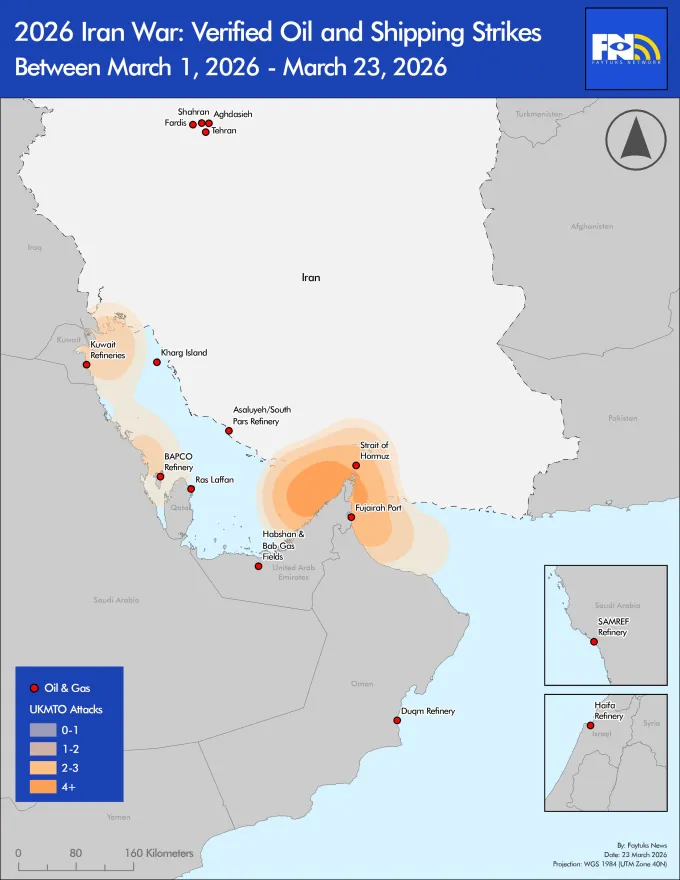
Verified Ship Attacks (UKMTO/IRGC-corroborated; 21+ by 12 March, additional through 19 March; total ~24 documented incidents):

  • 1 Mar: `, captain +1 killed; MKDVYOM abandoned, 1 killed; multiple others (Hercules Star, Ocean Electra, LCT Ayeh) damaged.
  • 2 Mar: Stena Imperative (US-linked, Bahrain) fire (1 port worker killed, 2 wounded); AtheNova drone strike.
  • 4–6 Mar: Sonangol Namibe (oil spill); Mussafah 2 tug sunk (4 killed).
  • 11 Mar: Mayuree Naree (Thailand bulk) abandoned, 3 missing; Safesea Vishnu & Zefyros (Iraqi waters) ablaze by Iranian boats, 1 killed; ONE Majesty, Star Gwyneth, Source Blessing projectiles.
  • Later: Parimal abandoned (captain missing), others minor damage. Traffic: 70% drop Day 1 → virtual standstill (only selective Chinese/Turkish/Saudi-approved passages; many AIS-dark or anchored).

Casualties: 11+ seafarers killed/missing; 1+ port worker.

This comes amid the dangerous and costly escalation of strikes on the oil facilities

The hormuz dilemma

Verified Hits on Oil/Gas Facilities

Israel: 

  • Bazan Group (Oil Refineries Ltd.) complex in Haifa, Israel

Gulf Nations:

  • Saudi Arabia: Drone strike on SAMREF refinery (Yanbu, Red Sea — alternative bypass route); earlier references to Ras Tanura targeting. Production rerouting disrupted.
  • Qatar: Missiles caused extensive damage to Ras Laffan LNG (exports -17%, ~$20B annual revenue loss projected); part of South Pars shared field.
  • Kuwait: Drone/missile fires at Mina Al-Ahmadi and Mina Abdullah refineries (no fatalities reported).
  • UAE: Habshan gas field & Bab field shut; Fujairah port drone; vessels ablaze off coast; Abu Dhabi operations halted.
  • Bahrain: BAPCO facility hit; Stena Imperative port strike.
  • Others: Oman Duqm fuel tank ; Iraq ports and oil fields force majeure on oil exports.

Iranian Facilities (targeted by Israel/US):

  • South Pars/Asaluyeh (world’s largest gas field; Israeli strike 18 Mar — explosions, refinery/storage damage, production halted at two units).
  • Kharg Island (major Iranian oil export hub; major US strike; Trump noted restraint on full destruction but threatened escalation).
  • Asaluyeh petrochemical/storage tanks.

US/Gulf Responses: Trump offered Navy escorts, political-risk insurance, and continued strikes on Iranian naval/minelaying assets. G7 discussed escorts; China pressed Iran privately while routing select vessels. Iraq declared force majeure; shipping firms (Maersk) suspended.

Detailed Analytical Timeline

  • 28 Feb: Strikes begin; iInitial IRGC VHF warnings + early ship strikes (3+ tankers).
  • 1–2 Mar: Traffic -70%; 5+ ship hits,Stena fire by hits in Bahrain.
  • 3–4 Mar: Formal closure announcement by IRGC; 8+ vessels damaged; US destroys minelayers.
  • 5–11 Mar: Selective passages allowed (China etc.); peak attacks (11 Mar wave: 6 vessels); insurance 4–6x; Fujairah/Duqm hits.
  • 12–19 Mar: Near-zero traffic; additional hits (Parimal etc.); selective approvals; Trump: “dribble” of tankers resuming under pressure; Gulf facility strikes intensify (Yanbu, Ras Laffan, Kuwait pair).
  • Ongoing (to 21 Mar): No changes in strait situation and condition.

Conclusion:

Iran’s asymmetric playbook selective enforcement allowing approved passages while punishing Western-linked vessels, paired with retaliatory strikes against critical infrastructure exploits existential stakes to impose global leverage without inviting total naval defeat. US/Israeli Strikes on its naval fleet has degraded but not eliminated Tehran’s drone/USVs/shore-missile capacity, sustaining functional denial.

Strategically, this proves selective disruption outperforms absolute blockade: it has spiked oil prices, forced Gulf curtailments, triggered force majeures, and exposed bypass-route fragility delivering outsized economic coercion at sustainable risk. As of 21 March 2026, the chokepoint remains contested, underscoring hybrid warfare’s potency at energy arteries: Iran trades short-term pain for diplomatic leverage, while the US retains reopening tools but faces escalation. Absent swift ceasefire, the crisis cements the strait as a durable hybrid battlefield where verified pressure, not conquest, reshapes global energy security.

Iran Appoints Mojtaba Khamenei as New Supreme Leader Amid Ongoing War with US and Israel

Iran’s Assembly of Experts has named Mojtaba Khamenei, the 56-year-old son of the assassinated Ayatollah Ali Khamenei, as the Islamic Republic’s third Supreme Leader. The announcement, broadcasted on state television early Monday local time, marks the first hereditary transfer of power since the 1979 revolution and comes as the country reels from the devastating US-Israeli military campaign, resulting in the death of his father.

Mojtaba Khamenei, a low profile cleric with deep ties to the Islamic Revolutionary Guard Corps (IRGC), now holds ultimate authority over Iran’s military, judiciary, media, and foreign policy at the most perilous moment in the nation’s 47-year history.

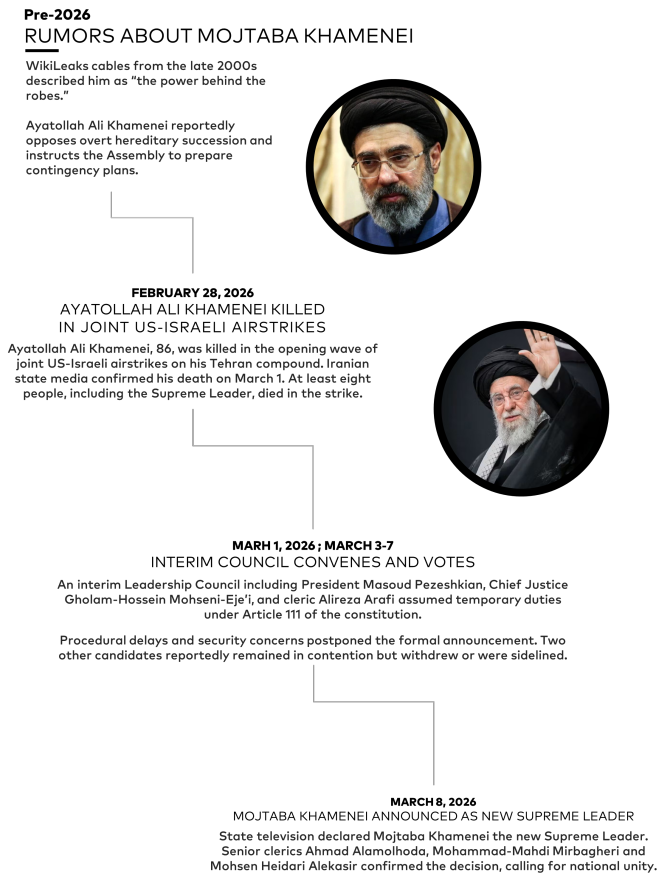
Timeline of Succession

Iran appoints mojtaba khamenei as new supreme leader amid ongoing war with us and israel

Who Is Mojtaba Khamenei?

Born on September 8, 1969, in Mashhad, Mojtaba is the second of Ali Khamenei’s six children. He briefly served in the Iran-Iraq War as a teenager, then pursued seminary studies in Qom from age 30 (unusually late for a cleric). He holds mid-ranking clerical credentials and has never held elected office or given a public speech. Despite his reclusive image, He wields significant backdoor influence. He is accused of orchestrating IRGC and Basij interference in the 2005 and 2009 presidential elections and of suppressing the Green Movement.

Reports indicate he lost mother and wife in addition to his father in the recent US-Israeli strikes.

Significance of the Appointment

The decision is historic and deeply controversial. The Islamic Republic has always rejected hereditary rule, emphasizing clerical merit over bloodlines. Mojtaba’s selection pushed by the IRGC represents the first father to son transfer of supreme power and cements hardliner dominance at a time when reformist voices have been sidelined. It seems like the appointment of Mojtaba is the establishment of a puppet as the figurehead to ensure their control and power in the regime. It also looks like the plot to ensure policy continuity for the regime, uncompromising opposition to the West, support for regional proxies and tight control over the nuclear program. However, it risks eroding legitimacy among a war affected population already facing economic collapse and civilian casualties from the protests.

What Lies Ahead: His Fate

Mojtaba Khamenei assumes power as a marked man in the middle of the Islamic Republic’s greatest existential crisis. Israel has explicitly threatened his life alongside Trump’s comments suggesting Washington will not accept him without concessions. His leadership remains untested; he has never managed public crises or addressed the nation. Mojtaba’s personal tragedy, his father, mother, his sister and wife may harden his stance against compromise. Yet the war’s devastation, severed oil revenues and international isolation pose enormous challenges. Whether he can unify a fractured elite, rally a grieving public and navigate potential further assassinations will define not only his fate but the survival of the Islamic Republic itself.

A senior cleric told state media,: “The nation must rally behind the new leader to preserve our dignity and independence.” In the streets of Tehran, however, the mood remains one of shock, defiance and uncertainty as explosions continue to echo across the region.

Faytuks Network Exclusive: Battle Damage assesment on NSA BAHRAIN

Faytuks Intel® Battle Damage Assessment

Battle Damage Assessment: Iranian Missile and Drone Strikes on NSA Bahrain (U.S. Fifth Fleet Headquarters)

On February 28 2026, Iran launched a major retaliatory operation codenamed “Truthful Promise 4” following U.S.-Israeli strikes on Iranian targets, leading to the then Iranian Supreme Leader, Ayatollah Ali Khamenei being assassinated. One of the primary targets was “NSA Bahrain”, the forward headquarters of the U.S. Navy’s Fifth Fleet. Multiple waves of ballistic missiles, cruise missiles, and Shahed-136 drones struck the base and surrounding areas in Manama starting February 28, 2026. Following is the BDA assessment done by our Intel team from Faytuks Network.

Timeline of Reported Hits

– February 28, 2026 (Saturday – initial major strike): Iranian forces fired waves of ballistic and cruise missiles plus drones directly at NSA Bahrain. Eyewitness video captured explosions and black smoke rising over the Mina Salman port area. Bahrain’s defense forces intercepted many incoming projectiles, but several penetrated and impacted the base. U.S. service members inside the base recorded missiles landing nearby.

– March 1–5, 2026 (follow-on strikes and drones): Additional Iranian drone attacks hit residential buildings near the base (including Fontana Towers) and a facility close to Salman Port. A separate wave of ballistic missiles targeted the broader Manama area on or around 

-March 5–6, 2026. Bahrain’s Interior Ministry stated its forces intercepted 75 Iranian ballistic missiles during this period, destroying 65.  

Faytuks network exclusive: battle damage assesment on nsa bahrain

Detailed Damage Assessment 

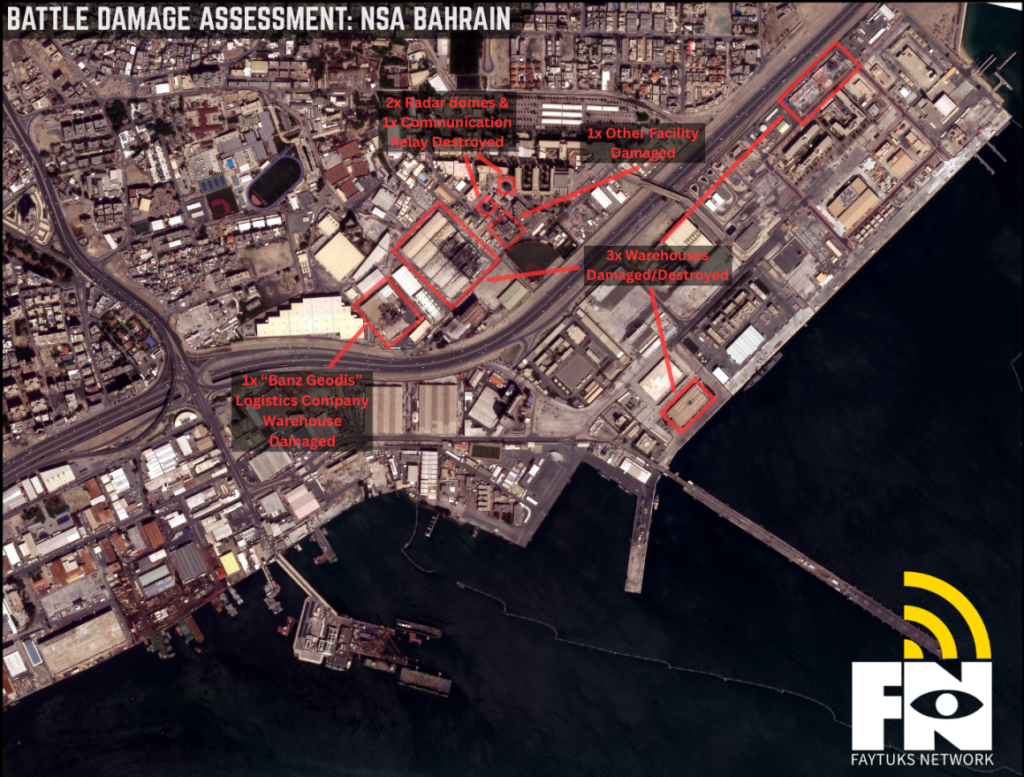
High-resolution satellite imagery revealed the following damage at NSA Bahrain:

– 2× Radar domes & 1× Communication Relay Destroyed: Multiple satellite dishes and radar installations in the central and northern sections of the base were obliterated. Reports specifically noted the loss of two large satellite communications terminals.  

– 3× Warehouses Damaged/Destroyed: Three large warehouse-style buildings along the eastern edge of the base (near the port) showed clear structural damage, collapsed roofs, and burn marks consistent with precision missile impacts.  

– 1× Other Facility Damaged: an additional support building (possibly administrative or logistics) sustained partial destruction.  

– 1× “Banz Geodis” Logistics Company Warehouse Damaged: a prominent logistics warehouse operated by or associated with Banz Geodis (a commercial logistics provider with ties to regional supply chains, potentially supporting military-adjacent operations) sustained visible damage

– Additional visible damage included fires at a possible fuel storage or ship-repair area near the ASRY facility in Al Hidd, and debris fields around the main NAVCENT headquarters buildings.

U.S. Central Command initially stated that damage to U.S. installations was minimal and has not impacted operations, with no combat casualties being reported. However, satellite images and local reporting showed extensive and visible destruction, more than initially acknowledged, including destroyed buildings and damaged areas. 

Strategic Context and Impact

NSA Bahrain is the operational command centre of the U.S. Fifth Fleet, hosting command staff, logistics, mine countermeasure ships, and allied naval forces (including UK and Italian detachments). The fact that Iran was able to reach and damage this high-value target has raised serious questions about regional air defense gaps, despite Bahrain’s Patriot air defense system and other systems downing the majority of incoming threats.

As of this writing, Operations at the base continue, but with heightened security, partial evacuations of non-essential personnel, and U.S. diplomatic facilities in Bahrain temporarily closed. The strikes have determined the risk possessed by the strike capability of Iran forcing other bases to be on high alert and having the possibility of penetration which have been seen in this conflict.This also exposed the vulnerability of the layered air defense systems to saturation attacks despite on higher rate of interceptions for Ballistic missiles.This attack marks one of the most direct strikes on a major U.S. overseas headquarters in decades and underscores the vulnerability of forward-deployed forces in the CENTCOM theater.

Iran’s fate: A Messy War – Stalemate or Forced Conclusion?

As of March 7, 2026, Iran’s fate is no longer a question of “next messy war or conclusion”—the messy war is actively unfolding. On February 28, 2026, the United States and Israel launched coordinated large-scale airstrikes (U.S. Operation Epic Fury; Israeli Operation Roaring Lion) against Iranian targets, including nuclear facilities, missile infrastructure, air defenses, naval assets, government buildings in Tehran, and leadership compounds. This has already killed Supreme Leader Ayatollah Ali Khamenei, dozens of senior IRGC and government officials, and over 1,300 Iranians (military and civilian), with significant damage to critical infrastructure.

Iran has retaliated with hundreds of ballistic missiles and thousands of drones targeting Israel, U.S. bases in the Gulf, and civilian/economic sites in the UAE, Qatar, Saudi Arabia, and beyond (including Cyprus, Azerbaijan, and tanker traffic near Oman). The Strait of Hormuz has faced temporary closures and disruptions, spiking global oil prices and threatening 20% of world oil trade. The conflict now in its second week builds directly on the unresolved June 2025 “Twelve-Day War” and collapsed 2025–2026 nuclear negotiations. This is not abstract forecasting. It is a live geopolitical rupture driven by miscalculation, maximum-pressure doctrine, and opportunity after Iran’s regional proxies (Hezbollah, Houthis, Iraqi militias) were severely degraded since October 2023.

Background and Immediate Triggers: From Proxy Attrition to Direct Confrontation

Iran’s “Axis of Resistance” strategy forward defense via proxies, missiles, and a advancing nuclear program provided deterrence but invited preemption. Post-2018 U.S. JCPOA withdrawal and “maximum pressure,” Iran enriched uranium to near-weapons-grade levels (enough theoretical material for multiple devices), rebuilt capabilities after 2025 Israeli/U.S. strikes, and faced reinstated UN sanctions in late 2025.

Domestic pressure compounded this: January 2026 protests (sparked by economic collapse—rial at historic lows, inflation >40%) were brutally suppressed, eroding legitimacy even among reformists. Failed indirect U.S.-Iran talks in Muscat/Geneva (February 2026) collapsed despite Iranian concessions on enrichment suspension; Trump and Netanyahu saw a window after intelligence indicated leadership vulnerability.

Geopolitically, U.S. (Trump administration) and Israeli objectives converged on degrading Iran’s missile/nuclear programs permanently and achieving de facto regime change without ground troops—echoing Venezuela 2025 dynamics. Iran miscalculated that its asymmetric toolkit and great-power patrons (Russia/China) would deter direct attack. They did not.

Key Geopolitical Factors Shaping the Conflict

  • Military Asymmetry and Iranian Vulnerabilities: U.S./Israeli strikes have destroyed much of Iran’s air defenses, air force, navy (>30 warships sunk), and key missile production/launch sites. Retaliatory salvos have caused limited damage (dozens killed in Israel; hits on Gulf infrastructure) but depleted stocks and exposed overstretch. Proxies are sidelined: IRGC advisors fleeing Lebanon, Hezbollah under renewed Israeli pressure.
  • Internal Fragility and Succession Crisis (Including Current Executive Power Vacuum): Khamenei’s death shattered the clerical-military compact. An interim Leadership Council (President Pezeshkian, Chief Justice Mohseni-Eje’i, Ayatollah Arafi) immediately assumed powers under Article 111 of the Constitution. Pezeshkian stated on state television March 1: “The interim leadership council has begun its work” and vowed to “powerfully crush the enemy’s bases” while staying “along the path set by Imam Khomeini.” The Assembly of Experts is tasked with selecting a permanent successor (Mojtaba Khamenei widely seen as frontrunner), but strikes have delayed proceedings. In practice, real executive authority has shifted to the IRGC, which now dominates defense, command-and-control, and internal security amid the decapitation of much of the civilian and clerical leadership (48–49 senior figures killed). This creates an acute executive power vacuum—constitutional on paper, IRGC-dominated in reality—with risks of elite infighting and command disarray. The vacuum compounds continuous pre-existing problems: economic implosion (rial exceeding 1 million to the USD on black market, inflation >40%, food prices up 70%), suppressed nationwide protests from December 2025–January 2026, chronic water/electricity shortages, and infrastructural decay. These structural crises predate the war and now accelerate legitimacy erosion, limiting the interim council’s ability to stabilize governance even as the IRGC hardens into a “garrison state.”
  • Great-Power Dynamics: Russia provides satellite intel and verbal support but prioritizes Ukraine—no direct intervention. China evacuates citizens, condemns strikes, and faces a bind: Iran supplied discounted oil (80-90% of Iran’s exports), but Hormuz disruptions risk supply shocks. Europe is divided; Gulf states align with the U.S. umbrella.
  • Economic and Energy Leverage: Sanctions + war isolate Iran further. Global oil volatility benefits Russia short-term but threatens recession risks elsewhere. The Strait of Hormuz remains Iran’s ultimate deterrent.

Scenarios: Messy War Toward Conclusion, or Entrenched Chaos?

Three plausible medium-term paths (12–24 months) emerge from current trajectories:

  1. Contained Regime Change or Forced Capitulation : Sustained U.S./Israeli strikes degrade capabilities until Iran offers “unconditional surrender” or internal collapse empowers opposition elements. Trump has signaled a 4-week horizon and easier post-strike negotiations. Decapitation, proxy weakness, power vacuum make sustained resistance costly. Outcome is weakened Islamic Republic, nuclear program set back years, possible reintegration talks.
  2. Protracted Attrition : Iran conserves missiles for guerrilla-style retaliation, closes Hormuz fully, or activates sleeper cells. IRGC hardens into “garrison state,” suppressing dissent amid the vacuum. Spillover is seen so far, but escalation could draw in more actors. Global energy shock deepens.
  3. Managed Transition or Fragmentation (Lower Probability): Elite deal produces pragmatic leadership seeking reintegration. Or chaos: factional fighting, Kurdish/Baloch opportunism, or popular uprising fueled by continuous economic pain.

Critical assessment

The war reflects U.S. assertion of dominance amid multipolar competition. Iran’s “resistance” model proved unsustainable once proxies eroded and the power vacuum exposed internal fragility. However, victory is illusory without “day-after” planning; a vacuum invites extremism or opportunistic footholds. Oil interdependence and proliferation risks mean no clean “conclusion” any resolution requires multilateral diplomacy that Trump has historically resisted.Human and strategic costs are getting increasingly immense. Long-term, Iran’s youth and resources could enable recovery under new governance but only if external powers avoid past errors.

Conclusion

Iran’s fate tilts toward a messy, violent conclusion regime transformation or indefinite stalemate that’s heading for yet another disaster in waiting. The 2026 war accelerates trends since 2023, with the executive power vacuum and continuous structural crises acting as decisive accelerants. The coming weeks will determine if this becomes a decisive pivot or another chapter in endless regional conflict. De-escalation windwos seems virtually closed.