




Trump-Xi Washington Summit: Pageantry, Tactical Truces, and the G2 Shift
- By Faytuks Newsroom
- • October 8 2026
- •
- 4 minutes
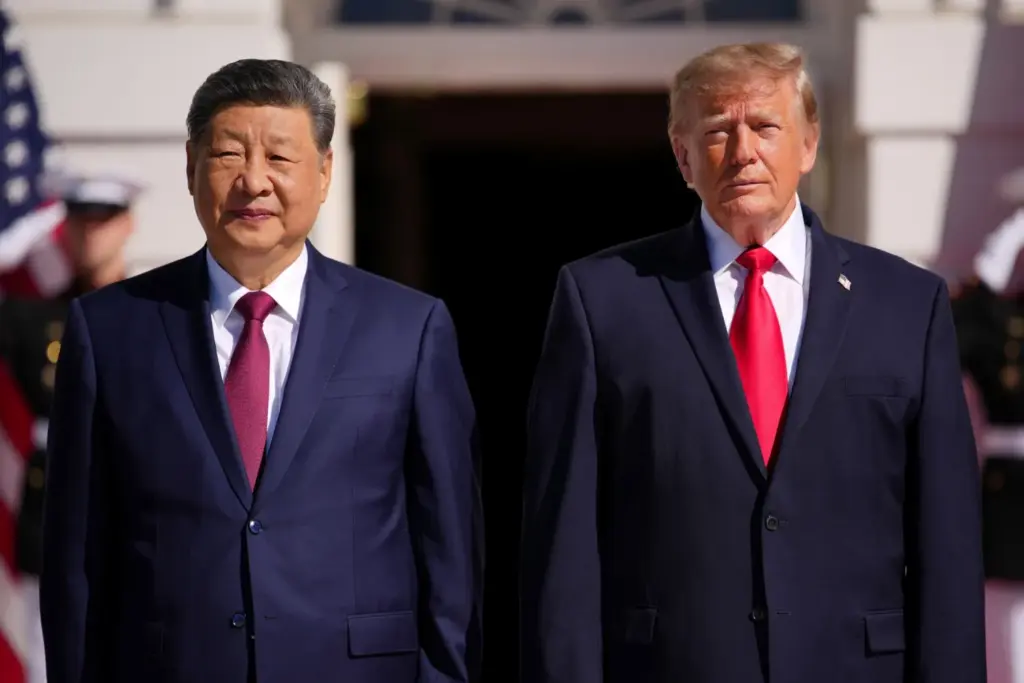
- U.S. President Donald Trump (R) greets President of China Xi Jinping as he arrives to the South Portico of the White House on September 25, 2026 in Washington, DC. Photo by Andrew Harnik via Getty Images.
Geopolitics rarely moves in straight lines, but high-stakes summits have a way of laying bare the underlying balance of leverage. When Chinese President Xi Jinping arrived at the White House for his September 23–25 state visit—his first in Washington in over a decade—the ceremonial grandeur belied a hard, transactional reality. Against the backdrop of escalating multipolar fragmentation and an accelerating shift toward a bipolar “G2” dynamic, the summit was engineered to deliver immediate political de-escalation rather than structural resolution.
While the meeting yielded headline deliverables, most notably an extension of the bilateral trade truce, a formal AI risk dialogue, and targeted commodity purchase agreements, the strategic dividends were distinctly asymmetric. Beijing leveraged Washington’s preference for transactional wins to cement great-power parity, blunt unilateral tariff pressures, and deflect scrutiny from its critical mineral export curbs and industrial excess capacity. For Washington, short-term economic relief came at the expense of allied cohesion and long-term strategic coherence.
1. The Summit Architecture: Optics vs. Structural Impasse
The operational atmosphere in Washington reflected two fundamentally divergent approaches to statecraft:
- Washington’s Transactional Focus: The administration prioritized tangible, immediate deliverables capable of steadying domestic markets ahead of midterms. Bilateral mechanics centered on reviving working-level economic platforms and avoiding an uncontained tariff escalation.
- Beijing’s Long-Horizon Posture: Xi arrived prepared to indulge Washington’s appetite for optics in exchange for structural breathing room. Framing China not as a revisionist challenger but as an indispensable equal, Beijing sought to stabilize its external periphery while insulating its domestic economy against supply-chain fracturing.
The result was an exercise in managed stability: sufficient procedural activity to signal de-escalation, but minimal movement on the foundational friction points that triggered the strategic confrontation in the first place.
2. The Bilateral Balance Sheet: Gains and Tactical Offsets
| Strategic Domain | United States: Gains & Exposure | China: Gains & Exposure |
| Trade & Commerce | Gain: Extension of the trade truce; operationalization of the US-China Board of Trade and Board of Investment; reciprocal tariff reviews on $30B in non-sensitive goods; 10M metric tons annual coal export pledge. Loss: Structural industrial overcapacity and state subsidies left entirely unaddressed. | Gain: Neutralized immediate tariff escalation; secured market stability without conceding ground on core industrial policy or high-tech subsidization. Loss: Long-term tariff architecture remains intact as latent economic leverage. |
| Critical Minerals & Supply Chains | Loss: Failed to secure the removal of export impediments on rare earths and critical minerals imposed following Washington’s Liberation Day tariffs. | Gain: Preserved critical mineral restrictions as a potent asymmetric countermeasure against future Western tech controls. |
| Emerging Tech & AI | Gain: Institutionalized a dedicated bilateral AI risk and safety governance dialogue. Loss: Sidelined broader technology security controls and export enforcement. | Gain: Established a high-level consultative channel, validating China’s status as a frontier AI peer. |
| Security & Taiwan | Loss: Strategic coherence eroded by reported proposals to sell conventional weapons to Beijing while consulting on Taiwan arms transfers, raising operational alarm across regional defense networks. | Gain: Reasserted its baseline Taiwan rhetoric on the White House stage, testing Washington’s deterrent credibility. |
| Counternarcotics & Illicit Finance | Gain: Continued operational exchanges and joint casework on targeted precursor chemicals (e.g., orphines). Loss: Failed to secure binding legal mechanisms, material support statutes, or enforcement against Chinese money laundering networks. | Gain: Maintained transactional cooperation via piecemeal precursor scheduling, deflecting broader punitive measures without reforming legal oversight. |
3. Allied Repercussions: The Cost of Bilateral Exclusivity
The summit’s pronounced bilateralism generates immediate friction across Washington’s alliance network in Europe and the Indo-Pacific:
- Indo-Pacific Reassurance Deficits: For Tokyo, Seoul, and Canberra, Washington’s willingness to compartmentalize regional security, and explore ad hoc defense discussions with Beijing, revives concerns over great-power dealmaking over the heads of front-line partners. Japan, currently undergoing its own historic defense and lethal export transformation, views any ambiguity surrounding Taiwan and sea-lane deterrence with acute concern.
- Transatlantic Divergence: European capitals, having gradually aligned with Washington’s “de-risking” framework and critical-material supply chain defenses, face an erratic policy landscape where unilateral US trade truces risk leaving partner markets exposed to redirected Chinese industrial oversupply.
- Deflection of Trilateral Frameworks: Washington’s ambition to pull Beijing into trilateral arms control discussions alongside Moscow gained zero traction, underscoring Beijing’s continued refusal to constrain its nuclear modernization within US-designed architectures.
4. The Transitional Moment: Multilateral Platforms and the “G2” Trajectory
Xi’s visit occurs within a fluid international system where traditional multilateral institutions are increasingly subordinated to direct great-power bargaining. The emerging dynamic is neither a return to Cold War bipolarity nor a settled multipolar equilibrium; it is a transitional order dominated by a de facto G2 operating atop an assertive Global South.
The strategic calendar over the coming quarter highlights this pivot:
- APEC (Shenzhen, November 2026): Beijing will host the forum as an operational showcase for its dual-track economic model—projecting itself as the primary anchor of regional trade connectivity while championing alternative, Global South-aligned development rails.
- G20 Summit (Miami, December 2026): Washington will seek to reassert its economic leadership on home turf. However, if bilateral Trump-Xi sideline negotiations again eclipse multilateral agendas, it will confirm to third-party states that systemic challenges ranging from cross-border debt to sovereign supply-chain resilience are being subordinated to bilateral horse-trading.
- The Multilateral Squeeze: Middle powers and regional blocs (ASEAN, the Quad, and the expanded BRICS) are increasingly forced to hedge. As Washington and Beijing construct parallel institutional machinery—bilateral boards of trade on one hand, alternative settlement mechanisms and raw material syndicates on the other—the rest of the global economy is inexorably drawn into the perimeter of their bargain.
The Bottom Line
The September 2026 White House summit achieved its immediate operational objective: arresting a downward spiral and establishing anemic stability through personal diplomacy and short-term transactional relief.
By trading optical deference and targeted commercial purchases for time and parity, China preserved its principal asymmetric levers from critical mineral controls to state-backed industrial dominance intact. Unless Washington anchors its bilateral engagements within a coherent, long-term strategic doctrine backed by allied integration, the transition toward a G2 architecture will increasingly reflect terms dictated by Beijing’s endurance rather than American leverage.
More Stories
from the Faytuks Newsroom.
Share this Story
From Faytuks Network

Boeing has identified a 737 MAX software glitch that could cause an automated navigation feature to fail, prompting concerns about a potential safety risk while planes are landing - WSJ
German Foreign Minister Johann Wadephul met with Russian Foreign Minister Sergei Lavrov in New York on the sidelines of the UN General Assembly, marking the first bilateral meeting between the countries' foreign ministers since Russia's invasion of Ukraine in 2022.
No details on
Support Faytuks Network
Faytuks Network is built by volunteers and powered by its community. Contributions help cover the hosting, security and infrastructure costs that keep the site running. Plus, exclusive Discord and X benefits!
Contribute





No comment yet, add your voice below!