Eileen Wang, the mayor of Arcadia, California, resigned Monday after federal prosecutors charged her with acting as an illegal agent of the Chinese government and said she agreed to plead guilty.
Gov. Bill Lee signed a new congressional map into law Thursday, breaking up Memphis’ majority-Black 9th District and giving Republicans a strong chance to control all nine of Tennessee’s U.S. House seats.
Saronic’s Marauder autonomous vessel aims to strengthen U.S. Navy logistics with long-range, unmanned cargo transport for contested waters. Backed by major funding and its planned Port Alpha shipyard, the company is pushing to reshape American shipbuilding for future near-peer conflicts.
The U.S. Supreme Court ruled 6-3 in Louisiana v. Callais to reject Louisiana’s newly drawn congressional map, a move that could significantly change how voting rights laws are applied across the country. The case focused on whether the state could create a second majority black congressional district to better reflect its population.
The Court’s majority said the map went too far by relying heavily on race when drawing district lines. In plain terms, the justices argued that while representation matters, race cannot be the primary factor in how districts are designed. That reasoning led them to strike down the map as unconstitutional under equal protection principles.
The decision reshapes how the Voting Rights Act of 1965 is used. Previously, maps could be challenged if they resulted in discrimination against minority voters, even without clear proof of intent. Now, the ruling makes those challenges harder, signaling that courts may require stronger evidence that lawmakers intentionally discriminated.
The immediate impact is uncertainty in Louisiana, where officials may need to redraw district boundaries and could delay upcoming elections. More broadly, the ruling is expected to influence redistricting nationwide, giving states greater leeway while raising concerns among critics that protections for minority voters have been weakened.
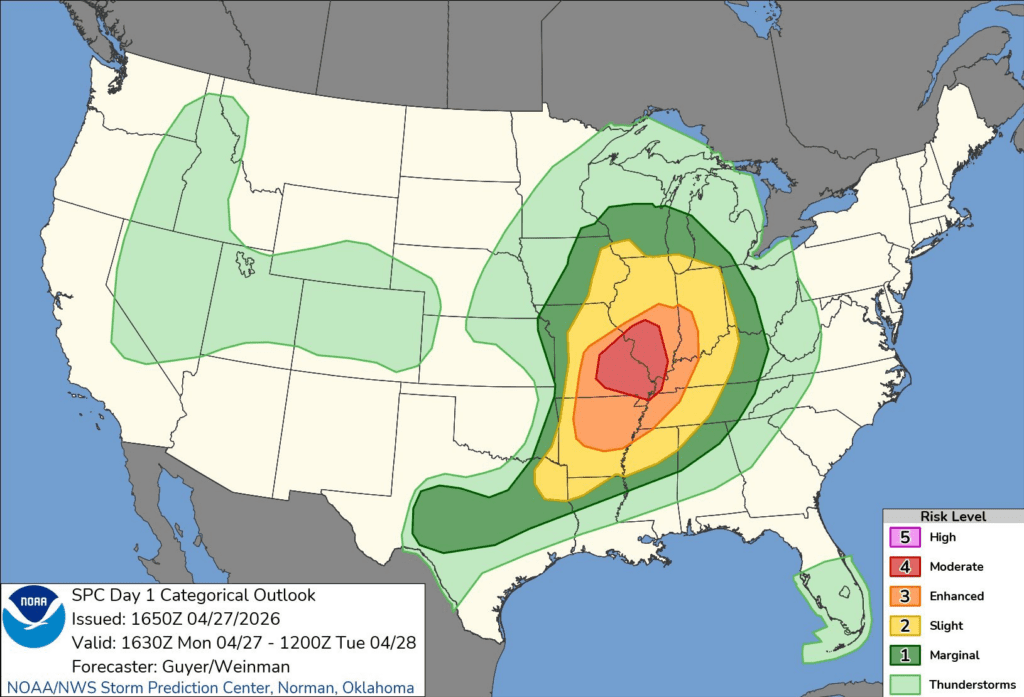
The Storm Prediction Center has issued a Moderate risk (Level 4/5) today in an all hazards type severe weather day for portions of eastern Missouri and southwest Illinois. Within this risk, there is a 15% CIG (Conditional Intensity Group) 2 for Tornadoes. What this means, is that within a 25 mile radius of hose in that risk, there is a 15% chance of an EF3 tornado, which would indicate winds between 136-165 mph, or 219-265 kph. Tornadoes aren’t the only risk today though, as there is also a 45% wind risk, which would indicate a good chance of severe wind gusts of over 60 mph or 64 kts. Finally, there is also a 30% CIG 1 risk for Hail, which means that there is a 30% chance of hail that is 2+ inches in size, or about the size of a hen egg.
Day 1 severe weather outlook. Image: NWS/SPC
The reason why this severe weather set up is so interesting, is that as of writing there is a line of storms going through Central Illinois. What this should do is limit the atmosphere and it’s ability to recover instability to make this outbreak more widespread. Unfortunately, even with that line of storms going through up north, meteorologists are still very confident in the main moderate risk. Overall, it has been shaping up to be a big severe weather impact day.
Due to the severe weather forecasted, over twenty school districts within the St. Louis metro either have closed, or will close early today. If you are placed under a warning today, ensure you are sheltering in a sturdy building, in the lowest interior room with no outside walls. Make sure you are wearing or have closed toe shoes ready, and bring a helmet if you can! If you are caught driving, do not shelter under an overpass. Being under an overpass during any type is dangerous as the overpass almost acts as a tunnel for wind and rain.
The Faytuks Weather team will be monitoring this event throughout the day, and posting updates to the twitter as we can.
Iran’s oil exports have effectively collapsed under the CENTCOM naval cordon, turning a ceasefire into a slow economic strangulation campaign that may threaten the regime more than open war ever did. Cut off from its main source of revenue and stripped of its usual wartime rally narrative, Tehran is now confronting one of the most dangerous moments in its modern history.
We use cookies to ensure that we give you the best experience on our website. If you continue to use this site we will assume that you are happy with it.AcceptPrivacy Policy